Last updated: May 2026
This page contains affiliate links. As an Amazon Associate, HydraulicToolsShop.com earns from qualifying purchases at no extra cost to you.
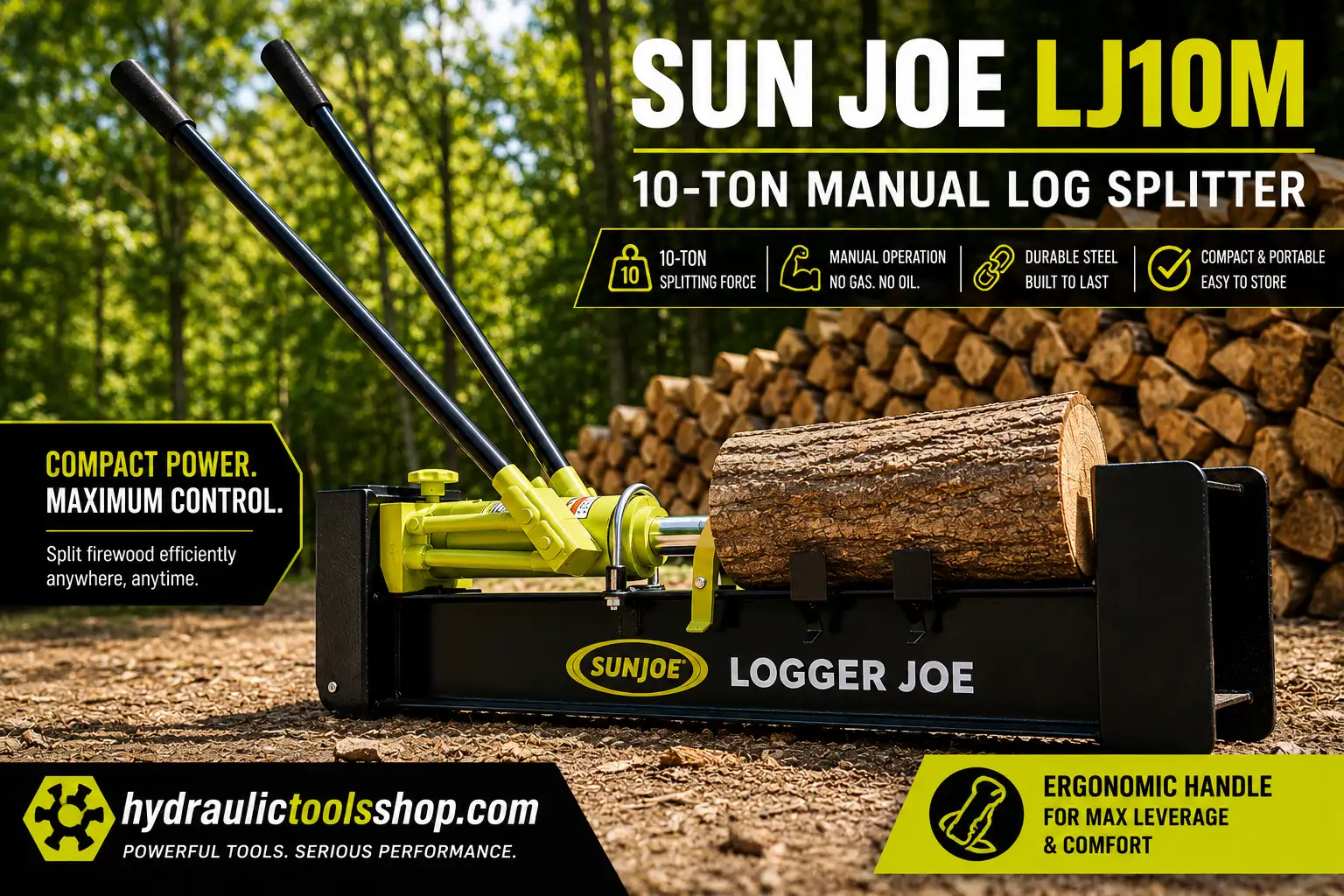
Sun Joe LJ10M Log Splitter Review: No Power, No Problem for Light Firewood
Sun Joe Logger Joe • LJ10M • 10 Ton Manual Hydraulic • ~$249
You split softwood occasionally, have no outdoor outlet, or want a portable unit that stores in a corner and needs very low maintenance between sessions.
Manual operation means physical effort per cycle. Splitting speed depends entirely on the operator. Not practical for large volume sessions.
You split hardwood regularly, process more than a quarter cord per season, or have rounds above 8 inches diameter consistently.
Score based on splitting capacity for intended use, ease of operation, value for money, owner feedback patterns, and long-term reliability signals.
How the Sun Joe LJ10M Actually Works
Most log splitters use an engine or electric motor to drive a hydraulic pump automatically. The Sun Joe LJ10M uses a 2-speed manual pump — you operate the handle yourself. Each pump stroke moves hydraulic fluid into the cylinder, advancing the wedge through the log. The 2-speed mechanism provides fast travel on the approach stroke and increased force on the splitting stroke. When the split completes, a release valve retracts the ram and you reset for the next piece.
The result is a machine with 10 tons of hydraulic splitting force that requires no power source, no fuel, no battery, and no engine maintenance. The trade-off is operator effort and speed. Each cycle takes as long as you take to pump — there is no motor setting the pace. For small volumes of softwood in a location without power access, that trade-off is often the right one.
Watch It in Use
What to Watch For
Pay attention to how the operator switches between the two pump speeds. The transition from fast approach to high-force splitting stroke is where most first-time users lose efficiency — pumping in low gear through the full travel wastes effort. The video shows the correct technique clearly.
Watch the cycle time on different log types. On straight-grained dry softwood the LJ10M moves quickly. On anything with knots or irregular grain the manual effort required increases noticeably — a useful preview of what to expect from your specific wood source.
Note the storage footprint. The LJ10M is more compact than most electric alternatives and the beam folds for wall storage. If garage space is limited this matters as much as any performance spec.
Specs at a Glance
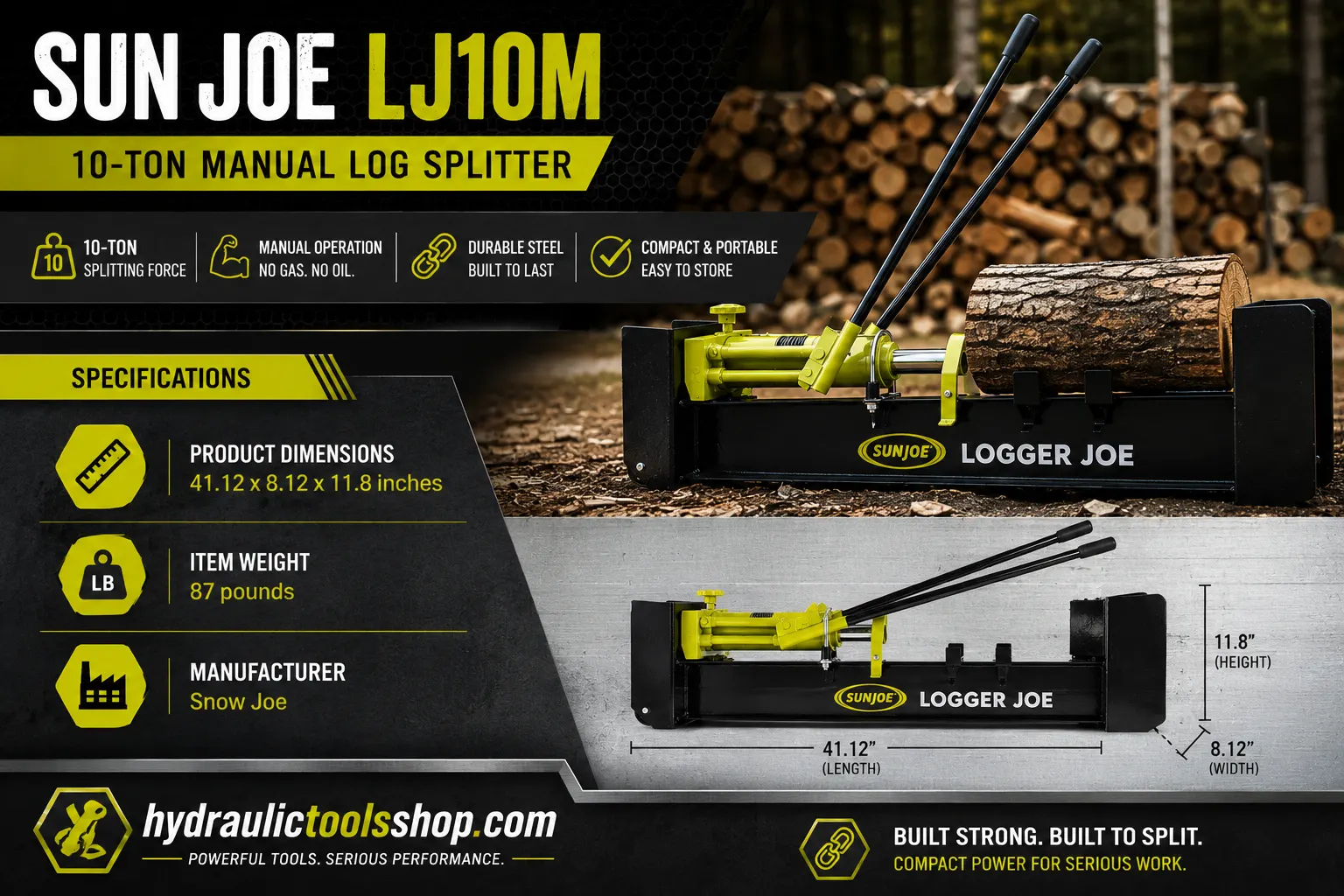
| Splitting Force | Manufacturer-rated 10-ton splitting force |
| Power Source | Manual hydraulic — no electricity or fuel |
| Pump | 2-speed manual pump |
| Log Capacity | 18 in length x 8 in diameter |
| Weight | 87 lbs |
| Dimensions | 41.12 x 8.12 x 11.8 inches |
| Wheels | Rear wheels for portability |
| Price | ~$249.00 |
Amazon Associate link
The Manual Reality — What Most Reviews Skip
Reviews of manual log splitters tend to focus on what the machine can do. The more useful question is what the operator will feel like after an hour.
A manual hydraulic log splitter requires physical effort on every single cycle. On a straight-grained 6-inch pine round, each split takes 8 to 12 pump strokes. On a knotty 8-inch piece the stroke count increases and the resistance per stroke increases. After 30 minutes of splitting in cooler weather on dry softwood — a comfortable session. After 30 minutes of splitting in summer heat on mixed species — a genuinely demanding workout.
This is not a criticism of the LJ10M specifically. It is the nature of manual splitting. The reason it matters: buyers who compare the 10-ton manual rating against a 6.5-ton electric and conclude the Sun Joe is more powerful are measuring the wrong thing. Rated tonnage and practical splitting throughput are different metrics entirely when one machine does the work and the other requires you to do it.
Scorecard
Manual vs Electric — Which Is Actually Right for You
| Feature | Sun Joe LJ10M (Manual) | BILT HARD / WEN (Electric) |
|---|---|---|
| Price | ~$249 | $319 to $337 |
| Power needed | None | 120V outlet required |
| Splitting force | 10 ton | 6.5 ton |
| Operator effort | High — manual pump | Minimal — motor driven |
| Cycle speed | Operator dependent | ~18 seconds automatic |
| Max log diameter | 8 inches | 9.8 to 10 inches |
| Noise level | Very quiet compared to electric or gas | Moderate motor hum |
| Maintenance | Minimal | Low |
| Portability | High — no cord | Limited by cord length |
| Our score | 7.4 | 7.8 to 7.9 |
The Sun Joe is cheaper and more powerful on paper. The electric alternatives are faster, require less physical effort, and handle slightly larger diameter logs. The decision comes down to one question: do you have a convenient outdoor outlet where you split? If yes — electric is almost always the more practical daily tool. If no — the Sun Joe is the logical choice.
Manual splitter prices shift regularly. Check current stock before deciding.
Check Current Price on Amazon See all log splitters →What Owners Report
With nearly 2,000 verified reviews the Sun Joe LJ10M has one of the largest owner feedback bases in the manual log splitter category. The pattern is consistent and telling.
Positive reports cluster around three scenarios: off-grid and cabin use, small suburban lots where noise from a gas or electric unit is a genuine constraint, and buyers who split infrequently and want a machine that sits in a corner for months without needing any attention before the next use. The compact storage footprint is mentioned repeatedly as a practical advantage.
Critical reports consistently identify the same limitation: buyers who purchased expecting the manual unit to match the throughput of an electric splitter. The 10-ton rating is real — the machine generates that force through the wedge. The physical effort required to generate it on every cycle is what catches volume-focused buyers off guard. This is not a product defect. It is a category characteristic that most listing pages understate.
Who This Splitter Is Actually For
The Sun Joe LJ10M fits a specific buyer profile precisely. Someone splitting softwood on a property without convenient outdoor power. A cabin owner processing a small volume of seasoned pine or fir for a wood stove. A homeowner in a close neighbourhood where operating an engine at any time of day creates problems with neighbours or local rules. Anyone who wants a machine stored in a garage corner that needs no maintenance between splitting sessions months apart.
For anyone with an outdoor outlet and a regular splitting schedule, the BILT HARD 6.5-ton electric or the WEN 56208 deliver faster, lower-effort results at a modest price premium. For hardwood or high-volume splitting, the gas units in this silo are the appropriate tool — start with the SuperHandy 25-ton review.
Frequently Asked Questions
Sources and transparency: Specifications verified against the Sun Joe LJ10M Amazon product listing and Sun Joe product documentation. Owner report analysis based on aggregated verified purchase reviews. Performance assessments based on published capacity specifications and mechanic network feedback — not controlled lab testing. Amazon Associate link used — commissions support this site at no extra cost to you. No payment received from Sun Joe.
Reviewed for HydraulicToolsShop.com by Hank Miller. Updated using owner feedback, product spec changes, and market comparisons. Questions or experience to share — reach Hank via the contact page.

20+ Years • Hydraulics and Heavy Equipment
Hank Miller
Born in Ohio’s Rust Belt. Two decades fixing trucks and heavy gear taught me one thing — good tools keep you safe, bad ones cost you time. I dig into owner data and make the call so you know exactly what you are buying. Read Hank’s full story.
2 comments
[…] Sun Joe LJ10M 10-Ton Manual — no power source needed, compact storage, light softwood use […]
[…] Where the Sun Joe LJ10M wins: No power source required. Very quiet compared with electric or gas splitters. Very low maintenance between sessions. Manufacturer-rated 10-ton splitting force on dry softwood in manageable diameters. At a lower price than either electric option. If the absence of an outlet is your constraint — the Sun Joe is the more practical tool regardless of the tonnage comparison with electric. Where the Sun Joe loses: Manual pumping on every cycle. A log diameter limit of 8 inches versus 9.8 to 10 inches for the electric options. Not practical for high-volume sessions or for anyone who wants the motor to do the work. The full review covers the realistic effort level in detail. Read the Sun Joe LJ10M review → […]