
Home » Best Car Lifts for Home Garages: What Hank Would Buy and Why

Best Car Lifts for Home Garages: What Hank Would Buy and Why

Last updated: May 2026

A car lift changes what your garage is capable of. Here is how to buy the right one the first time.

A car lift is not an impulse purchase. It is a permanent change to your garage — one that requires the right ceiling height, the right concrete, the right power supply, and the right lift type for the work you actually do. Get those four things right and a home garage car lift pays for itself in saved shop labour within a year. Get any one of them wrong and you have an expensive problem bolted to your floor. This page covers what Hank would buy and why — and more importantly, what to check in your garage before you spend a dollar on anything.
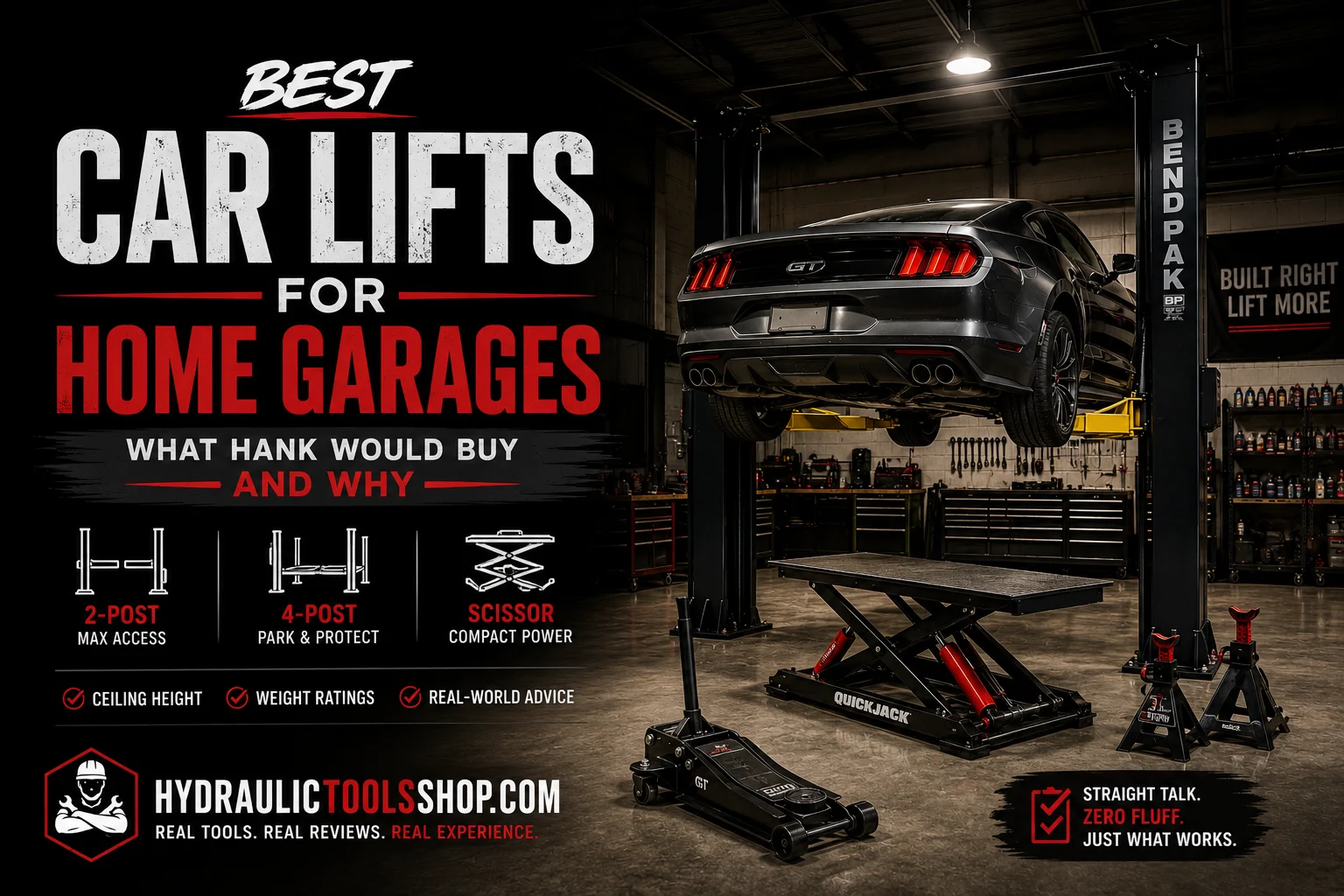
Best car lifts for home garages showing 2-post, 4-post and scissor lift options
Two-post, four-post, scissor — three different tools for three different garages.

Best Car Lifts for Home Garages: What Hank Would Actually Buy and Why

Car Lift Category • 2-Post, 4-Post and Scissor • Home Garage Installation • Hank Miller

Quick Answer — Which Lift Type Is Right for You

Lift TypeBest ForCeiling NeededPrice Range
2-Post Lift Full undercar access — brakes, suspension, exhaust, transmission 12 ft minimum $1,900 to $2,600
4-Post Lift Vehicle storage, oil changes, basic maintenance — drive-on platform 10 to 11 ft $2,800 to $3,800
Scissor / Portable Low ceiling garages, tire rotations, quick inspections, portability 8 to 9 ft $1,200 to $1,500
How Hank approaches car lifts: A floor jack with jack stands is how most home mechanics lift vehicles for years. A car lift is the upgrade that changes the game — but only if your garage is ready for it. Hank has seen too many mechanics buy a lift without checking ceiling height or concrete thickness first. This page covers what to check before you buy anything. The individual reviews below the blog grid go deep on specific models.

Before You Buy Anything — Check Your Garage First

Most people research the lift before they research their garage. That is the wrong order. A car lift that does not fit your space, cannot be anchored to your floor, or requires electrical work you have not budgeted for is a $2,000 plus problem regardless of how good the lift itself is. These are the three numbers to know before you look at a single product.

12ft

Ceiling Height

Most 2-post lifts need a minimum of 12 feet of clear ceiling height. The formula is simple: lift height plus vehicle height plus 6 inches of safety buffer. A standard 4-post storage lift works in 10 to 11 feet. Scissor and portable lifts work in 8 to 9 feet. Measure floor to ceiling before anything else — and account for garage door openers, lights, and HVAC ductwork that steal 8 to 12 inches of that space.

4in

Concrete Thickness

Most 2-post lifts require a minimum of 4 inches of concrete at 3,000 PSI compressive strength. Six inches is the recommended thickness for long-term reliability. If your slab is thinner, you can pour reinforced concrete islands specifically under the lift posts — a common workaround. New concrete must cure for at least 28 days before installing any lift. If you do not know your slab thickness, a concrete contractor can core-drill a test hole for under $100.

220V

Power Supply

Portable and scissor lifts typically run on 110V standard household current. Most 2-post and 4-post lifts require a dedicated 220V single-phase circuit. If you do not have 220V in your garage, budget $200 to $600 for an electrician to run a dedicated circuit before purchasing any full-size lift. Some home lifts now run on 110V — confirm the electrical requirement before buying.

The mistake that costs the most: Ordering a lift, having it delivered, partially assembling it, and then discovering the concrete is too thin to anchor the posts or the ceiling is 2 inches too low. Returns on car lifts are expensive and complicated. Measure everything twice before you order.

Three Questions That Decide Which Lift You Need

Before looking at brands or prices, answer these three questions. The answers will narrow your choice to one lift type almost every time.

Answer These Before You Shop

1
What work will you do under the car? If you need full access to the transmission, driveshaft, exhaust, and suspension with wheels hanging free — you need a 2-post lift. If you mainly do oil changes, inspections, and want to store a second vehicle — a 4-post drive-on platform is simpler and safer for that use case. If you just need to get under the car occasionally without a permanent installation — a portable scissor lift does the job.
2
What is your ceiling height? Under 9 feet — scissor or portable lift only. 9 to 11 feet — 4-post storage lift is possible, 2-post is tight. 12 feet and above — all three types work. This single measurement eliminates most of the market for garages with standard 8 to 9 foot ceilings.
3
Is this a permanent installation? A 2-post or 4-post lift is anchored to the concrete floor — it is not moving once installed. A portable scissor lift can be stored against the wall or in a corner. If you rent your garage, plan to move, or share the space with non-automotive uses, a portable lift is the practical choice regardless of what the other answers suggest.

The Three Lift Types — What Each One Actually Does

Most buying guides treat these as interchangeable options at different price points. They are not. Each lift type has a specific use case it excels at and situations where it is genuinely the wrong tool.

Full Service Work

2-Post Lift

  • Two vertical columns anchor to the floor on either side of the vehicle
  • Swing arms lift the vehicle by the frame with wheels hanging free
  • Full undercar access — transmission, driveshaft, exhaust all reachable
  • The professional shop standard for a reason
  • Needs 12 ft ceiling minimum and 220V power
  • Asymmetric arms allow car doors to open fully during work

Not for: Low ceiling garages, renters, or anyone who mainly needs storage rather than full service access.

Storage and Basic Service

4-Post Lift

  • Four columns support two drive-on runways — vehicle stays on its tyres
  • Drive the vehicle onto the platform, press the button, vehicle rises
  • No lift point knowledge required — much simpler to use
  • Excellent for storing a second vehicle above the first
  • Works in 10 to 11 ft ceilings for most passenger cars
  • Add a rolling bridge jack for wheels-off work

Not for: Full suspension or transmission work without a bridge jack add-on. Takes up more floor space than a 2-post.

Portable and Low Ceiling

Scissor / Portable Lift

  • Hydraulic frames slide under the vehicle and lift from the centre
  • No floor anchoring required — fully portable
  • Works in standard 8 to 9 ft garage ceilings
  • Runs on 110V standard household power
  • Raises vehicle 24 to 28 inches — enough for most maintenance
  • Can be stored against a wall when not in use

Not for: Transmission or driveshaft work — the lifting mechanism occupies the centre undercarriage space.

Side by Side Comparison

Feature2-Post Lift4-Post LiftScissor / Portable
Ceiling required 12 ft minimum 10 to 11 ft 8 to 9 ft
Floor anchoring Yes — permanent Yes — permanent No — portable
Concrete required 4 in, 3,000 PSI min 4 in, 3,000 PSI min Not required
Power supply 220V dedicated 110V or 220V 110V standard
Undercar access Full — wheels free Partial — tyres on Centre blocked
Vehicle storage No Yes — stack two cars No
Installation Professional recommended Professional recommended DIY possible
Price range $1,900 to $2,600 $2,800 to $3,800 $1,200 to $1,500
Commission per sale ~$90 to $117 ~$126 to $171 ~$54 to $67

Pre-Purchase Checklist — Five Things to Confirm Before You Order

Check Every Box Before Your Order Goes Through

1
Measure your ceiling height. Floor to the lowest obstruction — not just the ceiling. Include garage door tracks, opener motors, light fixtures, and HVAC ductwork. Use the formula: lift column height plus tallest vehicle height plus 6 inches. That is your minimum ceiling requirement.
2
Confirm your concrete thickness and strength. Minimum 4 inches at 3,000 PSI for most 2-post and 4-post lifts. If you are unsure, have it tested before ordering. Pouring new anchor islands is possible but adds cost and time to the installation.
3
Check your electrical supply. Confirm whether the lift requires 110V or 220V. If 220V is needed and you do not have it, get an electrician quote before ordering the lift — not after it arrives.
4
Measure your floor space. A 2-post lift needs clearance on both sides for the columns and space to walk around the vehicle. A 4-post lift needs runway length plus approach and exit space. Check post-to-post width against your bay width with room for car doors to open.
5
Check your local building codes and HOA rules. Some municipalities require a permit for permanent lift installation. Some HOAs restrict commercial-grade equipment in residential garages. A five-minute check now avoids a much larger problem later.

What Hank Would Buy — And Why

Twenty years of working on vehicles in home garages and professional shops gives a clear picture of what actually matters in a car lift versus what sounds good in a spec sheet.

For a garage with 12 foot ceilings and serious service work: A 2-post lift every time. The open wheel access changes what you can do under a vehicle — brake jobs, suspension rebuilds, exhaust work, transmission drops. Everything that takes three times as long on jack stands becomes straightforward on a 2-post. The APlusLift HW-10KOH-A is the specific model Hank would start with at this price point — 10,000 lb capacity, 329 owner reviews, ALI certified, and industry-leading warranty coverage.

For a garage with 10 foot ceilings and a need for vehicle storage: A 4-post lift. The ability to park one vehicle above another doubles your garage capacity without any construction. The drive-on platform removes the lift point knowledge requirement entirely — park the car, press the button, done.

For a standard 8 to 9 foot ceiling or a portable solution: A portable scissor lift. The VEVOR 7,000 LBS portable is the specific recommendation here — 120V power, 28 inch max height, 195 owner reviews, and no floor anchoring required. It stores against a wall when not in use and covers 90 percent of routine maintenance jobs.

The one thing most buyers underestimate: Installation complexity and cost. A 2-post or 4-post lift arriving in boxes is not a weekend DIY project for most people. Professional installation runs $300 to $600 and ensures the posts are plumb, the anchors are torqued correctly, and the equalisation cables are properly tensioned. That cost should be in your budget before you order, not a surprise after delivery.

Safety Before You Lift — Non-Negotiable Rules

A car lift carries significantly more risk than a floor jack. These rules are not optional.

RULE 1 — Always lower onto mechanical safety locks. Never work under a vehicle supported only by hydraulic pressure. Every car lift has mechanical safety locks that engage as the lift rises. Lower the vehicle onto those locks before going underneath. Every single time. The hydraulics hold the lift up. The locks keep you alive if they fail.
RULE 2 — Know your lift points before the first raise. Every vehicle has specific manufacturer-specified lift points. Using the wrong contact point on a 2-post lift risks structural damage and an unstable lift. Check your owner's manual and the lift manufacturer's vehicle adapter guide before the first lift on any new vehicle.
RULE 3 — Check the safety locks audibly on every raise. As a 2-post lift rises, the safety locks should click into position audibly at each increment. If you do not hear the click, stop and investigate before the vehicle goes any higher.
RULE 4 — Never exceed the rated capacity. Car lift capacity ratings are maximums with safety margins built in — but they are not unlimited. Confirm your vehicle's weight against the lift's rated capacity before the first raise. For EVs, confirm the battery pack weight is included in the figure you are checking against.
RULE 5 — Inspect monthly. Check hydraulic lines for leaks, confirm anchor bolts are torqued correctly, verify equalisation cables are even, and listen for any unusual sounds during operation. A lift that is inspected regularly is a lift that does not fail unexpectedly. Full guidance at OSHA vehicle lifting standards.

The Car Lift Reviews- Pick Your Type, Read the Deep Dive

Car Lift Reviews — Deep Dives on Specific Models

The posts below cover individual car lift models in full detail — specs, installation requirements, owner report analysis, and Hank's specific recommendation for each one. Use the quick answer table above to identify which lift type fits your garage, then read the relevant review before buying.

Frequently Asked Questions

What ceiling height do I need for a car lift?
It depends on the lift type. Most 2-post lifts need a minimum of 12 feet of clear ceiling height — measured to the lowest obstruction including garage door hardware and light fixtures. Four-post storage lifts typically work in 10 to 11 feet for standard passenger cars. Scissor and portable lifts work in 8 to 9 feet. The formula for any lift: lift column height plus your tallest vehicle height plus 6 inches of safety buffer equals your minimum ceiling requirement.
How thick does my concrete need to be for a car lift?
For most 2-post and 4-post lifts rated at 7,000 to 10,000 lbs, the minimum is 4 inches of concrete at 3,000 PSI compressive strength. Six inches is the recommended thickness for long-term reliability. For heavier lifts above 12,000 lbs, 6 inches minimum with 3,500 PSI is the standard. New concrete must cure for at least 28 days before installation. If you are unsure of your slab thickness, a concrete contractor can core-drill a test hole for under $100.
Can I install a car lift myself?
Portable scissor lifts can generally be set up without professional installation. Two-post and four-post lifts are mechanically possible to install yourself if you are experienced with this type of work — but professional installation is strongly recommended. Anchoring posts plumb, torquing anchor bolts correctly, and tensioning equalisation cables are not steps where mistakes are recoverable once a vehicle is in the air. Professional installation typically runs $300 to $600 and is worth every dollar.
What is the difference between a 2-post and 4-post car lift?
A 2-post lift raises the vehicle by its frame with the wheels hanging free — giving full access to the brakes, suspension, exhaust, and drivetrain. A 4-post lift raises the vehicle on drive-on runways with the tyres on the platform — simpler to use, better for storage, but with limited undercar access without a bridge jack add-on. The 2-post is the service work tool. The 4-post is the storage and light maintenance tool.
Do car lifts work with EVs?
Yes, with the right approach. EVs are heavier than comparable petrol vehicles due to battery pack weight — confirm your lift's capacity covers the specific EV's weight with a safety margin. EV lift points are specific reinforced locations, often marked on the sill, that avoid contact with the battery enclosure. Some 2-post lifts require specialised low-profile adapters for EVs. Always check the lift manufacturer's EV compatibility guidance and your vehicle's owner documentation before the first lift.
Is a car lift worth it for a home garage?
For anyone doing regular maintenance on their own vehicles, yes. A single brake job at a shop costs $200 to $400. A full suspension service costs $800 to $1,500. A car lift that enables you to do that work yourself pays back its purchase price within one to two years of regular use for most home mechanics. The question is not whether it pays off — it is whether your garage is physically ready for the installation, which is why the ceiling height, concrete, and electrical checks matter so much before purchasing.

Sources and transparency: Installation requirements based on manufacturer specifications across major lift brands and verified against published industry standards. Ceiling height, concrete, and electrical guidance cross-referenced against ALI (Automotive Lift Institute) published installation guidelines. Safety rules referenced against OSHA vehicle lifting standards. No affiliate links on this page — individual product reviews linked below contain full analysis and purchasing information.

Hank Miller, hydraulic tools expert

Hank Miller

Born in Ohio's Rust Belt. Over 20 years fixing trucks and heavy gear taught me one thing: good tools keep you safe, bad ones cost fingers. I gather intel from fellow mechanics, dig into owner data, and make the call so you know exactly what you are buying before it goes under your vehicle. Read Hank's full story.