Last updated: May 2026
A car lift that plugs into a standard outlet. No electrician, no anchors, no permanent commitment.
The VEVOR 7,000 LBS portable car lift raises vehicles from 10.24 inches to 26.8 inches. It runs on a standard 120V household outlet. No floor anchoring required. Folds against a wall when not in use. Built from Q235B carbon steel with mechanical safety locks at each height position and two 11-inch extension plates for trucks and long-wheelbase SUVs. For home garage mechanics who cannot install a permanent lift — low ceiling, thin concrete, rented space, or budget — this is the tool that makes substantial undercar access possible without the installation commitment. This review is based on manufacturer specifications verified across multiple retailers, one-year owner feedback patterns, and mechanic network input rather than controlled lab testing.
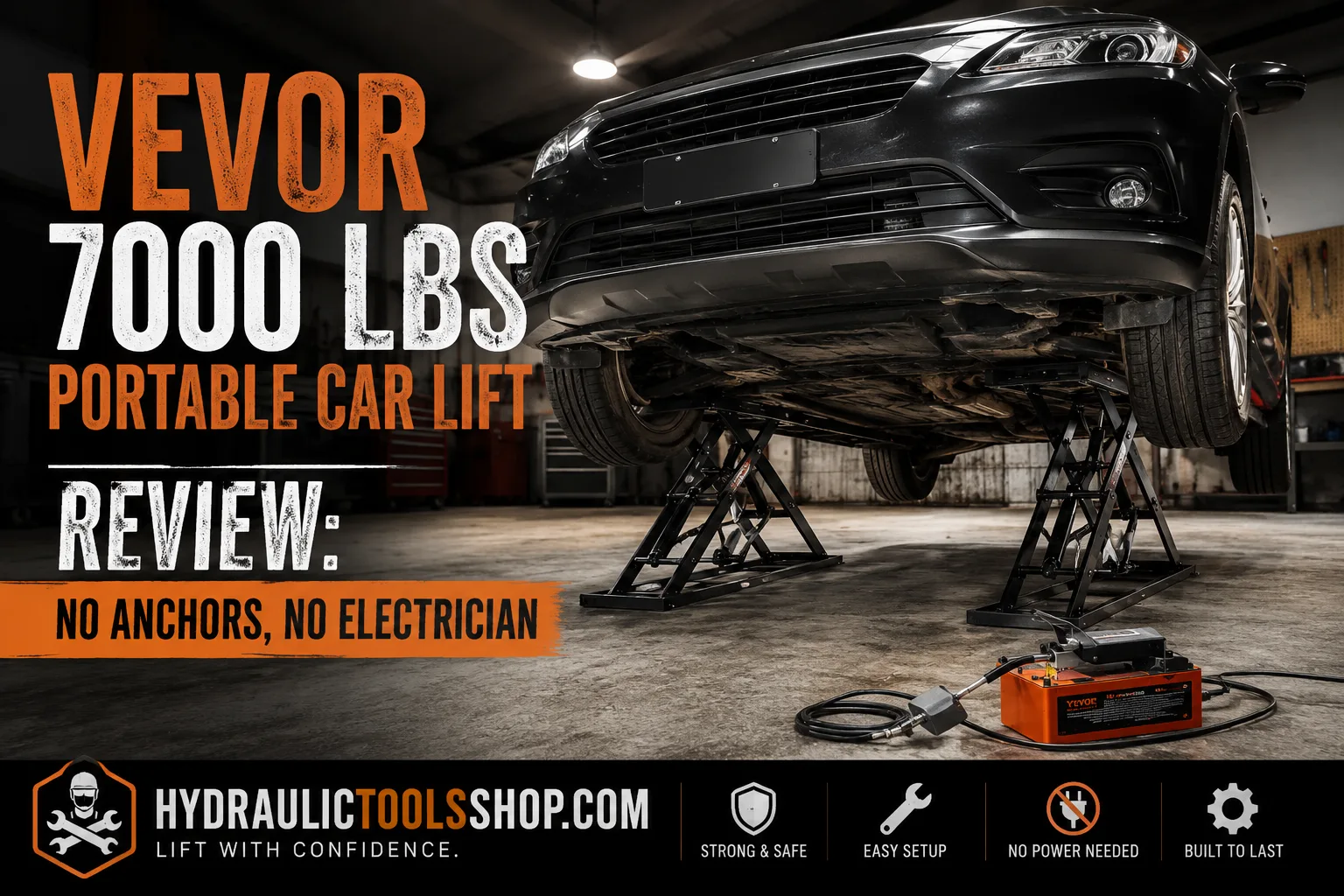
VEVOR 7000 LBS Portable Car Lift Review: No Anchors, No Electrician
VEVOR 7,000 LBS • Portable Car Lift • 120V • No Floor Anchoring • Q235B Carbon Steel
| Capacity | 7,000 lbs |
| Min Height | 10.24 inches |
| Max Height | 26.8 inches |
| Lifting Pad Range | 6.5 to 20 inches |
| Column Adjustment | Up to 3.2 inches per column |
| Power | 120V standard outlet |
| Floor Anchoring | Not required |
| Construction | Q235B carbon steel |
| Extension Plates | 2 x 11-inch plates included |
| Safety | Mechanical locks at each height position |
| Ceiling Needed | 8 to 9 ft minimum |
| Price Range | ~$1,499 |
As an Amazon Associate I earn from qualifying purchases.
VEVOR 7,000 LBS Portable Car Lift — Quick Verdict
| Best for | Home garages where a permanent lift is not possible — low ceilings, rented spaces, or tight budgets |
| Not for | Full transmission drops or driveshaft work — the centre frame blocks undercarriage access |
| Capacity | 7,000 lbs — covers most trucks, SUVs, and passenger cars |
| Max height | 26.8 inches |
| Power | 120V standard outlet — no electrician needed |
| Floor anchoring | Not required — fully portable |
| Hank’s score | 8.4 / 10 |
Hank’s Verdict
The VEVOR portable solves a problem most car lift reviews ignore. What do you do when your ceiling is 8 to 9 feet, your concrete is too thin for anchors, or you rent and cannot bolt anything to the floor? The answer used to be jack stands and a floor jack. Now it is this. Seven thousand pounds of capacity. A 120V plug-in. Folds against the wall when not in use. The mechanical safety locks click into position at each height increment. The extension plates handle trucks with long wheelbases. The honest limitation: the centre frame structure means full transmission drops and driveshaft work are not practical here. Brake jobs, suspension work, exhaust, and inspection work are all accessible. For those jobs, at this price, without the installation requirements of a permanent lift — it is a strong option based on reported usage patterns across a meaningful owner base.
1 Year Later — Real World Owner Perspective
Why the 1-Year Review Matters
Most car lift reviews cover the unboxing and first lift. This video covers what the VEVOR portable looks like after a year of actual home garage use — what held up, what wore, and the tips that make it easier to use than it is out of the box.
Key things to watch for: how the hydraulic hoses behave after extended use, whether the mechanical locks remain crisp at each position, and the real-world storage experience of folding and unfolding the unit repeatedly.
The tips and tricks section of this video is particularly useful for first-time owners — the lift has a learning curve on positioning that experienced owners figure out quickly but that the manual does not cover well.
Why Portable Beats Permanent for Many Home Garages
The default assumption in most car lift discussions is that a permanent 2-post or 4-post lift is always the better choice and a portable lift is the compromise. That assumption does not hold for a significant portion of home garage mechanics. The full breakdown of when each type makes sense is in the car lifts category page.
A permanent lift requires a minimum of 12 feet of ceiling height for most 2-post models, 4 inches of concrete at 3,000 PSI for anchor bolts, a dedicated 220V circuit, and in many cases professional installation at $300 to $600 on top of the lift price. For garages with 8 to 9 foot ceilings — which describes the majority of standard residential garages built before the 1990s — none of those permanent options work.
The VEVOR portable works in 8 to 9 feet of ceiling height, runs on a standard household outlet, requires no floor preparation, and can be moved or stored flat when the garage needs to be a garage again. For the specific situation it is designed for, it delivers substantial undercar access without the permanent installation commitment.
Performance Scorecard
Rated across five categories based on manufacturer specifications, verified owner reports, and one-year ownership feedback patterns.
Specs at a Glance
The Numbers That Matter
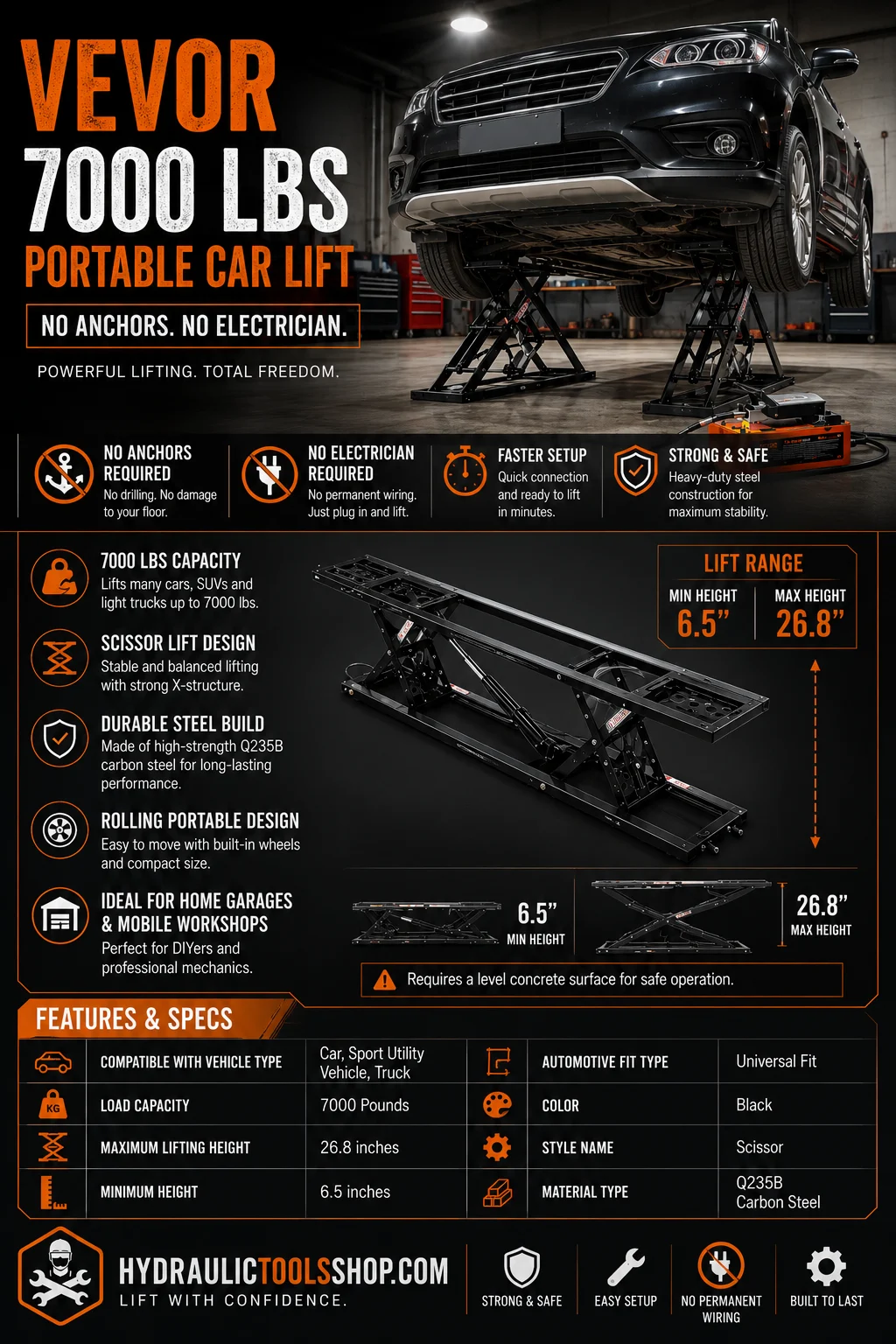
7,000 lbs capacity — covers most trucks, full-size SUVs, and passenger cars at full vehicle weight. Confirm your specific vehicle’s weight before the first lift.
10.24 to 26.8 in lift range — the four adjustable columns add up to 3.2 inches of additional height each, giving flexibility across different vehicle heights. Four lifting pads operate in a 6.5 to 20-inch range for fine positioning.
120V standard outlet — the single biggest advantage over permanent lifts for most home garages. No electrician, no dedicated circuit, no additional installation cost.
No floor anchoring — rolls into position on four high-strength nylon wheels, folds flat for wall storage. Fully portable between garage bays or locations.
8 to 9 ft ceiling needed — works in standard residential garages where permanent 2-post and 4-post lifts cannot be installed.
How the Lift System Works
The VEVOR portable uses four independent hydraulic columns connected to a central 120V power unit. The columns position under the vehicle’s frame or pinch weld points — not the centre undercarriage — and rise simultaneously to lift the vehicle evenly. Mechanical safety locks engage at each height increment as the columns rise, providing a positive mechanical stop independent of hydraulic pressure.
The four lifting columns are adjustable in height by up to 3.2 inches each, which allows the lift to accommodate vehicles with different frame heights and geometries. Two 11-inch extension plates widen the contact footprint for long-wheelbase trucks and SUVs, keeping the lift stable under heavier vehicles with more widely spaced lift points.
Safety Rules for Portable Car Lifts
These rules apply every time. No exceptions.
Pros and Cons
What Works
- 120V standard outlet — no electrician or dedicated circuit needed
- No floor anchoring — works in rented garages and low-ceiling spaces
- 7,000 lb capacity — covers most trucks, SUVs, and passenger vehicles
- Mechanical safety locks at each height position — positive mechanical support
- Foldable with nylon wheels — stores against a wall when not in use
- 11-inch extension plates included for long-wheelbase vehicles
- Works in 8 to 9 ft ceilings where permanent lifts cannot be installed
- One-year owner feedback pattern is consistently positive for intended use cases
What to Watch
- Centre frame limits access for transmission drops and driveshaft work
- Hydraulic hoses cannot be disconnected while lift is raised under load
- Column positioning takes practice on first few uses
- Not for slopes or uneven surfaces — flat concrete required
- Large footprint when deployed — requires adequate bay width
- At ~$1,499 it is a significant investment for a portable unit
Car lift prices fluctuate with shipping costs. Check current stock before reading on.
View Current Price on Amazon → See all car lift options →How It Sits Against the Alternatives
The VEVOR portable occupies a specific niche — high capacity without permanent installation. Here is how it compares to the main alternatives.
| Lift | Type | Capacity | Max Height | Power | Anchoring | Ceiling |
|---|---|---|---|---|---|---|
| VEVOR 7,000 LBS Portable | Portable | 7,000 lbs | 26.8 in | 120V | None | 8 to 9 ft |
| APlusLift HW-10KOH-A | 2-post | 10,000 lbs | 72 in | 220V | Required | 12 ft min |
| KATOOL 4-Post 9,500 lbs | 4-post | 9,500 lbs | 70 in | 220V | Required | 10 to 11 ft |
| Standard floor jack and stands | Jack | 3.5 ton | 22 in | None | None | Any |
The VEVOR’s position is clear — it fills the gap between a floor jack and a permanent lift. More capacity and working height than a floor jack setup, without the installation requirements of a 2-post or 4-post permanent lift. For the specific garage situation it is designed for, there is no direct comparable at this price point.
What Owners Report After a Year
The one-year ownership feedback pattern — drawn from verified purchase reviews, mechanic network reports, and community forum discussions — is more useful than first-impression reviews for a tool this significant. Here is what the pattern shows.
Owners using the VEVOR portable for brake jobs, suspension work, exhaust, and inspections report it performs consistently as described. The mechanical locks are noted positively for providing genuine confidence when working underneath — the audible click at each position is mentioned frequently as a reassuring feature in long-term reports. The extension plates are well-received for truck and SUV use.
The most consistent long-term complaint is the hydraulic hose limitation — owners who discovered they could not disconnect the pump while the lift was raised under load had not anticipated that constraint. It is not a defect — it is a design characteristic of this type of hydraulic system — but it catches first-time owners off-guard and is worth understanding before the first use.
Best Alternative
If your ceiling is 12 feet or higher and your concrete can take anchor bolts, the APlusLift HW-10KOH-A 2-post lift is the step up worth considering. It provides full wheel-free access including for transmission and drivetrain work, 10,000 lbs of capacity, and a significantly larger working height envelope. The installation requirements are real — 220V circuit, professional installation recommended, concrete anchoring — but for a garage that can accommodate them, the 2-post delivers more capability than any portable lift at any price.
If you are not ready to commit to any lift and currently use a floor jack with stands, the Blackhawk B6350 is the floor jack worth having as a complement to or replacement for the VEVOR for truck-specific lifting needs.
Should You Buy It?
If your garage ceiling is 8 to 9 feet, your concrete cannot take anchor bolts, you rent your space, or you simply want a high-capacity lift that stores flat and plugs into a standard outlet — yes. The VEVOR 7,000 LBS portable solves a real problem that permanent lifts cannot address, at a price that is reasonable for what it delivers.
If you need full drivetrain access with wheels hanging free, or if your garage already qualifies for a permanent 2-post or 4-post installation — the permanent lift is the better long-term tool. See the full car lifts breakdown to compare all three types side by side before deciding.
No anchors. No electrician. No permanent commitment. The lift for the garage that cannot take a permanent one.
Check Price on AmazonAs an Amazon Associate I earn from qualifying purchases.
Frequently Asked Questions
Sources and transparency: This review is based on VEVOR manufacturer specifications verified against product listings on Amazon, VEVOR’s own site, Lowes, and Wayfair; one-year owner feedback patterns from verified purchase reviews and mechanic community discussions; and mechanic network input — not controlled lab testing. Safety rules referenced against OSHA vehicle lifting standards. No payment received from VEVOR. Amazon Associate link used — commissions support this site at no cost to you.

Hank Miller
Born in Ohio’s Rust Belt. Over 20 years fixing trucks and heavy gear taught me one thing: good tools keep you safe, bad ones cost fingers. I gather intel from fellow mechanics, dig into owner data, and make the call so you know exactly what you are buying before it goes under your vehicle. Read Hank’s full story.
2 comments
[…] one or more of the above apply, the VEVOR 7,000 LBS portable lift is worth a look — it operates on 120V, requires no concrete anchoring, and works in lower-ceiling […]
[…] garages built before the 1980s often have 8 to 9 foot ceilings — check before ordering. The VEVOR portable lift is the alternative for low-ceiling […]