
Last updated: May 2026
Car Lift for Home Garage: What Your Space Actually Needs
Car Lift Requirements • Ceiling Height • Concrete • Power Supply • Hank Miller
Three things determine whether a car lift works in your garage. Ceiling height. Concrete thickness. Power supply. Get all three right and the lift goes in without problems. Miss any one of them and you are looking at a return, a concrete pour, an electrician bill, or all three combined. This page covers what to measure and what those measurements mean before you spend anything on a lift.
Ceiling Height
Minimum for most 2-post lifts with a standard vehicle. Calculate yours before ordering.
Concrete
Minimum thickness at 3,000 PSI for anchor bolts. Many manufacturers recommend 5 to 6 inches for heavier lifts — confirm your specific model.
Power
Most 2-post lifts require a dedicated 220V circuit. Some 4-post lifts run on 110V.
Ceiling Height — The First Number to Measure
Ceiling height is the most commonly misunderstood requirement in car lift purchasing. Most buyers measure to the ceiling and stop there. That number is almost never the one that matters.
What matters is the clearance to the lowest obstruction in the bay where the lift will be installed. Garage door openers hang 10 to 14 inches below the ceiling on most residential installs. Fluorescent light fixtures add another 4 to 8 inches. HVAC ductwork, overhead storage tracks, and insulation all reduce the usable clearance further. A garage that measures 12 feet floor to ceiling may offer only 10 feet of actual usable clearance once all of those obstructions are accounted for.
The Ceiling Height Calculation
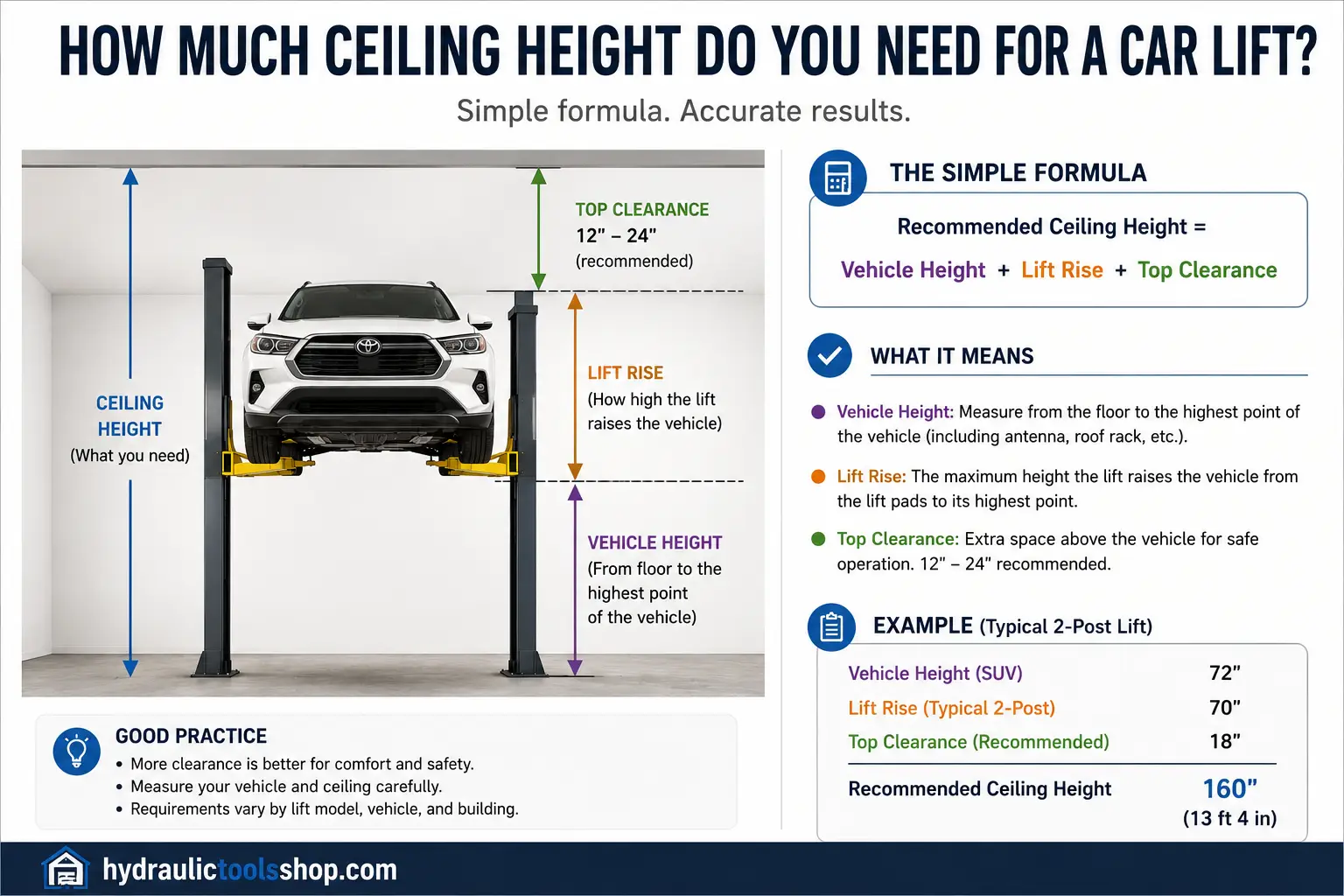
One formula applies to every lift type and every vehicle combination. Run this before ordering anything.
How to Calculate the Minimum Ceiling You Need
Ceiling Requirement by Vehicle Type
These figures use the APlusLift HW-10KOH-A 2-post at 72 inches maximum height plus a 6-inch safety buffer as the reference. Add or subtract based on the specific lift model you are considering.
| Vehicle | Approx Roof Height | Min Ceiling Needed | Standard 9ft Garage | Standard 12ft Garage |
|---|---|---|---|---|
| Honda Civic, Toyota Corolla | ~56 inches | ~134 inches (11.2 ft) | Does not fit | Fits |
| Toyota Camry, Honda Accord | ~58 inches | ~136 inches (11.3 ft) | Does not fit | Fits |
| Toyota RAV4, Honda CR-V | ~65 inches | ~143 inches (11.9 ft) | Does not fit | Tight — confirm |
| Ford F-150 (stock) | ~76 inches | ~154 inches (12.8 ft) | Does not fit | Does not fit |
| Chevy Silverado 1500 | ~74 inches | ~152 inches (12.7 ft) | Does not fit | Does not fit |
| Full-size SUV (Tahoe, Expedition) | ~72 inches | ~150 inches (12.5 ft) | Does not fit | Does not fit |
| Lifted truck (4 inch lift) | ~84 inches+ | ~162 inches (13.5 ft) | Does not fit | Does not fit |
Concrete Thickness and Strength
A car lift anchors to the floor. The anchor bolts transfer the vehicle’s load into the concrete slab. If the slab cannot handle that load, the anchor bolts pull out under stress — a serious structural failure. Concrete requirements are not guidelines. They are minimums that exist for safety reasons.
Two numbers matter. Thickness and compressive strength.
Thickness: Most 2-post and 4-post lifts at the home garage capacity range require a minimum of 4 inches of concrete. Many manufacturers recommend thicker slabs — often 5 to 6 inches — for heavier lifts or long-term commercial-style use. The exact requirement varies by model, anchor design, and slab condition. Always confirm against the specific lift’s installation documentation. Residential garage slabs are commonly poured at 4 inches — but not always, and the actual thickness often varies across the slab.
Compressive strength: 3,000 PSI is the standard minimum. 3,500 PSI is recommended for heavier lifts. Most residential garage slabs meet 3,000 PSI if they were poured correctly and have cured fully. Older slabs, improperly mixed concrete, or slabs that experienced ground movement may fall below that threshold.
How to Check Your Slab Thickness
The most reliable method is a core drill test. A concrete contractor drills a small hole through the slab and measures the depth. Cost is typically under $100. This is the only way to know the actual thickness with certainty — estimates based on when the garage was built are not reliable enough for a lift installation decision.
How to Check Compressive Strength
If the concrete is original to the garage and appears sound with no cracking, scaling, or visible damage, 3,000 PSI is a reasonable assumption for most residential slabs poured after 1980. For older slabs or any slab with visible deterioration, a concrete professional can test the strength before installation.
When Your Concrete Is Too Thin
A slab that is too thin does not automatically rule out a car lift. Two practical solutions exist for garages where the existing slab falls below the minimum thickness requirement.
Concrete anchor islands: Pour new reinforced concrete pads specifically under each lift post location. The pads are typically 24 by 24 inches and 6 inches deep, tied into the existing slab with rebar. This is the most common workaround and adds approximately $300 to $600 in materials and labour depending on your location.
Surface-mounted anchoring systems: Some lift manufacturers offer surface-mounted base plate systems that distribute the load across a larger area of the existing slab rather than concentrating it at anchor bolt points. Check with the specific manufacturer before assuming this is available for the model you want.
Power Supply Requirements
The power requirement is the cost most buyers do not budget for. If your garage does not have the right electrical supply, getting it installed adds real money to the total cost of the lift.
110V single phase: Standard household current. The VEVOR 7,000 LBS portable lift runs on 110V. The KATOOL 4-post standard power unit runs on 110V and may avoid the need for a new dedicated 220V installation for many home garages. Verify your existing circuit can handle the load before connecting.
220V single phase: Required for most permanent 2-post lifts including the APlusLift HW-10KOH-A. If your garage does not have a 220V circuit, a licensed electrician needs to run one before the lift arrives. Budget $200 to $600 for this work depending on your panel location and the distance to the lift position.
Visual Summary
Pre-Order Checklist — Do This Before You Buy
Confirm every box before your order goes through
Ready to Choose a Lift — Read These Next
Frequently Asked Questions
Sources and transparency: Ceiling height requirements based on manufacturer installation documentation for the APlusLift HW-10KOH-A and KATOOL 4-post lift. Concrete specifications cross-referenced against ALI (Automotive Lift Institute) published installation guidelines at autolift.org. Vehicle roof height figures based on published manufacturer specifications. Electrical cost estimates based on industry averages and vary by location. Safety guidance referenced against OSHA vehicle lifting standards. No affiliate links on this page.

Hank Miller
Born in Ohio’s Rust Belt. Over 20 years fixing trucks and heavy gear taught me one thing: good tools keep you safe, bad ones cost fingers. I gather intel from fellow mechanics, dig into owner data, and make the call so you know exactly what you are buying before it goes in your bay. Read Hank’s full story.