Last updated: August 2026
This page contains affiliate links. As an Amazon Associate, HydraulicToolsShop.com earns from qualifying purchases at no extra cost to you.
Hank’s Tonnage Framework
What Size Log Splitter Do I Need?
How to choose the right tonnage for your wood, so you do not underbuy and stall on a hard round, or overpay for power you will never use.
The short answer
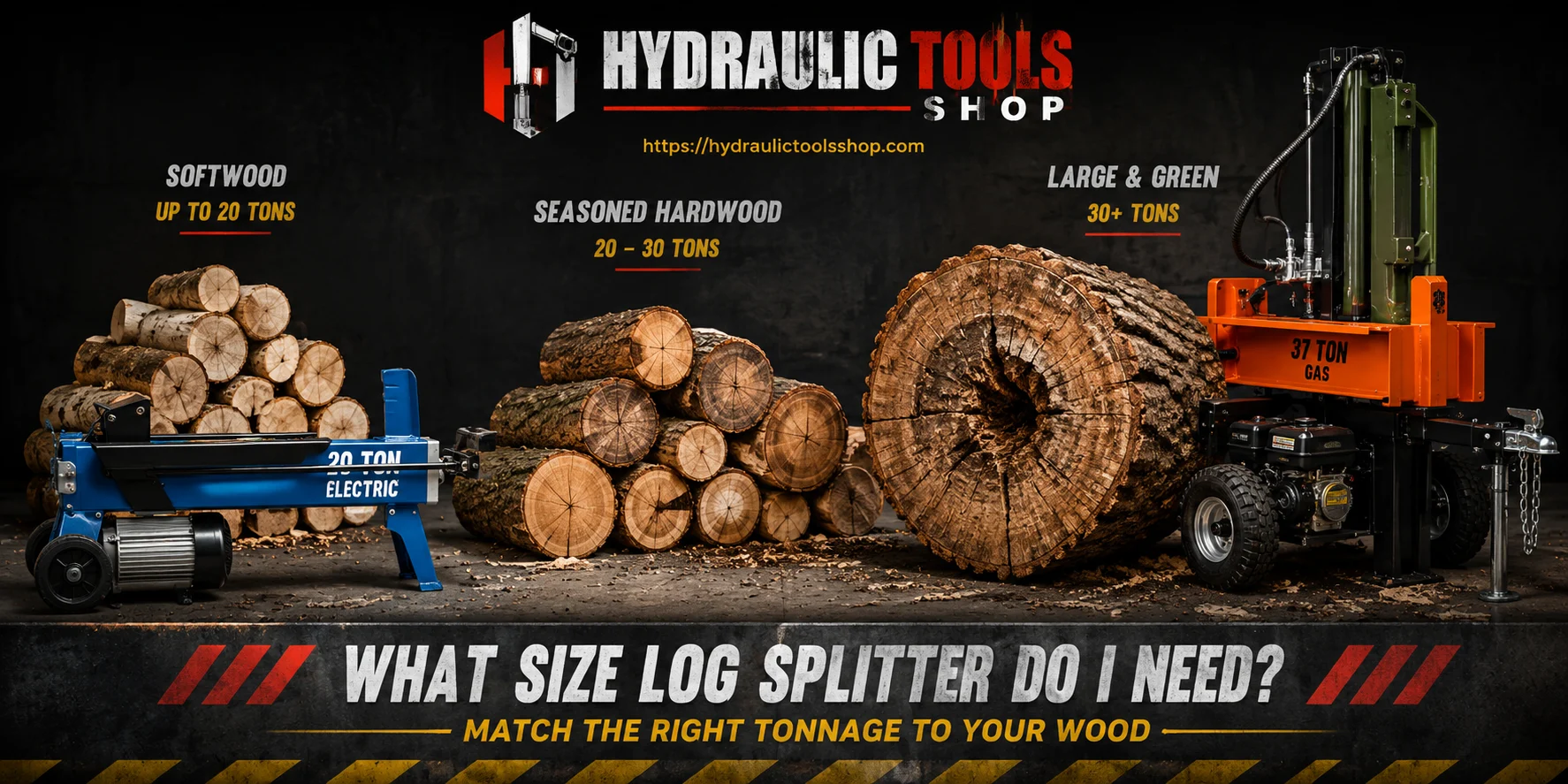
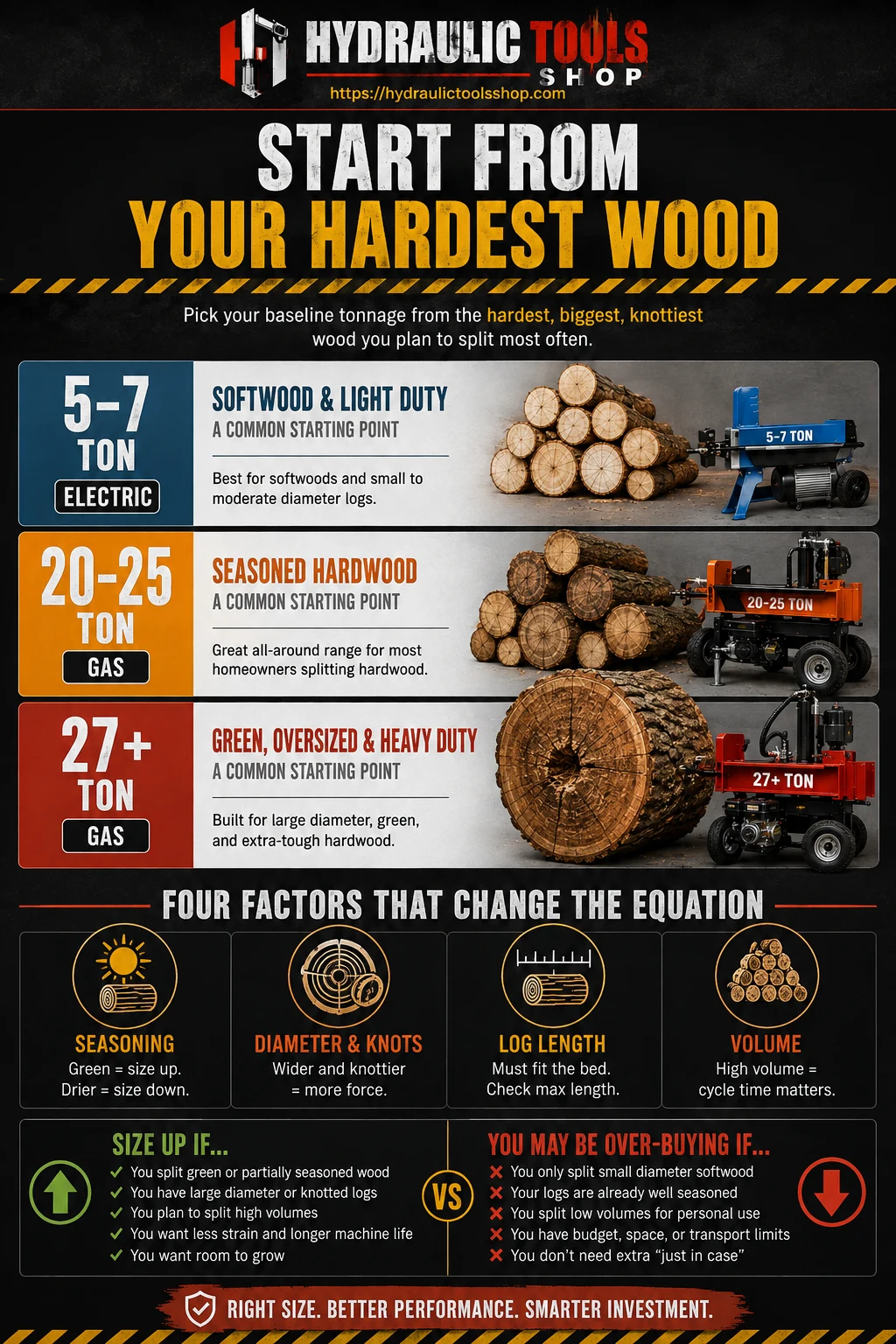
As a common starting point, most homeowners land in the 20 to 25 ton range for a mix of seasoned hardwood. 5 to 7 ton electric units handle softwood and lighter seasoned hardwood, and 27 to 30 ton and up is aimed at green wood, oversized rounds and heavier workloads.
Those ranges are a general starting point, not a promise. The rest of this page shows how to adjust the number for your actual wood, because tonnage alone does not tell you whether a machine will split what you have.
Tonnage is a starting point, not a guarantee
The tonnage categories are useful starting points, but rated tonnage does not tell the whole story about real-world splitting performance. The number on the box is a maximum force figure, not a measure of real splitting difficulty. That difficulty changes with wood condition, diameter, grain, knots and moisture.
Two people can buy the same rated log splitter, sometimes sold as a wood splitter, and have completely different days. One splits dry, straight-grained rounds with ease. The other stalls on green, knotty stock of the same diameter. The number did not change. The wood did. Plenty of good sizing pages already list the factors that matter. The opportunity is to make the interaction between these factors clearer and more actionable for a buyer, and that is where this page tries to help. So do not choose by tonnage alone. Start from the hardest logs you actually expect to split, then work down the sequence below.
How to size your splitter, in order
Work through these nine steps in sequence. Each one narrows the answer the previous one gave you. The value is not that any single factor is a secret, it is that this order turns a pile of variables into a single, defensible choice.
Biggest diameter you typically split
Start here, not with species. Wider rounds spread the load and need more force. Size to your regular large rounds, not the average, so the machine is not overwhelmed by your worst normal day.
Hardest wood you regularly split
Dense hardwood (oak, hickory, elm, hard maple) demands more than softwood at the same diameter. Set your baseline from the toughest species you actually handle often, not the easiest.
Green or seasoned
Green, freshly cut wood resists the wedge far more than the same wood dried. Mostly green stock pushes you up a tier. Well-seasoned wood often lets you come back down.
Knots and twisted grain
Knots and interlocked grain resist splitting regardless of tonnage. If your wood source produces a lot of knotty or crotch stock, add headroom rather than sizing to the clean rounds.
Maximum log length
Now a hard constraint, not a force question. Every splitter accepts logs only up to a set length. If your rounds do not fit the bed, tonnage is irrelevant, so confirm the capacity matches how you cut.
How much wood you process
A few rounds a season is a different job from several cords. Volume is what pulls cycle time and power type into the decision, and often matters more than an extra few tons.
Land on a tonnage tier
Steps one to four set how much force you need; steps five and six sanity-check it against fit and workload. Together they place you in an entry, mid or heavy tier rather than a guessed number.
Electric or gas
Electric suits seasoned wood, moderate volume and a nearby outlet, quietly and with no maintenance. Gas suits green wood, large rounds, high volume or off-grid use, at the cost of noise and upkeep.
Cycle time
The last filter. On low volume it barely matters. At high volume a faster cycle is the difference between an afternoon and a weekend, so weigh it before you finalise between two similar machines.
The two judgment calls people get wrong
Most of the nine steps are straightforward once you know the order. Two are judgment calls worth a little more, because they swing the answer the most and are the easiest to misread.
Diameter versus species
Buyers tend to obsess over species and underweight diameter, when in practice a narrow round of dense oak can be easier than a very wide round of softer wood, because the wedge has less material to force apart. That is why diameter leads the sequence. Read a machine’s stated maximum diameter as the comfortable ceiling on straight-grained, seasoned wood, not a promise on knotty or green stock of the same size.
How much seasoning really changes
Seasoning is usually the single largest swing in splitting difficulty. The same round that fights a machine when green can split with noticeably less force after a season of drying. So the honest question is not just “what wood,” it is “what wood, in what condition.” If you split green as it comes down, size up for margin. If you cut and stack to dry first, you can often work comfortably with less machine than the generic tiers suggest.
As one illustration of that, some owners of entry electric units report successfully splitting larger seasoned hardwood rounds than the tonnage rating would suggest. Those reports are individual experiences, not controlled performance testing, and they do not extend to green or heavily knotted wood, where a small machine still runs out of force. Treat them as a reason not to assume a low rating is useless on seasoned wood, not as a reason to buy an entry machine for a hardwood-heavy or green pile.
Quick reference: what matters for your situation
Rather than assign a single tonnage to each species, which oversimplifies a job that depends on several variables at once, this shows what drives the difficulty in each case so you can reason about your own pile.
| Your wood or use case | What matters most |
|---|---|
| Softwood | Diameter and seasoning |
| Seasoned hardwood | Species, diameter and knots |
| Green hardwood | Higher resistance and moisture, so size up |
| Large or knotted rounds | Diameter, grain and available force |
| High-volume splitting | Cycle time becomes important, not just tonnage |
Sizing for oak and dense hardwood
Oak appears prominently in Google’s autocomplete suggestions, making oak and hardwood sizing an important related intent worth answering directly.
Oak, hickory, elm and hard maple are dense, and dense wood resists the wedge more than softwood of the same diameter. Whether a given machine copes comes down mostly to seasoning and knots. Well-seasoned, straight-grained oak splits more readily than many people expect. Green oak, or oak with big knots and crotch grain, is genuinely demanding and is where smaller machines struggle. For a pile that is mostly dense hardwood, especially with any green in it, sizing toward the higher tiers gives you margin. We cover the specific machines that suit oak and hardwood on our Best Log Splitter for Oak and Hardwood page, added as this section of the site grows.
Two limits that have nothing to do with tonnage
You can buy exactly the right tonnage and still be unhappy, because two constraints decide day-to-day satisfaction independently of force.
Log length capacity
Every splitter accepts logs only up to a maximum length. If your rounds are longer than the bed, you will cut every one down before it fits, no matter how much tonnage you bought. Check the length capacity against how you actually cut your rounds before you look at anything else.
Cycle time versus your volume
Cycle time is how long the ram takes to extend and retract for one split. On a handful of rounds it is irrelevant. Across several cords it is the difference between an afternoon and a weekend. If you split high volume, a faster cycle and usually a gas machine matter as much as tonnage. If you split occasionally, a slower electric unit is perfectly livable and quieter.
When more tonnage is wasted money
Most sizing advice, affiliate content especially, nudges you upward, because recommending more power is the safe answer for the writer. It is not always the right one for you. Over-sizing costs three ways: a bigger machine costs more, gas units add noise, fuel and maintenance that electric units avoid, and heavier machines are harder to move and store. Here is where each tier actually earns its place, so you can see when to stop.
When a 25-ton machine is unnecessary
If your wood is mostly seasoned softwood or light hardwood, your rounds are moderate in diameter, your logs already fit an entry or mid machine’s bed, and you split occasionally rather than by the cord, 25 tons is more than the job needs. An entry electric or a manual unit does this work at lower cost, lower noise and no maintenance. Paying for 25 tons here buys margin you will rarely touch.
When a 25-ton machine is sensible
25 tons becomes the right call once you are regularly splitting seasoned dense hardwood at larger diameters, or a mix that includes some green wood and the occasional knotty round, at real firewood volume. This is the range that covers a typical hardwood-burning household with comfortable headroom, which is why it is the common recommendation for “most homeowners.” If your pile genuinely lives here, this is money well spent, not over-buying.
When 30 tons and up starts making sense
Move past 25 tons when the demanding cases stop being occasional and become the norm: mostly green wood, frequent oversized rounds, heavily knotted or crotch stock, or high continuous volume where you also want the fastest cycle you can get. This is also the territory for anyone doing near-commercial workloads. If none of that describes your wood, 30 tons and up is capability you are paying to carry around rather than use.
Match your answer to a machine
Once you have sized from your hardest wood and worked through the five steps, you land in one of these tiers. Each pick below is matched to a use case, not chosen for having the biggest number. Confirm current specifications and price on the product page before buying.
Entry tier, electric
BILT HARD 6.5-Ton Electric Log Splitter
A 120V plug-in unit with a 20.5 inch by 9.8 inch log capacity and an 18 second cycle (per the listing specifications).
Best for: seasoned softwood and light-to-moderate seasoned hardwood, occasional home use, quiet suburban splitting.
Where it stops: green wood, oversized rounds, and logs past the length cap.
Check Price on AmazonAmazon Associate link. Full write-up on our BILT HARD 6.5-Ton review.
Manual tier, no power needed
Sun Joe LJ10M 10-Ton Manual Log Splitter
A cordless manual hydraulic unit rated at 10 tons. No electricity and no fuel, so it works anywhere.
Best for: low volume, tight budgets, off-grid or no-outlet situations, smaller seasoned rounds.
Where it stops: it is slow and hand-powered, so it is not suited to high volume, large diameter, or green dense hardwood.
Check Price on AmazonAmazon Associate link. Full write-up on our Sun Joe LJ10M review.
Gas tier, heavy duty
SuperHandy 25-Ton Gas Log Splitter
A 25 ton gas unit with horizontal and vertical operation for large rounds that are hard to lift.
Best for: dense and green hardwood, large rounds, higher volume, rural or off-grid use.
The trade-offs: gas noise, fuel and maintenance, a higher price, and it cannot run in an enclosed space.
Check Price on AmazonAmazon Associate link. Full write-up on our SuperHandy 25-Ton review.
Gas tier, alternative
BILT HARD 22-Ton Gas Log Splitter
A 22 ton gas unit with a 209cc engine, a 2-stage 14 GPM hydraulic pump and a 21 inch log capacity, horizontal operation (per the listing specifications).
Best for: home and farm splitting of dense or green hardwood where a slightly lower tier than 25 ton and up still leaves plenty of force.
The trade-offs: as with any gas unit, noise, fuel and maintenance, and it works horizontally rather than converting to vertical.
Check Price on AmazonAmazon Associate link.
Frequently asked questions
Sources and transparency: product specifications are drawn from the manufacturers’ Amazon listings and are verifiable. Owner experience described on this page is user-reported evidence from published reviews, not independent testing. Broad tonnage ranges reflect commonly cited general guidance and are presented as a starting point, not a measured claim by this site. Amazon Associate links are used, and commissions support this site at no extra cost to you. No payment received from any brand mentioned.
Written for HydraulicToolsShop.com by Hank Miller. Have a splitting situation you are unsure how to size for? Reach Hank via the contact page.

20+ Years, Hydraulics and Heavy Equipment
Hank Miller
Born in Ohio’s Rust Belt. Two decades fixing trucks and heavy gear taught me one thing: buy the tool the job needs, not the biggest one on the shelf. I dig into the specs and the owner data so you know exactly what you are buying. Read Hank’s full story.