Last updated: May 2026
A certified budget jack that gets the basics right — but with clear limits.
The ANTPOWER 2-ton floor jack lifts from 5.31 inches to 13 inches, weighs 18.3 lbs, and carries both ASME and GS safety certifications at a price under $50. It is built for sedans, compact cars, and light vehicles where portability matters as much as lifting capacity. With a small but growing review base, it sits in an interesting position — a budget jack with independent safety certification that most competitors at this price skip. This review is based on manufacturer specifications verified against the product listing and aggregated owner feedback rather than controlled lab testing.
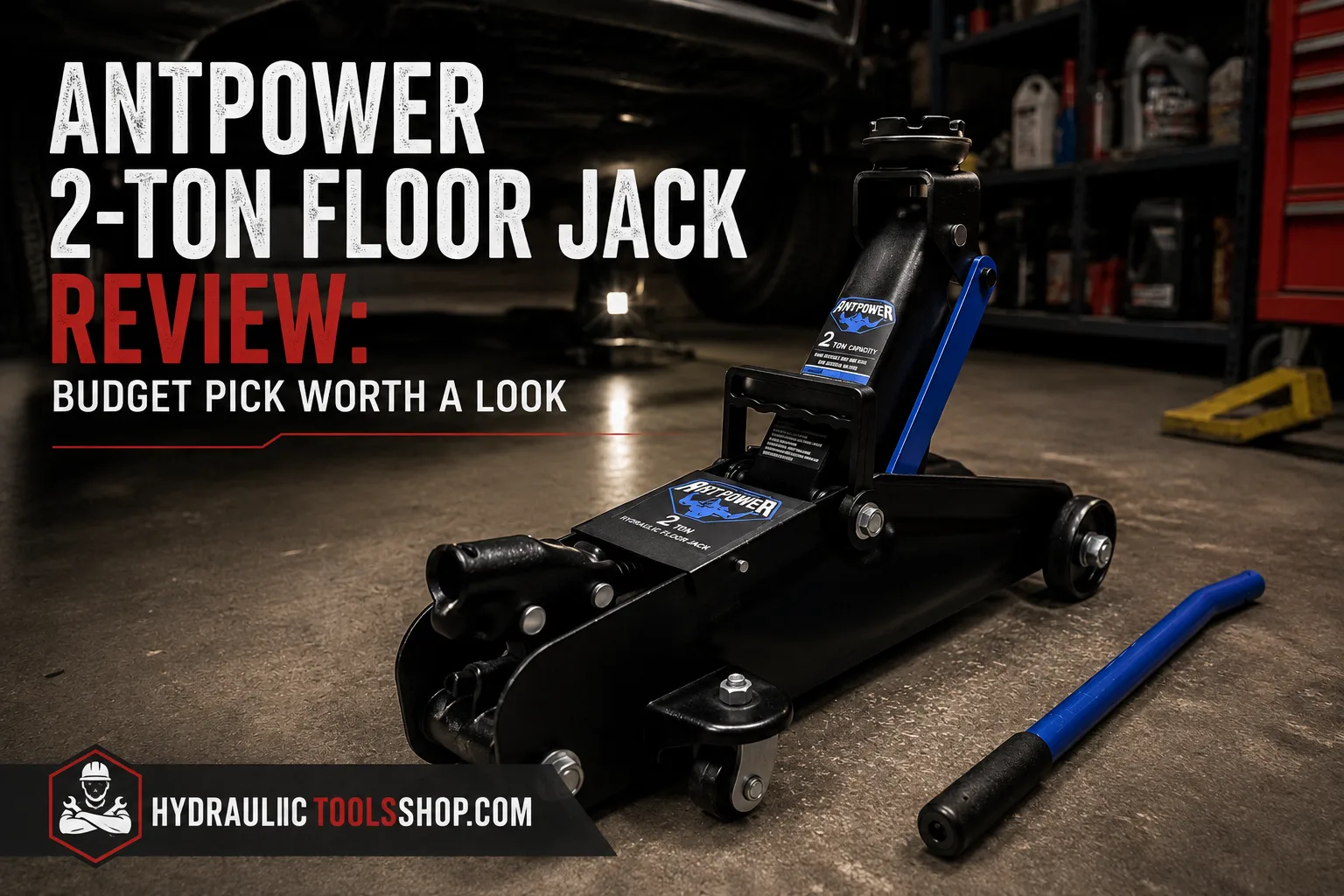
ANTPOWER 2-Ton Floor Jack Review (ASME Certified Budget Jack)
ANTPOWER 2-Ton • ASME and GS Certified • 5.31 in Min Height • Under $50
| Capacity | 2 Ton (4,400 lbs) |
| Min Height | 5.31 inches (135mm) |
| Max Height | 13 inches (330mm) |
| Construction | Alloy steel, welded |
| Weight | 18.3 lbs (8.3 kg) |
| Certifications | ASME and GS safety certified |
| Warranty | 1-year manufacturer warranty |
| Best For | Sedans, compact cars, light vehicles |
| Price | ~$47.99 |
As an Amazon Associate I earn from qualifying purchases.
ANTPOWER 2-Ton — Quick Verdict
| Best for | Compact cars, sedans, and light vehicles needing a portable budget jack |
| Not for | Trucks, SUVs, heavier crossovers, or vehicles needing more than 13 inches of lift |
| Min height | 5.31 inches |
| Max height | 13 inches |
| Capacity | 2 ton (4,400 lbs) |
| Certifications | ASME and GS certified |
| Weight | 18.3 lbs |
| Hank’s score | 7.6 / 10 |
Hank’s Verdict
At under $50 with both ASME and GS safety certification, the ANTPOWER stands out in a budget category where most competitors skip independent certification entirely. That certification is not just a sticker — it means the stated 2-ton capacity has been independently verified rather than self-reported by the manufacturer. The 13-inch maximum height is the hard limitation — it covers standard wheel changes on compact cars and sedans but will not clear the axle on anything taller. At 18.3 lbs it is one of the lightest jacks in the category, which matters if you keep it in a vehicle for roadside use. For the right vehicle and the right use case, it delivers more than the price suggests.
Why Certification Matters at This Price
The budget floor jack market under $50 is full of products making capacity claims that have never been independently verified. A manufacturer can print any number on a label. ASME and GS certifications are different — they require third-party testing against defined safety standards before the certification is granted.
ASME (American Society of Mechanical Engineers) sets standards for hydraulic jack capacity and safety in the US market. GS (Geprüfte Sicherheit) is the German safety certification widely recognised across European and international markets. A jack carrying both certifications has been tested against two independent standards — which at under $50 is genuinely unusual and worth factoring into the buying decision.
For a full breakdown of what to look for in any floor jack beyond certification, the ton rating guide covers capacity selection across all vehicle types. And if you are comparing budget options, the Best Hydraulic Jacks guide covers the full category.
Performance Scorecard
Rated across five categories based on manufacturer specifications, certification data, and aggregated owner reports.
Specs at a Glance
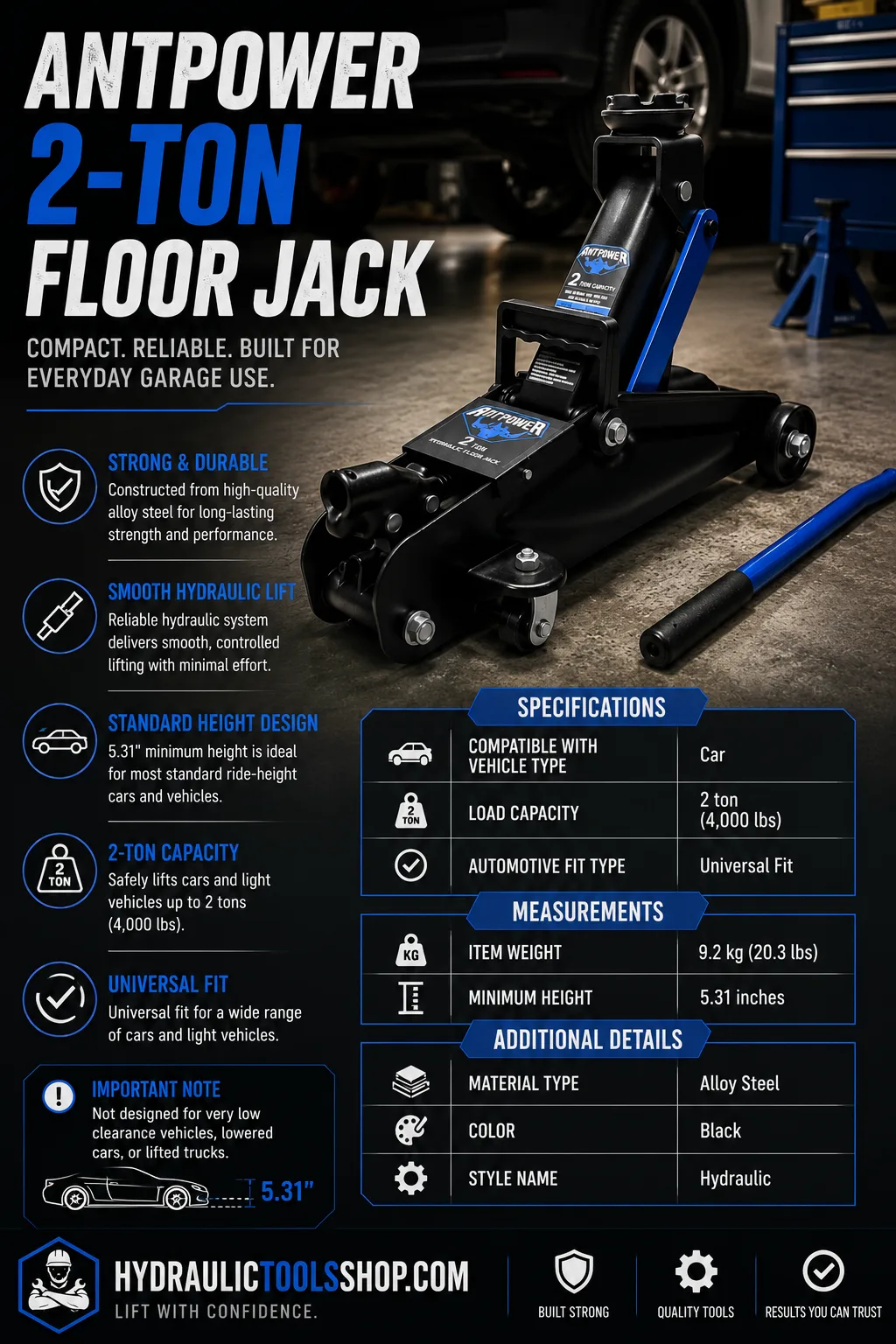
The Numbers That Matter
5.31 in minimum height — fits most standard-height sedans and compact cars at factory lift points. Not suitable for sports cars or heavily lowered vehicles that need below 5 inches.
13 in maximum height — the hard limitation of this jack. Covers standard wheel changes on compact cars and sedans. Will not clear the axle on crossovers, SUVs, or trucks.
2 ton (4,400 lbs) — covers most compact cars and sedans at one-corner loads comfortably. A 2-ton jack can handle compact cars, but a 3-ton jack is generally recommended for added safety margin and long-term reliability. For heavier vehicles a 3-ton jack is the appropriate choice.
ASME and GS certified — independently verified capacity at two separate safety standards. Unusual at this price point.
18.3 lbs — light enough to keep in a vehicle boot for roadside use. One of the lightest jacks in the budget category.
Honest Limitations
The 13-inch maximum height is the spec that decides whether this jack is right for your vehicle. For a Honda Civic doing a wheel change, 13 inches clears the brake rotor and allows tyre removal comfortably. For a Toyota RAV4 or any crossover, 13 inches falls short for rear axle clearance. For a truck it is not even in the conversation. Worth knowing: when lifting by the frame, suspension droop increases the distance needed to clear the wheel beyond what static measurements suggest — meaning the required lift height is often higher in practice than it looks on paper.
The 2-ton capacity is technically sufficient for most compact cars and small sedans. However — and this is worth understanding — operating a jack consistently near its maximum rated capacity accelerates hydraulic seal wear over time. A Civic or Corolla owner will never push the ANTPOWER near its 2-ton limit at a single corner. But anyone driving a heavier vehicle approaching the 2-ton threshold should step up to a 3-ton jack for the long-term reliability benefit. The ton rating guide covers this calculation in full.
Safety Rules
Four Rules. No Exceptions.
Pros and Cons
What Works
- ASME and GS certified — independently verified capacity at under $50
- 18.3 lbs — light enough for vehicle boot storage and roadside use
- Non-slip rubber saddle protects paintwork at the lift point
- 360-degree swivel front casters — easy to position under the vehicle
- 1-year manufacturer warranty — unusual at this price point
- Two-piece handle folds compactly for storage
What to Watch
- 13 in max height — will not clear axles on crossovers, SUVs, or trucks
- 2-ton capacity — not for heavier vehicles approaching the weight limit
- Small owner review base — limited long-term durability data
- Budget build quality — less refined than mid-range alternatives
- 5.31 in min height — not for sports cars or lowered vehicles needing below 5 inches
Budget jacks move in price frequently. Check current stock before reading on.
View Current Price on Amazon → See full floor jack comparison →How It Sits Against the Competition
The ANTPOWER targets the budget end of the compact car category. Here is how it compares across the relevant alternatives.
| Jack | Capacity | Min Height | Max Height | Weight | Certified |
|---|---|---|---|---|---|
| ANTPOWER 2-Ton | 2 ton | 5.31 in | 13 in | 18.3 lbs | ASME and GS |
| VEVOR 3-Ton | 3 ton | 2.8 in | 19.7 in | ~61 lbs | Not stated |
| ARCAN A20019 | 3 ton | 3.25 in | 19.5 in | ~56 lbs | Not stated |
| Pro-Lift F-767 | 2 ton | 3.375 in | 14 in | ~32 lbs | Not stated |
The ANTPOWER’s strongest differentiator against the Pro-Lift F-767 — its closest competitor on capacity and price — is the dual independent certification. Both are 2-ton budget jacks under $50. The ANTPOWER’s ASME and GS certification gives buyers an independently verified baseline that the Pro-Lift does not carry at a comparable price. For more lift height and capacity, the VEVOR 3-ton is the next step up.
What Owners Report
The ANTPOWER has a smaller owner review base than established alternatives. That context matters — the patterns that exist are positive, but the sample is not large enough to draw the same level of confidence as a product with hundreds or thousands of verified purchases.
Owners using the ANTPOWER on compact cars and sedans report it performs as described — the saddle clears the factory lift points cleanly on standard-height vehicles, the rubber pad protects paintwork, and the swivel casters make positioning straightforward. The weight is frequently mentioned positively — at 18.3 lbs it is easy to carry to a wheel change and store in a small space.
Best Alternative
If you need more than 13 inches of maximum lift height or more than 2 tons of capacity, the VEVOR 3-ton low profile jack is the next step up. It goes lower at 2.8 inches minimum height, lifts higher at 19.7 inches, and carries 3 tons of capacity — covering crossovers and mid-size vehicles the ANTPOWER cannot.
If your vehicle is a truck or a full-size SUV, neither the ANTPOWER nor the VEVOR is the appropriate tool. The truck floor jack guide covers that category.
For a complete picture of budget options across all price points, the Best Hydraulic Jacks guide and the Workbench maintenance guides are worth reading alongside any budget jack decision.
Should You Buy It?
If you drive a compact car, a small sedan, or a standard-height passenger vehicle and need a lightweight budget jack with independently verified safety certification — yes. At under $50 with ASME and GS certification and a 1-year warranty, the ANTPOWER delivers more credibility than most budget alternatives at the same price.
If you need more than 13 inches of lift, more than 2 tons of capacity, or plan to use the jack on anything heavier than a mid-size sedan — step up to a 3-ton jack. The price difference is small relative to the capability difference.
Certified at the price. Lightweight where it counts. Right for the right vehicle.
Check Price on AmazonAs an Amazon Associate I earn from qualifying purchases.
Frequently Asked Questions
Sources and transparency: This review is based on ANTPOWER manufacturer specifications verified against the Amazon product listing, ASME and GS certification documentation, and aggregated owner reports — not controlled lab testing. The smaller owner review base for this product is noted throughout. Safety rules referenced against OSHA vehicle lifting standards. No payment received from ANTPOWER.

Hank Miller
Born in Ohio’s Rust Belt. Over 20 years fixing trucks and heavy gear taught me one thing: good tools keep you safe, bad ones cost fingers. I gather intel from fellow mechanics, dig into owner data, and make the call so you know exactly what you are buying before it goes under your vehicle. Read Hank’s full story.