
Last updated: May 2026
The number on the label is not the whole story. Here is the whole story.
The ton rating on a floor jack tells you its maximum lifting capacity. What it does not tell you is whether that capacity is appropriate for your specific vehicle, your specific job, or the corner loads actually involved when you lift one wheel at a time. A 2-ton jack can technically lift a 4,000-lb car — but operating near the maximum rated capacity accelerates seal wear and reduces long-term reliability. This guide explains how to match the right ton rating to your vehicle based on real weight data and how hydraulic jacks actually work under load. And one thing worth stating upfront: lift height matters just as much as ton rating — a jack that cannot reach your vehicle’s lift point is useless regardless of its capacity.
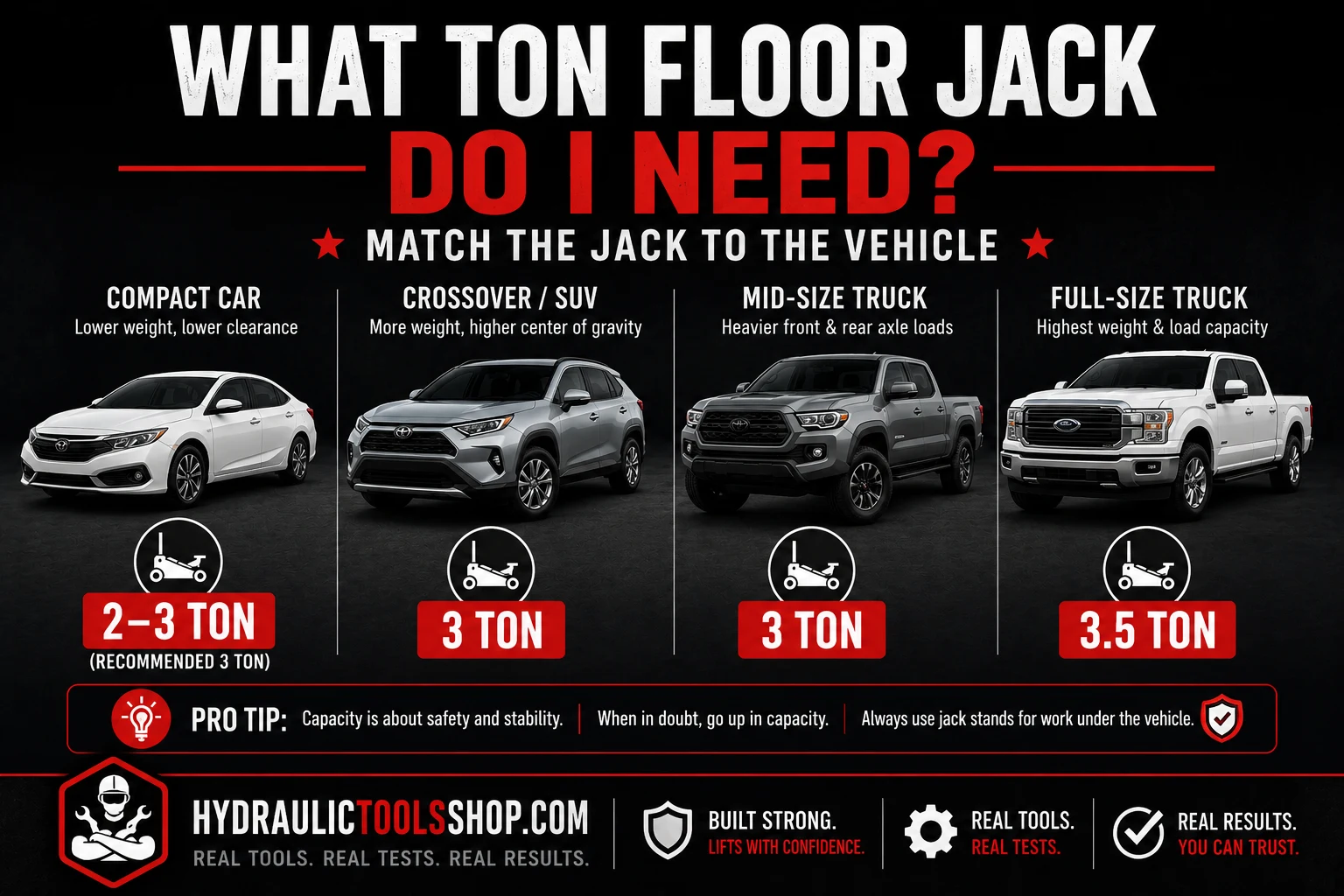
What Ton Floor Jack Do I Need: Hank Breaks It Down
Floor Jack Buying Guide • Ton Rating Explained • All Vehicle Types • Hank Miller
Quick Answer by Vehicle Type
| Vehicle Type | Examples | Ton Rating Needed |
|---|---|---|
| Compact car, small sedan | Honda Civic, Toyota Corolla | 2 Ton minimum — 3 Ton preferred |
| Mid-size sedan, crossover | Toyota Camry, Honda CR-V, RAV4 | 3 Ton |
| Sports car, performance car | Subaru WRX, Porsche 911, Mustang | 3 Ton |
| Mid-size truck, large SUV | Toyota Tacoma, Jeep Wrangler | 3 Ton |
| Full-size half-ton truck | Ford F-150, Chevy Silverado, Ram 1500 | 3.5 Ton |
| Heavy-duty truck | Ford F-250, F-350, Ram 2500 | 4 Ton plus |
| EV — Tesla Model 3, Model Y | Tesla Model 3, Model Y | 3 Ton |
| EV — Tesla Model S, Model X | Tesla Model S, Model X | 3.5 Ton |
How Ton Ratings Actually Work
A floor jack’s ton rating is its maximum lifting capacity — the total weight it can lift at the saddle point. A 3-ton jack lifts up to 6,600 lbs. A 3.5-ton jack lifts up to 7,700 lbs. That sounds straightforward until you realise you are never lifting the entire vehicle.
When you place a floor jack under one corner of a vehicle, you are lifting roughly 25 to 35 percent of the vehicle’s total weight at that contact point. The rest of the vehicle’s weight stays on the other three wheels. This is called the corner load — and it is the number that actually matters when choosing a jack, not the vehicle’s total curb weight.
The Corner Load Calculation
You do not need a calculator for this. The rule of thumb Hank uses: take 35 percent of your vehicle’s gross vehicle weight rating (GVWR) and that is the maximum corner load you are likely to put on a jack. Choose a jack rated comfortably above that number.
How to Calculate Your Corner Load
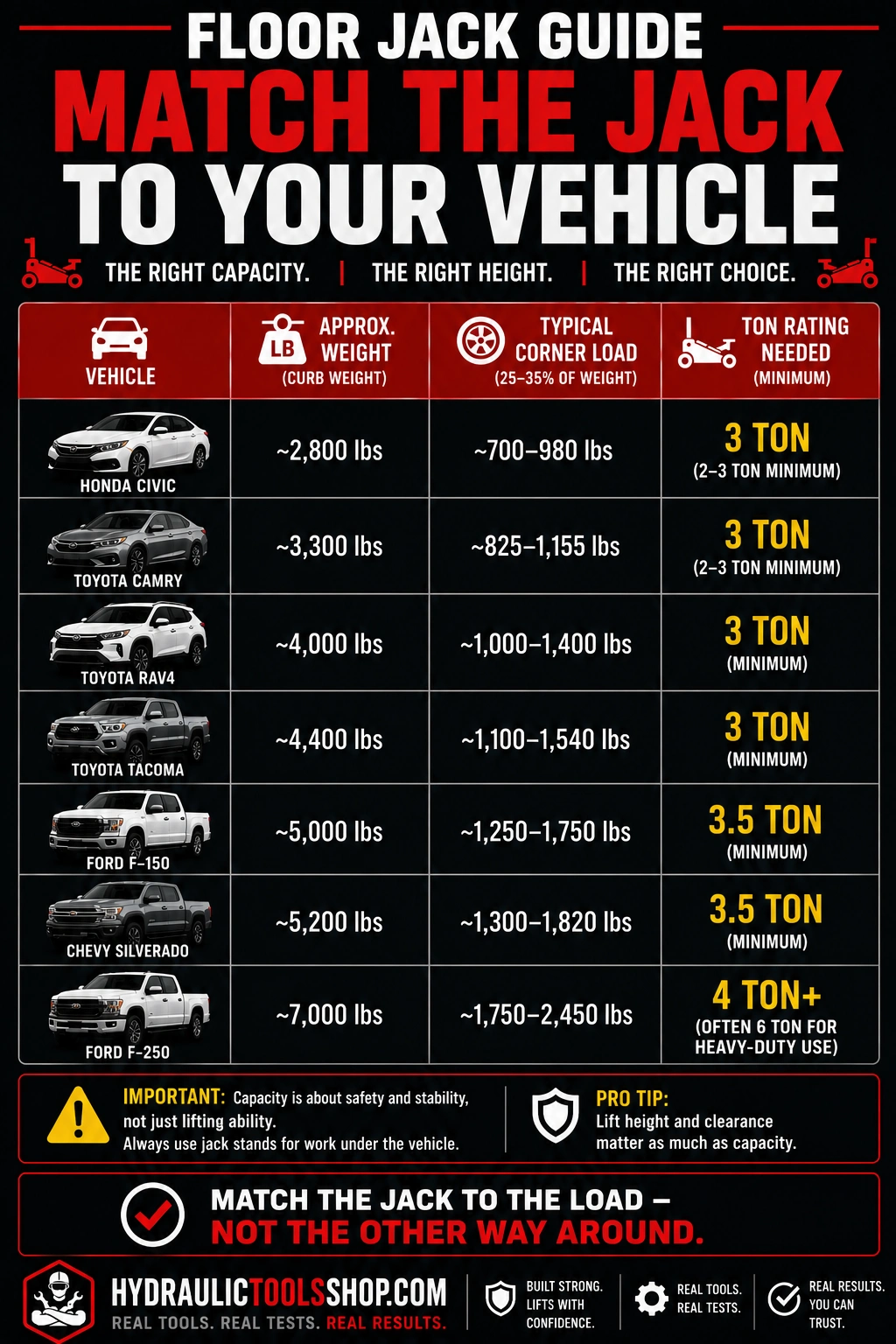
Full Vehicle Reference Table
Approximate weights based on published manufacturer curb weights. Corner loads estimated at 25 to 35 percent of curb weight for one corner. Always confirm against your specific vehicle’s door jamb sticker.
| Vehicle | Approx Curb Weight | Est. Corner Load | Min Ton Rating | Recommended |
|---|---|---|---|---|
| Honda Civic | ~2,800 lbs | ~700-980 lbs | 2 Ton | 3 Ton preferred |
| Toyota Corolla | ~3,100 lbs | ~775-1,085 lbs | 2 Ton | 3 Ton preferred |
| Honda Accord | ~3,400 lbs | ~850-1,190 lbs | 3 Ton | 3 Ton |
| Toyota Camry | ~3,300 lbs | ~825-1,155 lbs | 3 Ton | 3 Ton |
| Subaru WRX / BRZ | ~3,100-3,400 lbs | ~775-1,190 lbs | 3 Ton | 3 Ton |
| Porsche 911 | ~3,400 lbs | ~850-1,190 lbs | 3 Ton | 3 Ton |
| Tesla Model 3 | ~3,800-4,100 lbs | ~950-1,435 lbs | 3 Ton | 3 Ton |
| Tesla Model Y | ~4,400 lbs | ~1,100-1,540 lbs | 3 Ton | 3 Ton |
| Tesla Model S | ~4,900 lbs | ~1,225-1,715 lbs | 3.5 Ton | 3.5 Ton |
| Toyota RAV4 | ~4,000 lbs | ~1,000-1,400 lbs | 3 Ton | 3 Ton |
| Honda CR-V | ~3,600 lbs | ~900-1,260 lbs | 3 Ton | 3 Ton |
| Toyota Tacoma | ~4,000-4,400 lbs | ~1,000-1,540 lbs | 3 Ton | 3 Ton |
| Jeep Wrangler | ~4,200 lbs | ~1,050-1,470 lbs | 3 Ton | 3 Ton |
| Ford F-150 | ~4,700-5,500 lbs | ~1,175-1,925 lbs | 3.5 Ton | 3.5 Ton |
| Chevy Silverado 1500 | ~4,900-5,400 lbs | ~1,225-1,890 lbs | 3.5 Ton | 3.5 Ton |
| Ram 1500 | ~4,900-5,400 lbs | ~1,225-1,890 lbs | 3.5 Ton | 3.5 Ton |
| Ford F-250 | ~6,500-7,000 lbs | ~1,625-2,450 lbs | 4 Ton plus | 4 Ton plus |
| Ford F-350 | ~7,000-8,000 lbs | ~1,750-2,800 lbs | 4 Ton plus | 4 Ton plus |
Visual Ton Rating Guide
Why Headroom Matters More Than the Minimum
Buying a jack rated exactly to your corner load is technically correct. In practice it accelerates wear in ways that are not immediately visible.
Hydraulic floor jacks use rubber seals to hold pressure in the cylinder. When a jack operates near its maximum rated capacity consistently, those seals experience higher sustained pressure than they are designed for in normal use. Over time this causes slow hydraulic bleed-down — the jack that held perfectly in the first year starts settling under load in year two or three.
The practical rule Hank follows: choose a jack where your maximum expected corner load sits at no more than 60 to 70 percent of the jack’s rated capacity. A 3-ton jack used to lift a 1,200-lb corner load is operating at 18 percent of rated capacity. That is the comfort zone where seals last longest and hydraulic hold stays reliable throughout the jack’s service life.
A Note on EVs and Heavier Vehicles
Electric vehicles are heavier than their petrol equivalents of similar size. The battery pack adds significant weight — a Tesla Model 3 weighs roughly 800 lbs more than a comparable Honda Civic. That shifts the corner load calculation meaningfully.
For the Tesla Model 3 and Model Y, a 3-ton jack covers the corner loads comfortably. For the heavier Model S and Model X — which weigh close to 5,000 lbs — a 3.5-ton jack provides the appropriate headroom. As EVs become heavier in coming model years, the same principle applies: calculate the corner load first, then choose a jack rated comfortably above it.
EV lift points also require a rubber puck adapter to protect the battery enclosure. The jack capacity is only one part of safe EV lifting — correct saddle contact at the manufacturer-specified lift point is equally important. See the Workbench guide for EV-specific lifting guidance.
Jack Recommendations by Ton Rating
Based on the vehicle table above, here are the specific jacks worth considering for each capacity category. Each links to a full review.
2-Ton Jacks
Compact cars, small sedans. Technically sufficient — but a 3-ton jack used on these vehicles provides better long-term reliability and more versatility if you ever change vehicles.
Best option: Budget picks in the 3-ton category cover these vehicles better than dedicated 2-ton jacks.
See 3-ton options →3-Ton Jacks
The practical choice for most home garages. Covers sports cars, crossovers, mid-size trucks, and most EVs with comfortable headroom above the corner loads involved.
See best 3-ton floor jacks →3.5-Ton Jacks
Full-size half-ton trucks and heavier EVs. The Blackhawk B6350 is the specific recommendation — 3.5-ton capacity, 22-inch maximum height, dual-piston pump.
See Blackhawk B6350 review →4-Ton Plus
Heavy-duty trucks — F-250, F-350, Ram 2500 and above. These vehicles exceed the comfortable operating range of standard home garage floor jacks. A dedicated heavy-duty jack is required.
See truck floor jack guide →Know your ton rating now? Find the right jack for your vehicle.
See All Floor Jack Reviews →Safety Rules Regardless of Ton Rating
The ton rating is only one part of safe lifting.
Frequently Asked Questions
Sources and transparency: Vehicle weight figures are approximate and based on published manufacturer curb weights — actual vehicle weights vary by trim, configuration, and load. Corner load estimates use a 25 to 35 percent calculation and should be verified against your specific vehicle’s door jamb GVWR sticker. This guide is based on 20 years of automotive tool experience and hydraulic jack engineering principles — not controlled lab testing. Safety rules referenced against OSHA vehicle lifting standards. No affiliate links in this guide — product recommendations link to full reviews on this site.

Hank Miller
Born in Ohio’s Rust Belt. Over 20 years fixing trucks and heavy gear taught me one thing: good tools keep you safe, bad ones cost fingers. I gather intel from fellow mechanics, dig into owner data, and make the call so you know exactly what you are buying before it goes under your vehicle. Read Hank’s full story.
2 comments
[…] a full breakdown of what to look for in any floor jack beyond certification, the ton rating guide covers capacity selection across all vehicle types. And if you are comparing budget options, the […]
[…] Know your vehicle’s required lift height before choosing between these three options. The ton rating and lift height guide covers this calculation for every common vehicle […]