Last updated: May 2026
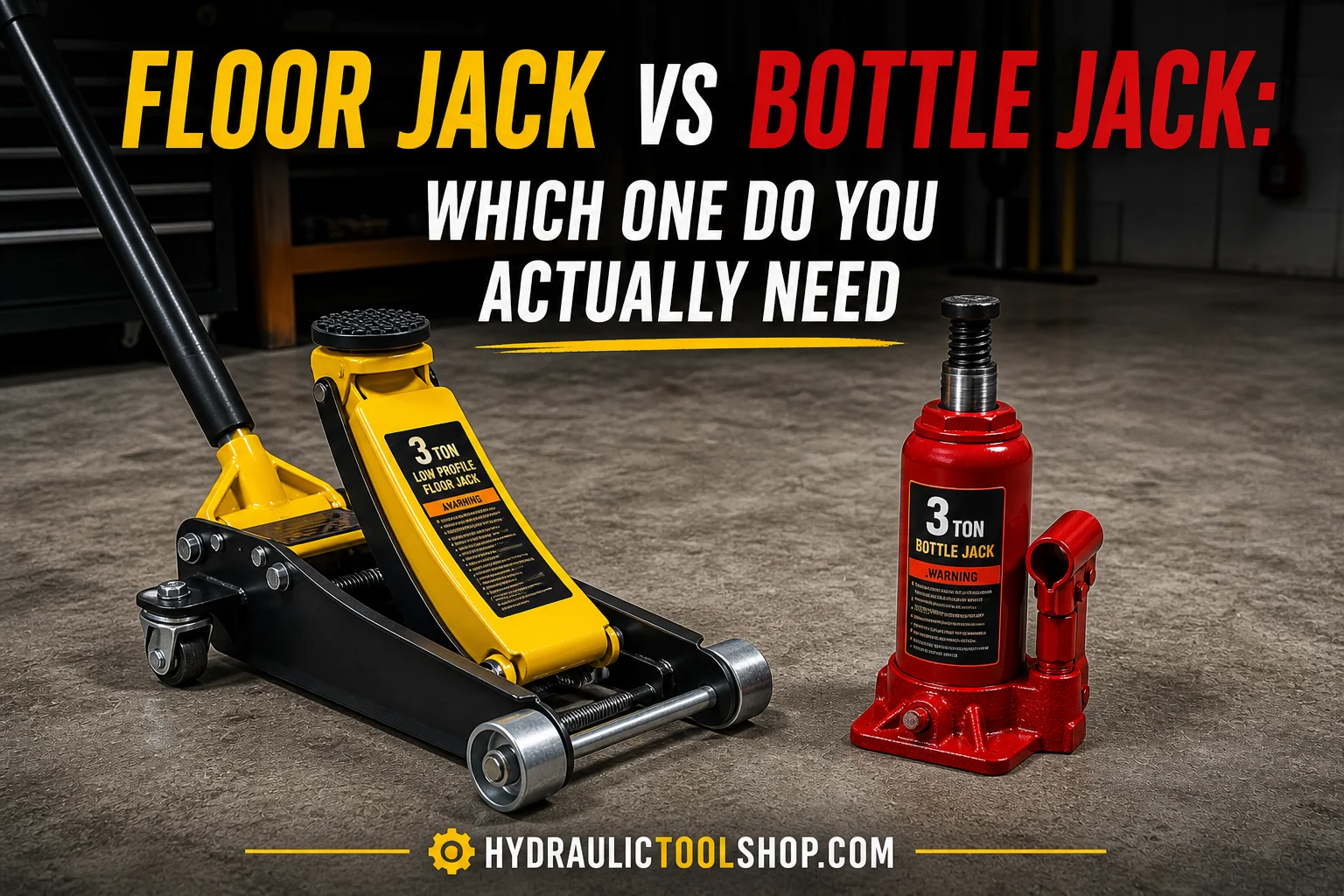
A floor jack rolls under your vehicle and lifts it horizontally. A bottle jack stands upright and pushes straight up. Both lift cars. Both belong in garages. Which one belongs in yours depends on what you drive, where you work, and what you are trying to do. This guide cuts through the confusion with a direct comparison based on 20 years of shop and garage experience.
Floor Jack vs Bottle Jack: Which One Do You Actually Need
Hydraulic Jack Comparison • Home Garage Guide • Hank Miller
Quick Answer
| Choose a floor jack if | You want ease of use, stability, and frequent home garage lifting on cars, trucks, and SUVs |
| Choose a bottle jack if | You need compact storage, higher capacity at lower cost, or lift points in tight spaces on trucks |
| Floor jack advantage | Easier to position, more stable, works on most vehicle types |
| Bottle jack advantage | Smaller footprint, higher capacity per dollar, easier to store |
| Neither replaces | Jack stands — always use stands before going under any vehicle |
What Is a Floor Jack
A floor jack — also called a trolley jack — sits low to the ground on four wheels and uses a long handle to pump hydraulic fluid into a horizontal ram that rises to lift the vehicle. You position it under the vehicle’s lift point, pump the handle, and the saddle rises to meet the chassis. For a full overview of the models available across different vehicle types and budgets, the Best Hydraulic Jacks guide covers the category from low profile sports car jacks to heavy-duty truck options.
The horizontal design gives a floor jack a wide, stable footprint. It rolls easily into position, reaches lift points on most vehicles without modification, and lowers in a controlled way using a release valve. Most home garage mechanics tend to use a floor jack as their default tool because it is the most versatile tool for the widest range of vehicles and jobs.
Floor Jack — At a Glance
- Rolls on four wheels — easy to position
- Low profile saddle reaches most factory lift points
- Wide stable footprint under load
- Works on cars, trucks, SUVs, and most vehicle types
- Takes up more floor space when stored
- Heavier than a bottle jack at the same capacity
Bottle Jack — At a Glance
- Stands upright — compact cylinder design
- Higher capacity per dollar than floor jacks
- Smaller storage footprint
- Better for trucks with high ground clearance
- Both jack types require firm, level ground — but bottle jacks are more sensitive to uneven surfaces due to their narrower base
- Can tilt slightly under off-centre loads — correct saddle alignment matters more than with a floor jack
- Harder to position on low clearance vehicles
What Is a Bottle Jack
A bottle jack is a compact upright hydraulic jack shaped roughly like a bottle. Instead of a horizontal ram, it pushes straight up. The cylinder sits on the ground and the ram extends vertically to lift the vehicle from below.
Bottle jacks are physically smaller than floor jacks of the same capacity, which makes them easier to store and easier to carry to a remote location. They are common in truck beds, farm equipment bays, and anywhere that storage space is limited or the vehicle being lifted sits high enough off the ground for the bottle jack to fit underneath. One handling detail worth knowing: a bottle jack can tilt slightly under off-centre loads if the saddle is not aligned precisely under the lift point. This requires more deliberate placement than a floor jack, particularly on uneven ground or when working alone.
See Both in Action
What to Watch For
Pay attention to how each jack is positioned under the vehicle — the floor jack rolls into place while the bottle jack is carried and set down manually.
Notice the lift speed difference. A floor jack with a dual-piston pump reaches working height in fewer strokes. A bottle jack typically requires more handle travel for the same lift height.
Watch how each jack behaves during lowering. A floor jack’s release valve gives gradual controlled descent. A bottle jack’s release can be less predictable if the valve is opened too quickly — something worth knowing before you use one for the first time.
Head to Head Comparison
| Category | Floor Jack | Bottle Jack |
|---|---|---|
| Ease of use | Rolls into position — easier | Carried manually — more effort |
| Minimum height | 2.8 to 5+ inches depending on model | Typically 7 to 9 inches minimum |
| Stability under load | Wide footprint — more stable | Narrow base — less stable |
| Capacity per dollar | Lower — more mechanism required | Higher — simpler design |
| Storage space | Larger — takes up floor space | Smaller — fits in a bag or box |
| Low clearance vehicles | Yes — low profile models reach 2.8 in | No — most cannot fit under low vehicles |
| Trucks and high vehicles | Yes — models up to 3.5 ton and 22 in lift | Yes — well suited to high ground clearance |
| Portability | Heavy — wheels help but it is still large | Lighter — easy to carry one-handed |
| Remote use | Not practical away from a flat garage floor | Good for roadside use or field repairs |
| Price range | $80 to $300 plus for home garage models | $30 to $150 for comparable capacity |
Which Job Needs Which Jack
The right jack depends less on preference and more on the specific job you are doing and the vehicle you are doing it on. Here is how the two tools split across common tasks.
Reach for a Floor Jack when…
- Doing wheel changes on a sports car or lowered vehicle
- Brake work requiring stable lift for extended time
- Suspension work on a passenger car or crossover
- Any job where you need to get under the vehicle safely
- Working alone — easier to position without an assistant
- Regular home garage maintenance on mixed vehicle types
Reach for a Bottle Jack when…
- Lifting a truck or heavy equipment with high ground clearance
- Roadside tire change where you need something compact
- Farm or field equipment repair away from a garage
- Lifting one end of a vehicle to change a spring or shock
- Storage space is very limited
- Budget is the primary constraint and the vehicle sits high
Match to Your Vehicle
| Vehicle Type | Recommended Jack | Reason |
|---|---|---|
| Sports car, lowered vehicle | Floor jack — low profile | Bottle jack minimum height will not clear the sill |
| Tesla Model 3, Model Y | Floor jack — low profile | EV lift points need low minimum height and precise positioning |
| Honda Civic, Toyota Corolla | Either | Standard height — both jacks fit. Floor jack easier to use. |
| Toyota Tacoma, Jeep Wrangler | Either | High clearance — bottle jack fits well. Floor jack more stable. |
| F-150, Silverado, Ram 1500 | Either | Floor jack preferred for ease. Bottle jack works at lower cost. |
| F-250, heavy duty trucks | Bottle jack — high capacity | High capacity bottle jacks are more affordable at 6 to 20 ton range |
| Farm or construction equipment | Bottle jack | High capacity, compact, portable — right tool for field repairs |
Storage and Portability
A floor jack lives in a garage. It is not a tool you carry in a vehicle boot for roadside emergencies — it is too heavy and too large for that role. A good floor jack for home use weighs between 50 and 70 lbs and rolls on wheels, which makes moving it within a garage manageable but not something you want to lift in and out of a car regularly.
A bottle jack fits in a bag. A 3-ton bottle jack weighs around 10 to 15 lbs and fits in a space smaller than a shoebox. It travels well, stores easily under a workbench or in a truck bed, and works wherever you need it as long as the ground is hard and level.
For home garage mechanics the floor jack is the better primary tool. For anyone who also wants something portable for roadside use or field repairs, a small bottle jack as a secondary tool makes practical sense — and at $30 to $50 for a basic unit it is not a significant investment.
Safety Rules for Both Jack Types
These rules apply regardless of which jack you use.
Hank’s Call
For the majority of home garage mechanics working on passenger cars, sports cars, crossovers, and standard-height trucks — a floor jack is the right primary tool. It is easier to position, more stable under load, and covers the full range of vehicles without the minimum height constraints that make bottle jacks impractical for low clearance vehicles.
A bottle jack earns its place in two specific situations: when storage space is genuinely limited, and when you need high capacity lifting at a lower price point — particularly for trucks, farm equipment, or anything that sits high enough off the ground to accommodate the bottle jack’s starting height.
If you can only own one — buy a floor jack sized for your heaviest vehicle. If you work on a mix of vehicles and also need something portable — own both. The bottle jack costs less than a decent dinner out and takes up less space than a shoebox.
Ready to pick a floor jack? Start with the full buying guide.
See All Floor Jack Reviews →Recommended Floor Jacks by Vehicle Type
Based on the vehicle match guide above, here are the specific jacks worth looking at depending on what you drive. Each links to a full review with complete specs and owner report analysis.
| Vehicle Type | Recommended Jack | Why |
|---|---|---|
| Trucks and full-size SUVs | Blackhawk B6350 | 3.5 ton, 22-inch max lift, dual-piston pump, steel construction |
| Sports cars and lowered vehicles | ARCAN A20019 | 3.25-inch minimum height, aluminium body, shop-proven track record |
| Budget home garage — low clearance | VEVOR 3-Ton Low Profile | 2.8-inch minimum height, under $150, hundreds of owner reviews |
| Not sure which you need | Full floor jack guide | Complete breakdown by vehicle type, capacity, and budget |
Frequently Asked Questions
Sources and transparency: This guide is based on 20 years of shop and garage experience, hydraulic jack engineering principles, and aggregated mechanic feedback. It is not based on controlled lab testing. Safety rules referenced against OSHA vehicle lifting standards. No affiliate links in this guide — product recommendations link to full reviews on this site.

Hank Miller
Born in Ohio’s Rust Belt. Over 20 years fixing trucks and heavy gear taught me one thing: good tools keep you safe, bad ones cost fingers. I gather intel from fellow mechanics, dig into owner data, and make the call so you know exactly what you are buying before it goes under your vehicle. Read Hank’s full story.
1 comment
[…] The spec that matters more than capacity: Minimum saddle height. All three jacks in this guide are rated to 3 tons. What separates them is how low they go — 2.8 inches, 3.25 inches, and 5.5 inches respectively. That difference determines whether the jack physically fits under your vehicle at the factory lift point. Know your vehicle’s ground clearance before choosing between them. For a full explanation see the floor jack buying guide. […]