Best 30-Ton Log Splitters: Picks for Big, Tough Rounds
The short answer
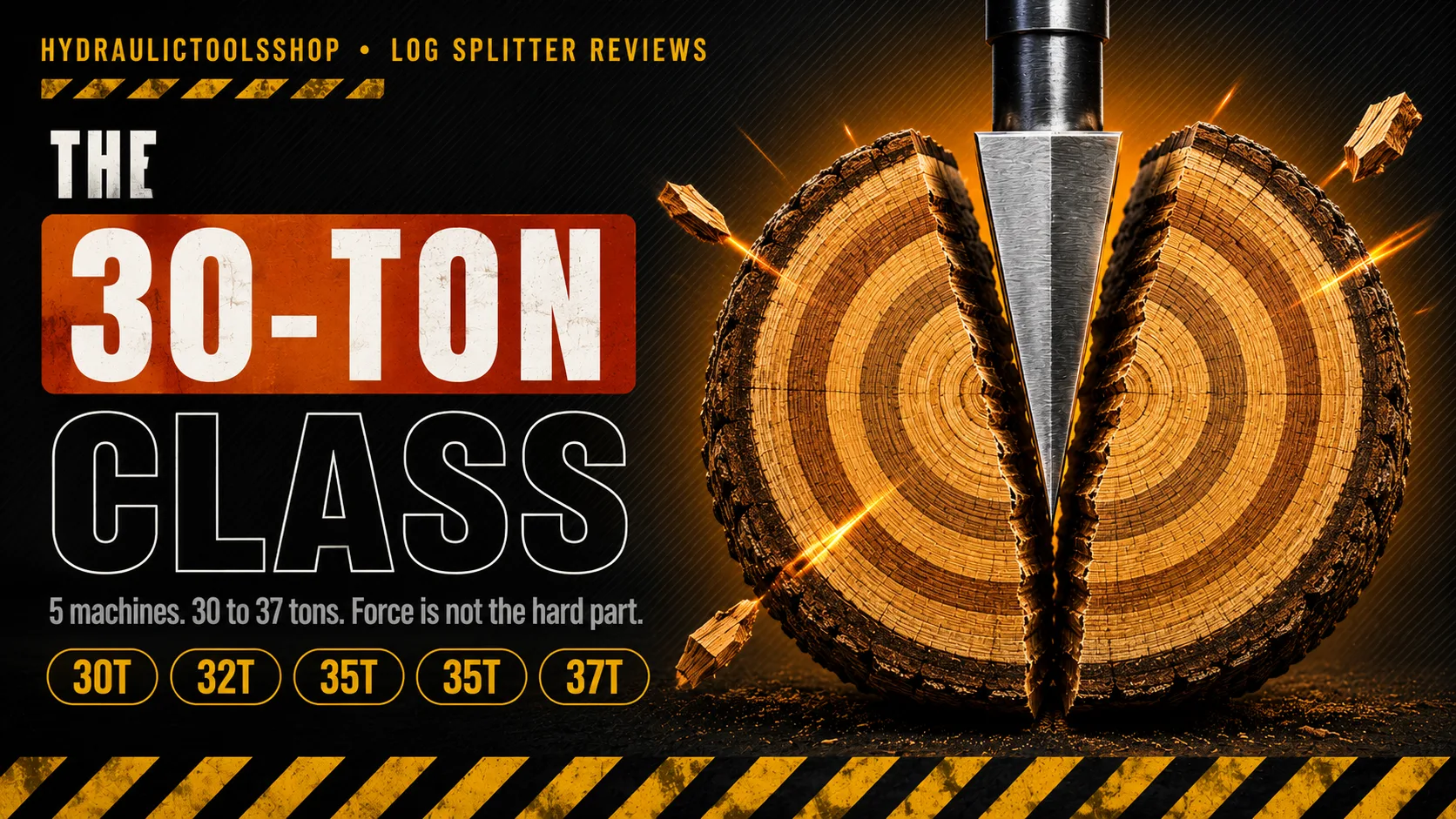
Once you are in the 30-ton class, raw force is rarely what holds you back. Every machine here will split seasoned oak, elm and knotty hardwood. What actually separates them is cycle time, how they handle a heavy round, how many pieces they throw per pass, and the logistics of owning a splitter that weighs anywhere from 430 to over 1,000 pounds and ships by freight. If you want the most capable self-contained machine, the SuperHandy 37-Ton is the easiest call. If you specifically want a true 30-ton at the lowest sensible price, the BILT HARD 30-Ton is the value pick.
The five splitters below run from 30 to 37 tons. That spread is on purpose. Buyers shopping “30 ton” cross-shop everything from 28 up to 38, because these machines split the same wood and sit in overlapping price ranges. Locking to the exact number 30 would leave out machines that may suit your pile better. What we did not do is relabel anything: a 32-ton machine is called 32 tons, a 37-ton machine is called 37 tons, and the manufacturer-rated force is used every time.
Quick picks
SuperHandy 37-Ton
The biggest engine here on a self-contained, towable full-beam machine that handles 24-inch rounds. Sold direct, which matters at this weight and price.
BILT HARD 30-Ton
The only genuine 30-ton in the group, with the fastest published cycle here and horizontal and vertical operation at a sensible price.
Full Boar 35-Ton
A hydraulic log lift and interchangeable 4-way and 6-way wedges. Built to process a lot of wood fast, at a premium price and over 1,000 pounds.
Yardmax 32-Ton
A Briggs and Stratton CR950 on a stronger U-beam, rated for logs up to 26.5 inches. The pick if a familiar engine brand matters to you.
The fifth machine, the BILT HARD 35-Ton, is the most tonnage per dollar in the group and gets its own section below.
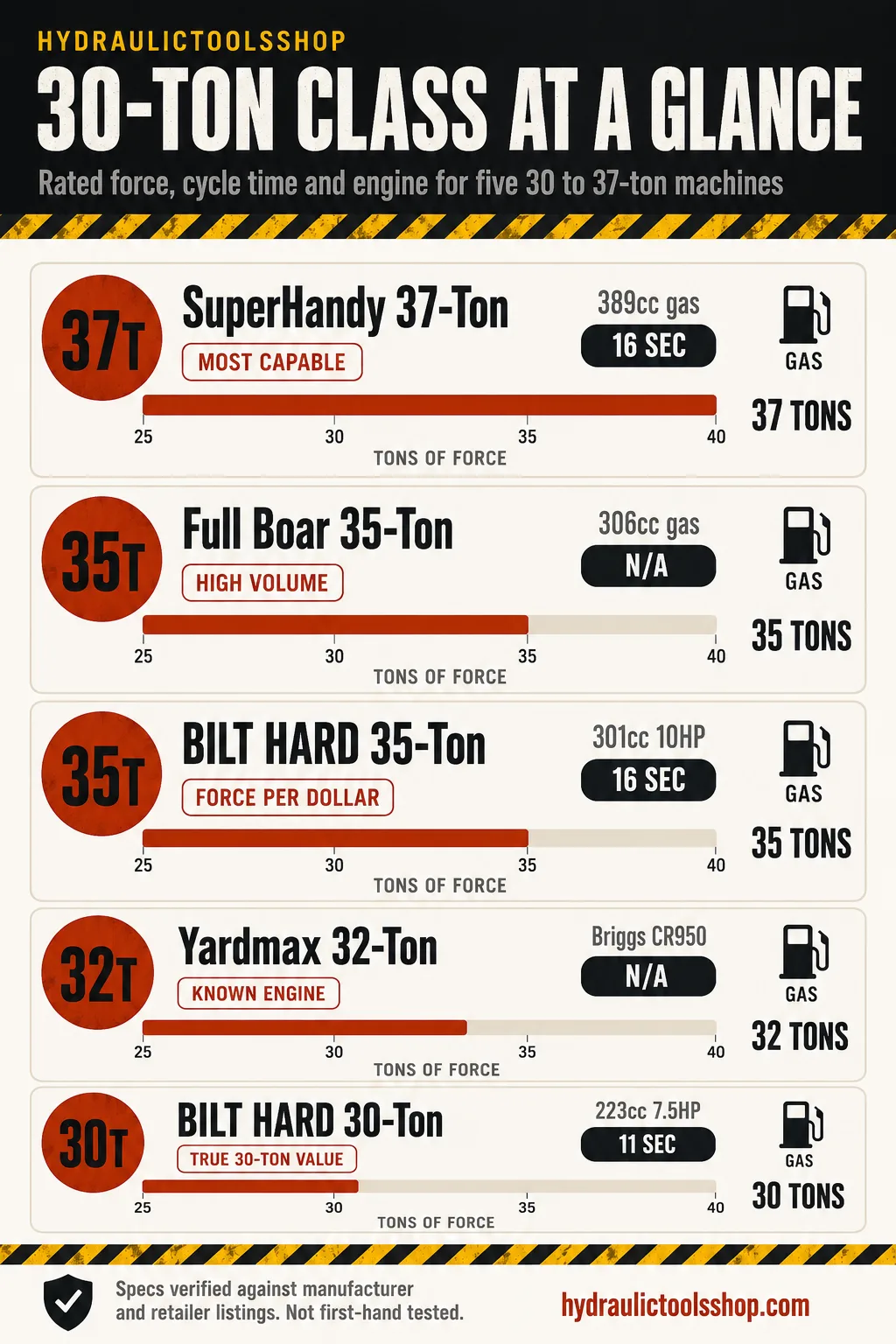
30-Ton-Class Log Splitters Compared
| Model | Rated Force | Engine | Cycle Time | Max Log | H / V | Best For |
|---|---|---|---|---|---|---|
| SuperHandy 37-Ton | 37 tons | 389cc gas | 16 sec | 24 in long, 24 in dia | Yes | Most capable |
| Full Boar 35-Ton | 35 tons | 306cc gas | Not specified | 32 in tray | Yes | High volume |
| BILT HARD 35-Ton | 35 tons | 301cc, 10 HP | 16 sec | 24 in | Yes | Force per dollar |
| Yardmax 32-Ton | 32 tons | Briggs CR950 | Not specified | 26.5 in | Yes | Known engine |
| BILT HARD 30-Ton | 30 tons | 223cc, 7.5 HP | 11 sec | Not specified | Yes | True 30-ton value |
Figures reflect current manufacturer and retailer listings. Availability and pricing change, so confirm both on Amazon before buying.
Read this before you buy any of them
Every machine on this page is a freight item, not a box that shows up on your porch. They weigh from roughly 430 pounds to over 1,000 pounds, ship on a pallet, and several sellers ask for a commercial address or a way to unload. A few buyers of these heavy splitters have reported an added delivery charge after checkout when there was no loading dock or forklift on site. Budget for how you will get it off the truck, and read the seller and return terms before you order.
The Splitters, Reviewed
SuperHandy 37-Ton Full Beam Gas Log Splitter (389cc)
Why it is the overall pick: It carries the largest engine in this comparison on a full-beam, towable machine, and it is sold and shipped by SuperHandy directly rather than a third-party reseller. At this weight and price, buying from the brand that makes it is worth something if you ever need parts or support.
The listed 24-inch diameter capacity is the headline number here. Combined with vertical operation, that means you can roll a big round to the beam instead of hoisting it, then split it without wrestling it onto a table. The 389cc engine gives it margin on green and knotted hardwood that smaller-displacement machines in this class do not have.
- Largest engine in the group, with real headroom on tough rounds
- Handles up to 24-inch diameter logs in vertical mode
- Sold and shipped direct by the manufacturer
- 16-second cycle is mid-pack, not the fastest here
- Non-returnable freight item
- Priced above the entry 30 and 32-ton machines
BILT HARD 30-Ton Full Beam Gas Log Splitter (223cc)
Why it is here: It is the only true 30-ton machine in the group, and it pairs that with the fastest published cycle time here. For a buyer who searched “30 ton” and means it, this is the value answer: real 30-ton force, horizontal and vertical operation, and a towable frame at a price below the bigger machines.
An 11-second cycle is quick for a hydraulic splitter and noticeably faster than the 16-second machines above it, which adds up over a long day. One honesty note: the detailed specs here come from BILT HARD’s own published family comparison rather than a full listing review, and the 30-ton has a limited review history, so treat the finer numbers as manufacturer-stated. BILT HARD machines in this class are also often sold through third-party sellers, so confirm who you are buying from and read the return terms.
- The only genuine 30-ton machine in this comparison
- Fastest published cycle time here at 11 seconds
- Lighter than the bigger machines, easier to move and store
- Detailed specs are manufacturer-stated, with a limited review history
- Often sold via third-party sellers; confirm the seller and returns
- Max log length is not clearly published for this model
Full Boar 35-Ton Gas Log Splitter (306cc, 4-Way and 6-Way, Hydraulic Log Lift)
Why it is here: This is the throughput machine. It is the only splitter in the group with a hydraulic log lift and interchangeable 2-way, 4-way and 6-way wedges. If your goal is to turn big rounds into stove wood as fast as possible, splitting into four or six pieces per pass and never lifting a heavy round by hand changes the whole job.
The hydraulic wedge height adjustment and the multi-way blades are genuinely useful on mixed rounds, and owners report splitting 24 to 30-inch oak with the six-way. The trade-offs are real, though. At roughly 1,045 pounds it is the heaviest machine here, it is the most expensive by a wide margin, and cycle time is not published. On support, some reviews report Full Boar being slow to respond, including one owner whose machine shed hardware. Full Boar’s published residential warranty runs 3 years on materials and workmanship, 2 years on the engine and 1 year on hydraulics, subject to its stated exclusions, so read those terms and weigh how much the support question matters to you.
- Hydraulic log lift removes the worst part of splitting big rounds
- Interchangeable 4-way and 6-way wedges for real throughput
- Strong owner ratings and Amazon’s Choice
- Heaviest and most expensive machine in the group
- Cycle time not published
- Some reviews raise concerns about support responsiveness
Yardmax 32-Ton Full Beam Gas Log Splitter (Briggs and Stratton CR950)
Why it is here: It is the pick for a buyer who wants a familiar engine name and a stronger beam. Yardmax runs a Briggs and Stratton CR950 on a patent-pending U-beam that it positions as more rigid than a standard I-beam, and it takes the longest logs in this comparison at 26.5 inches.
The 2-way wedge and the long 26.5-inch tray are practical touches, and the dual cradles keep split wood off the ground. Two honest caveats. Cycle time is only described as the fastest in its class, with no number given, so it stays unlisted here. And this listing showed a shipping restriction for some regions, which usually points to an emissions rule, so confirm it can ship to your state before ordering. It also has a limited review history so far.
- Briggs and Stratton CR950 engine, a name most buyers know
- Stronger U-beam and the longest log capacity here at 26.5 in
- 2-way wedge and dual log cradles built in
- Cycle time not published as a number
- Shipping restricted in some regions; confirm your state
- Limited review history
BILT HARD 35-Ton Full Beam Gas Log Splitter (301cc, 10 HP)
Why it is here: It is the most tonnage per dollar in the group. You get a 35-ton machine with a 10 HP 301cc engine and a 2-stage gear pump at a price that undercuts the other big-tonnage options. For a buyer who cares most about raw force and value, that is a strong combination.
Owners rate it well and describe a well-built, heavy machine, and hydraulic and engine oil are included. Two things to go in with your eyes open on. Its listed weight varies by source from about 430 pounds up to a 640-pound shipping weight, so plan for a heavy freight delivery. And it is sold by a third-party seller, with at least one buyer reporting an added delivery surcharge when the site had no loading dock, plus a dispute over a return. Confirm the seller, the delivery terms and the warranty before you order.
- 35 tons of force at a lower price than the other big machines
- 10 HP 301cc engine with a 2-stage 14 GPM pump
- Strong owner ratings; hydraulic and engine oil included
- Sold by a third-party seller; confirm terms and warranty
- Reported post-purchase delivery surcharge without a loading dock
- Listed weight varies by source; plan for a heavy freight drop
30 vs 28 vs 35 vs 38 Tons: Does More Force Matter?
Here is the honest truth about this class. By the time you reach 30 tons, the machine is almost never the reason a round will not split. A well-seasoned hardwood round that a 30-ton splitter cannot break is rare. What the extra tons buy you is margin on the worst wood: big, green, or heavily knotted rounds where the wedge wants to stall.
Take oak, the wood most of these machines get bought for. Green oak is wet and heavy and gives up more easily than most people expect. As oak seasons and dries, it hardens, the grain gets stringy, and knots develop tension that deflects a wedge. That is where a 35 or 38-ton machine pushes through with fewer stalls than a 30. Elm is the other classic problem: its interlocked grain resists a clean split at any tonnage, which is exactly where a 4-way or 6-way wedge and a hydraulic log lift do more for you than five extra tons ever will.
So the practical order of what matters at this level is: how the machine handles a heavy round, then cycle time, then wedge configuration, and only then raw tonnage. A 30-ton machine with an 11-second cycle and vertical mode will out-produce a heavier 38-ton unit with a slow ram and no log lift on a normal firewood day.
Do You Actually Need 30 Tons or More?
For most homeowners, honestly, no. A 25-ton machine covers the large majority of firewood work. You step up into the 30-plus class for specific reasons: you process large-diameter rounds regularly, you burn or sell a lot of wood, you split green or difficult species like elm and knotty oak, or you simply want a machine that never bogs down. If you are splitting straight-grained, seasoned rounds under about 20 inches, a 30-ton machine is comfortable overkill, and a 20 or 25-ton unit would be lighter, cheaper and easier to move. If any of the reasons above describe your pile, the extra force and the heavier build in this class earn their keep.
What to Look for in a 30-Ton-Class Splitter
Cycle time. At this size, seconds per cycle decide how long your day is. An 11 to 13-second cycle clears a pile noticeably faster than 16 seconds. Where a maker does not publish a number, treat that as a small red flag and ask.
Wedge configuration. A standard single wedge makes two pieces per pass. A 4-way or 6-way wedge makes four or six. On big rounds destined for a stove, multi-way wedges cut your total passes dramatically. This is the single biggest throughput upgrade in the class.
Log lift and vertical mode. A round in the 30-plus class can weigh more than you want to lift. A hydraulic log lift, or at minimum a vertical splitting mode you can roll a round into, saves your back and speeds the whole job.
Beam type. Makers in this class advertise I-beam, H-beam, U-beam and BOX beam designs, each claimed to resist flex on hard rounds. The label matters less than the overall build and weight, but a heavier, stouter beam is generally the point of buying up into this tonnage.
Engine and pump. Look for a 200cc-plus engine and a 2-stage pump, which runs fast under no load and drops to high pressure only when it meets resistance. That is what gives you both speed and force.
Seller, freight and warranty. This matters more here than on lighter machines. Confirm whether you are buying from the manufacturer or a third-party seller, how the freight delivery works, whether a commercial address or dock is expected, and what the warranty actually covers. A cheap machine that becomes a support headache is not a bargain.
Frequently Asked Questions
Is a 30-ton log splitter enough?
For nearly all firewood work, yes. A 30-ton machine splits seasoned oak, maple, ash and most knotty hardwood without stalling. You would only want more force if you regularly process very large, green, or badly interlocked rounds like elm, where extra tons and a multi-way wedge reduce stalls.
Is a 28-ton log splitter good, and how is it different from a 30?
A 28-ton splitter is a strong machine and handles the same firewood a 30 does. The two-ton difference is mostly reserve force for the worst rounds, and you will rarely feel it on normal seasoned wood. Cycle time, wedge type and log handling separate machines in this range far more than those two tons.
How big a log can a 30-ton splitter split?
Most machines in this class take rounds around 24 to 26 inches long, and diameter depends on the wood and whether you split vertically. A 30-ton unit will handle large seasoned hardwood rounds routinely. For very wide or green rounds, vertical mode and a log lift matter more than the raw tonnage number.
Do you really need 35 or 38 tons?
Only for heavy, repeated use on difficult wood. If you process large green oak, elm, or knotty rounds in volume, the extra force reduces stalls and pairs well with multi-way wedges. For average seasoned firewood, a 30 to 32-ton machine keeps pace, weighs less and costs less.
What wood is hardest to split?
Elm is the classic problem because its interlocked grain resists a clean split at any tonnage. Seasoned, knotty oak and sweetgum are also tough. For these, a 4-way or 6-way wedge and splitting while the round is oriented well help more than simply adding tons of force.
How long should logs sit before splitting?
You can split green or seasoned. Many people split green because wet wood often gives way more easily and then seasons faster once it is in smaller pieces with more exposed surface. Oak in particular hardens as it dries in whole-round form, so splitting sooner can make the job easier and speed seasoning.
Do I need both horizontal and vertical splitting?
In this class, yes. Rounds heavy enough to need a 30-plus-ton machine are often too heavy to lift onto a beam. Vertical mode lets you roll the round to the splitter instead. If a machine offers only horizontal operation at this size, that is a real limitation.
When is the best time to buy a log splitter?
Late fall, around the winter holidays, is when farm stores and big-box retailers most often discount outdoor power equipment. Buying in late summer or early fall also gives you time to split and season wood before winter. Prices and stock change, so compare current listings before you commit.
The Bottom Line
Best overall: the SuperHandy 37-Ton. The biggest engine here, 24-inch round capacity, towable, and sold direct by the manufacturer.
Best true 30-ton value: the BILT HARD 30-Ton. The only genuine 30-ton in the group, with the fastest published cycle and a sensible price, as long as you confirm the seller and terms.
Best for high volume: the Full Boar 35-Ton. A hydraulic log lift and 4-way and 6-way wedges make it the throughput machine, at a premium price and over 1,000 pounds.
Best known engine: the Yardmax 32-Ton. A Briggs and Stratton CR950 on a stronger U-beam with 26.5-inch log capacity.
Most force per dollar: the BILT HARD 35-Ton. Thirty-five tons at a lower price, with the third-party seller and freight caveats read carefully.
Related reading: What size log splitter do I need · Best 20-Ton Log Splitters
1 comment
[…] log splitter do you need, and the tier most large properties actually land on is covered in our best 30-ton log splitters […]
Comments are closed.