Last updated: August 2026
This page contains affiliate links. As an Amazon Associate, HydraulicToolsShop.com earns from qualifying purchases at no extra cost to you.
Hank’s 20-Ton Picks
Best 20 Ton Log Splitters: What to Buy and What to Look For
Most 20-ton splitters look identical on paper. Here is what actually separates them and which ones earn their price.
The short answer
For most homeowners splitting seasoned firewood at moderate volume, a 20-ton gas log splitter is a practical, well-priced entry point into serious splitting. The Landworks 20-Ton and the SuperHandy 20-Ton Portable are the two strongest options in this class, both built around the same Bucher hydraulic pump with hundreds of owner reviews behind them. If your wood is mostly dense or green hardwood, the BILT HARD 22-Ton adds meaningful headroom for a step up in price.
Prices and ratings shift. Confirm current figures on each product page before buying.
Hank’s picks at the 20-ton tier
Not sure 20 tons is the right size? Start with What Size Log Splitter Do I Need?
Is a 20 ton log splitter enough?
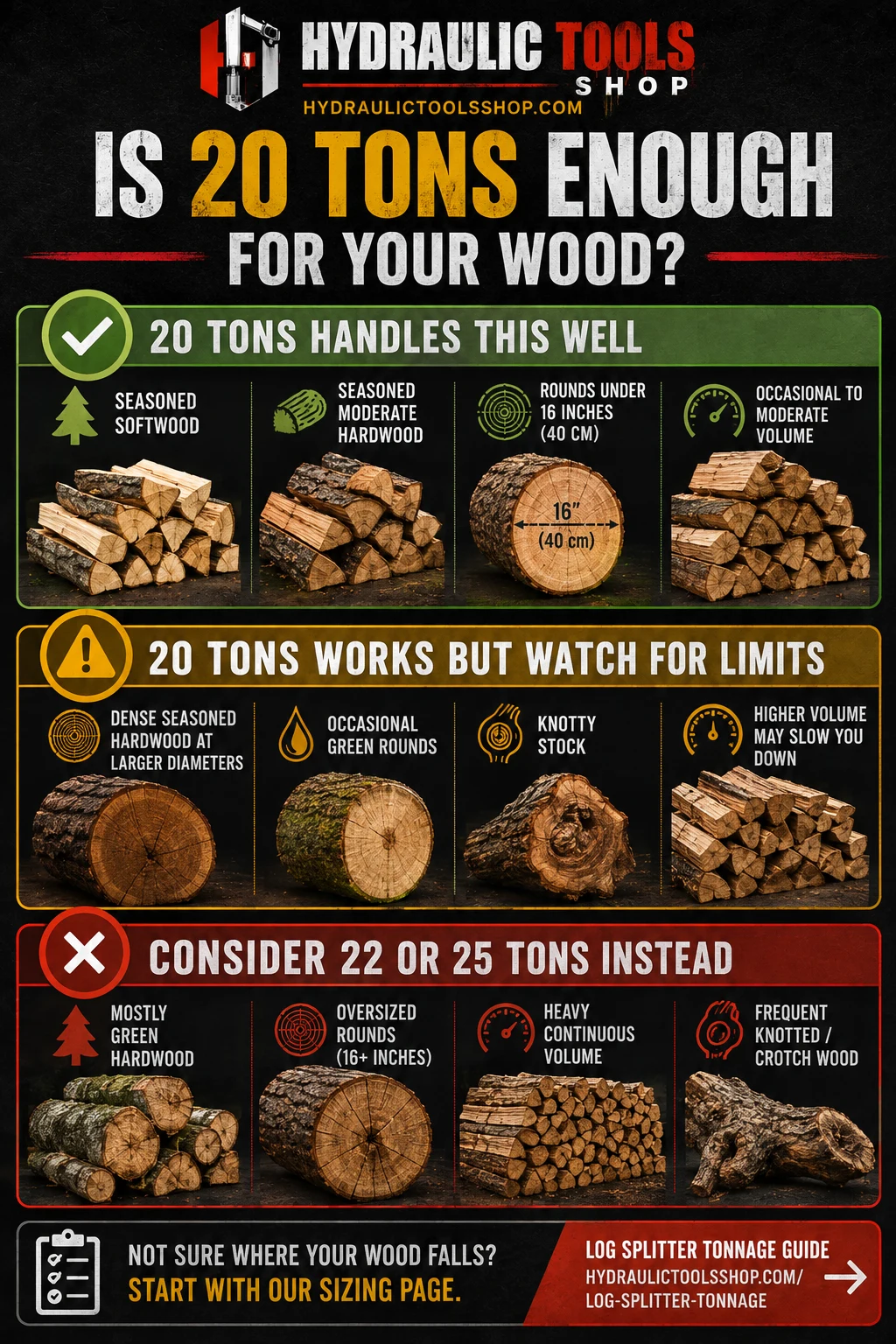
For most residential firewood work, yes. A 20-ton splitter handles seasoned softwood comfortably and does solid work on seasoned moderate hardwood at diameters within the machine’s rated capacity, typically around 16 inches. That covers the majority of what a homeowner processing a few cords per season actually encounters.
Where 20 tons starts to feel limited is on green dense hardwood, heavily knotted stock, and oversized rounds. The machine is not out of force on those logs because of its tonnage number alone, but because the combination of moisture, density and diameter pushes the demand past what the hydraulic system delivers in practice. If that describes most of your pile, 22 or 25 tons gives you headroom. If it describes the occasional tough round in an otherwise seasoned pile, 20 tons still makes sense and you work around the exceptions.
Our tonnage sizing page walks through the full decision, but the short version for 20-ton buyers: if your wood is mostly seasoned, your rounds are mostly under 16 inches, and you split at normal home volume, this tier fits. If your wood is mostly green or your rounds are regularly oversized, look one tier up.
The honest problem with comparing 20-ton splitters
Here is something most “best 20-ton log splitter” articles will not tell you: almost every machine in this class shares near-identical specifications. The typical 20-ton gas splitter is a 7HP engine (usually 196cc or 209cc), a 2-stage hydraulic gear pump, an 8-second cycle time, a 20 to 20.5 inch maximum log length, a 16-inch maximum diameter, horizontal only operation, and a weight around 130 to 135 pounds. The listings often read like they were written from the same template because the underlying hardware is that similar.
That means comparing them on headline specs alone tells you very little. What actually separates one 20-ton machine from another comes down to a smaller set of things: the hydraulic pump (branded and proven, or generic and unverifiable), the cycle time (7.5 seconds versus 8 seconds is a real productivity difference over a full session), how many owners have actually used the machine and reported back, and how the seller handles shipping damage, missing parts and warranty claims. Those are the differences this page focuses on.
20-ton splitter comparison: what actually differs
The first four machines are 20-ton gas splitters with horizontal operation. The BILT HARD 22-Ton is included separately as the step-up option. Specifications are from the Amazon listings at the time of research.
| Model | Engine | Pump | Cycle | Max log | Weight | Reviews |
|---|---|---|---|---|---|---|
| Landworks 20-Ton | 7HP gas | Bucher 2-stage | 7.5s | 20″ x 16″ | ~149 lbs | 349 (4.4) |
| SuperHandy 20T Portable | 7HP gas | Bucher 2-stage | 7.5s | 20″ x 16″ | ~130 lbs | 663 (4.3) |
| SuperHandy 20T Hydraulic | 7HP gas | Bucher 2-stage | 7.5s | 20″ x 16″ | 148.7 lbs | 154 (4.3) |
| Mutaomay 20-Ton | 7HP 209cc | 2-stage (generic) | 8s | 21″ x 16.5″ | ~133 lbs | 14 (4.2) |
| BILT HARD 22-Ton | 209cc gas | 14 GPM 2-stage | ~7s | 21″ | N/A | 76 (4.6) |
Ratings and review counts are from the time of research and will change. Confirm current figures on each listing. The BILT HARD 22-Ton is included because the 20-to-22 step is one of the most common decisions buyers face at this tier.
The picks, in detail
Best overall 20-ton
Landworks Portable 20-Ton Gas Log Splitter
7HP gas engine with a 2-stage Bucher hydraulic gear pump, 7.5-second cycle time, 20-inch by 16-inch log capacity, and 10-inch transport wheels. Ships from Amazon. 349 ratings at 4.4 stars at the time of research, ranking #20 in Power Log Splitters.
The Landworks earns the top spot not on any single spec advantage but on the combination of a named Bucher pump, a faster 7.5-second cycle, Amazon fulfillment, and the deepest verified owner feedback of any machine at this price point. Multiple owners report splitting oak and 16-inch-plus rounds without the engine straining. Assembly is a common complaint across every machine in this class, and the Landworks is no exception, though owners generally describe it as manageable in one to two hours. Several owners note the hydraulic hoses are barely long enough during assembly, which is worth knowing before you start.
Best for: the buyer who wants the most proven 20-ton machine with a reliable pump and Amazon shipping behind it.
Watch for: some owners report durability issues after extended use. Assembly requires patience with the hydraulic lines. Hydraulic fluid is not included.
Check Price on AmazonAmazon Associate link.
Most reviewed 20-ton
SuperHandy Log Splitter Portable 20 Ton
7HP gas engine, 2-stage Bucher hydraulic gear pump, 7.5-second cycle time, 20-inch by 16-inch log capacity, 130 pounds, 10-inch transport wheels. Amazon’s Choice at the time of research with 663 ratings at 4.3 stars.
The SuperHandy Portable has the largest review base in the 20-ton class by a wide margin, which matters when you are buying a machine from a category full of near-identical specs. Like the Landworks, it uses a named Bucher pump and achieves a 7.5-second cycle. Owners describe it as compact, easy to start, and capable on oak. The trade-off is that more reviews also surface more complaints: some owners report the unit broke on first use, and others note the instructions are poor. That said, the overall rating has held at 4.3 across 663 reviews, which is a meaningful signal.
Best for: buyers who value the largest owner evidence base and Amazon’s Choice designation at this tier.
Watch for: some durability complaints in the review tail. Hydraulic fluid not included.
Check Price on AmazonAmazon Associate link.
Budget 20-ton
Mutaomay 20 Ton Portable Gas Log Splitter
7HP gas engine with a 209cc displacement, 8-second cycle time, 21-inch by 16.5-inch maximum log capacity, 133 pounds. 14 ratings at 4.2 stars at the time of research.
The Mutaomay is the least expensive 20-ton option in this set, and it is the only one that accepts logs up to 21 inches long and 16.5 inches in diameter, which is a half inch wider and an inch longer than the standard 20-by-16 of the other machines. The pump is not branded (no Bucher designation in the listing), and the cycle time is 8 seconds versus 7.5. With only 14 reviews, the owner evidence is thin compared to the Landworks or SuperHandy, so you are taking on more uncertainty. The reviews that do exist are generally positive, with multiple owners noting it splits oak and that assembly took one to three hours. One owner flagged frame weakness on very large rounds.
Best for: the buyer on a tighter budget who needs a little more log capacity and is comfortable with a smaller review base.
Watch for: generic pump (not Bucher), slower cycle, and limited owner feedback. Assembly is a two-person job according to several reviews.
Check Price on AmazonAmazon Associate link.
Step up to 22 tons
BILT HARD 22-Ton Gas Log Splitter
209cc gas engine, 2-stage hydraulic pump rated at 14 GPM, approximately 7-second cycle time, 21-inch log capacity, horizontal operation. 76 ratings at 4.6 stars at the time of research.
The BILT HARD 22-Ton is the step-up pick for buyers whose wood regularly includes dense hardwood and occasional green rounds. Two extra tons of force, a higher flow pump (14 GPM versus the 11 GPM typical of the 20-ton machines), and a faster cycle time give it a measurable edge on demanding stock. It is also the highest-rated machine in this comparison at 4.6 stars, though with fewer reviews than the Landworks or SuperHandy. The price is notably higher, and it sits closer to the 25-ton tier in cost. If your wood is consistently seasoned and moderate, this is more machine than you need. If you want margin for the hard days, this is where you get it.
Best for: the buyer whose pile regularly includes dense or green hardwood and wants headroom without jumping to 25 tons.
The trade-off: higher price, gas noise and maintenance, and no vertical operation.
Check Price on AmazonAmazon Associate link.
What about the other 20-ton listings?
We looked at several additional 20-ton machines on Amazon and chose not to feature them as picks. The ZeHuoGe 20-Ton (12 reviews, 3.9 stars) and the GasXcel 20-Ton (6 reviews, 3.3 stars) both have very thin review histories and use generic pumps. One verified GasXcel reviewer reported the engine shipped with a 196cc Loncin rather than the 209cc advertised, which is the kind of spec discrepancy that erodes confidence. The LMAOSS 20-Ton has zero reviews at the time of research. None of these are necessarily bad machines, but with so little owner evidence, featuring them as recommendations would not be honest. If you are considering one of these, check whether the review count has grown since this was written.
We also excluded one listing titled “Electric Log Splitter, 20 Ton” that is actually gas powered. The only review at the time of research confirms the product runs on a gasoline engine despite the title. That kind of listing mismatch is a reason to pass.
20 ton vs 22 ton vs 25 ton: when to step up
The practical difference between 20 and 22 tons is smaller than the numbers suggest. Two extra tons of rated force is not dramatic on its own. What makes the 22-ton BILT HARD worth considering is not just the tonnage but the supporting specs: a higher-flow 14 GPM pump, a faster cycle, and a larger 209cc engine. Together, those specifications give the BILT HARD more hydraulic flow and a faster stated cycle than the 20-ton machines in this comparison, which may make the extra headroom attractive for demanding wood. If your wood is consistently seasoned and moderate, 20 tons does the job and the step to 22 is paying for margin you may not need.
The jump from 20 to 25 tons is more significant. At 25 tons you move into machines designed for regular green hardwood, large rounds, and higher volume, typically with vertical operation for logs too heavy to lift onto a horizontal bed. That tier costs more and the machines are heavier, louder and require more maintenance. If your pile lives there, our sizing page and our upcoming Best 25-Ton Log Splitters page cover those machines directly.
What to look for besides tonnage
Hydraulic pump brand
The pump is the heart of the system. A named pump like the Bucher used in the Landworks and both SuperHandy models is a verifiable component from a manufacturer with a track record. A generic, unbranded pump may perform identically out of the box, but you have no way to know its provenance, and replacement parts are harder to source. At similar prices, a branded pump is a real advantage.
Cycle time
The difference between 7.5 seconds and 8 seconds per split sounds trivial. Over a single cord it adds up. Over several cords it is the difference between finishing before you lose daylight and not. If you split high volume, the faster cycle matters. If you split a handful of rounds at a time, it does not.
Log capacity
Most 20-ton machines accept logs up to 20 inches long and 16 inches in diameter. The Mutaomay is slightly larger at 21 by 16.5 inches. Check this against how you actually cut your rounds. If your rounds are longer than the bed accepts, you have to recut every one before it fits, which is a hassle that has nothing to do with tonnage.
Review depth and seller reliability
When specs converge this tightly, the owner evidence becomes the strongest differentiator. A machine with 349 or 663 reviews gives you a much clearer picture of real-world assembly difficulty, reliability, and seller responsiveness than one with 6 or 14. That does not make a low-review machine bad, but it does mean you are taking on more uncertainty.
Who should buy a 20-ton splitter
The 20-ton tier fits a specific buyer well: someone splitting a few cords of mostly seasoned firewood per year, with rounds that fit within the machine’s bed, who wants gas power for portability and faster work than an electric unit provides. That covers a lot of typical firewood households.
It is less suited to someone processing mostly green dense hardwood, regularly splitting oversized rounds, or doing commercial-volume work. Those jobs push into the 25-ton and up territory, where machines are built with more hydraulic capacity and often offer vertical operation.
When a 20-ton splitter is not enough
Move past 20 tons when the hard cases stop being occasional and become the norm. If most of your wood is green and dense, if your rounds are consistently larger than 16 inches in diameter, if you are splitting at commercial or near-commercial volume, or if you need vertical operation for rounds too heavy to lift, you need a bigger machine. At that point, the 22-ton BILT HARD is a modest step up that keeps the price closer to the 20-ton range, and the 25-ton tier is a full step into a heavier-duty class. We cover those machines in our Electric vs Gas comparison and on the upcoming Best 25-Ton page.
Frequently asked questions
Sources and transparency: product specifications are drawn from the manufacturers’ Amazon listings and are verifiable. Owner experience cited on this page is from published Amazon reviews and is user-reported evidence, not independent testing by this site. Ratings and review counts are from the time of research and change over time. Amazon Associate links are used, and commissions support this site at no extra cost to you. No payment was received from any brand mentioned. One listing titled “Electric Log Splitter” was excluded because the product is gas powered despite the title.
Written for HydraulicToolsShop.com by Hank Miller. Have a question about a specific machine at this tier? Reach Hank via the contact page.

20+ Years, Hydraulics and Heavy Equipment
Hank Miller
Born in Ohio’s Rust Belt. Two decades fixing trucks and heavy gear taught me one thing: buy the tool the job needs, not the biggest one on the shelf. I dig into the specs and the owner data so you know exactly what you are buying. Read Hank’s full story.
2 comments
[…] Related reading: What size log splitter do I need · Best 20-Ton Log Splitters […]
[…] The homeowner sweet spot for seasoned hardwood: best 25-ton log splitter and best 20-ton log splitters. […]
Comments are closed.