Last updated: May 2026
This page contains affiliate links. As an Amazon Associate, HydraulicToolsShop.com earns from qualifying purchases at no extra cost to you.
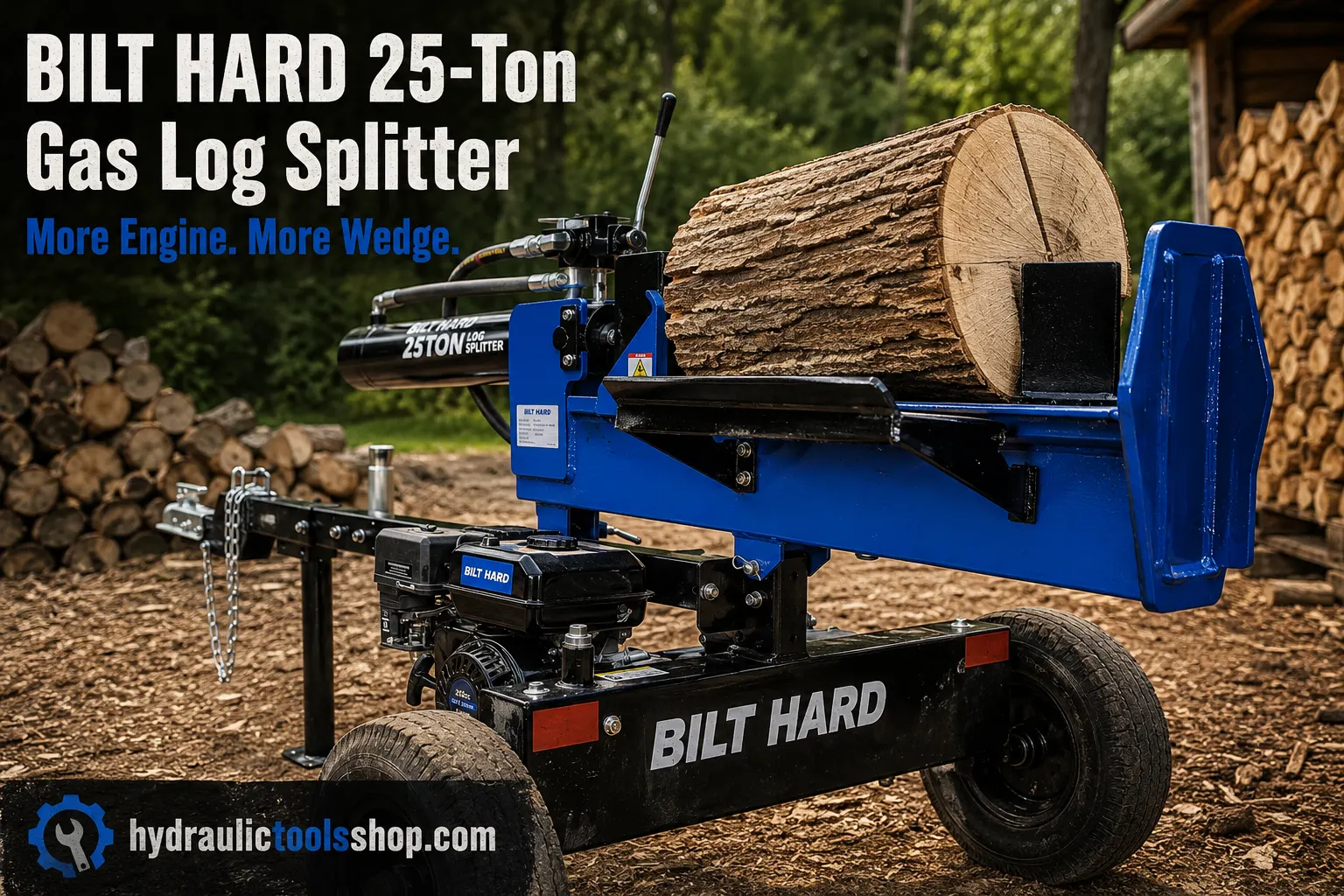
BILT HARD 25-Ton Gas Log Splitter Review: More Engine, More Wedge, More Money
BILT HARD, 25 Ton, gas OHV engine, horizontal and vertical, around $1,399
The BILT HARD 25-ton costs roughly $306 more than the SuperHandy at the same stated tonnage. What does that premium buy? A larger engine, a 9.6 ft-lb torque rating, and an 8-inch hardened steel wedge that is wider than most alternatives in this class. The trade-off is a slower cycle: 17 seconds versus 12 on the SuperHandy. This review looks at whether those differences justify the price gap for home firewood producers who have already narrowed to 25-ton gas.
The one question this review answers:
- You have decided on a 25-ton gas splitter. The SuperHandy is cheaper. The BILT HARD asks for more. Is the extra money worth it, and what specifically does it buy?
Score based on splitting capacity for intended use, ease of operation, value for money, owner feedback patterns, and long-term reliability signals. Editorial rating, not lab testing.
What the Premium Actually Buys
Comparing two 25-ton gas splitters at different price points comes down to what the extra money actually gets you in practice, not what the spec sheet implies.
Larger engine: the BILT HARD carries a bigger OHV gas engine than the SuperHandy’s 7HP unit, with a 9.6 ft-lb torque rating. Under normal residential firewood splitting conditions the difference is unlikely to be dramatic, since both machines are rated to the same 25-ton splitting force. Where extra engine headroom may matter: sustained high-volume sessions where heat buildup and continuous load affect smaller engines more than larger ones.
Wider wedge: 8 inches of hardened steel versus the SuperHandy’s standard wedge. A wider wedge makes contact across a larger surface area of the log at once. On knotty or irregular grain this can reduce the number of passes needed to complete a split compared to a narrower wedge at the same force rating.
Slower cycle: 17 seconds versus the SuperHandy’s 12. This is the one spec where the BILT HARD sits directly behind the SuperHandy at a higher price. Over a full splitting session, the longer cycle adds up. Whether it matters depends on how you split. Casual homeowners spending time positioning logs between cycles may not notice. High-volume producers running the machine continuously will.
Watch It Work
What to Watch For
Pay attention to how the 8-inch wedge behaves on knotty or large diameter rounds. The wider contact surface is visible in action, and the difference from a narrower wedge is clearest on difficult pieces rather than clean straight-grained softwood.
Watch the vertical operation setup. The BILT HARD converts between horizontal and vertical in the field. The video shows the process and how stable the machine is in vertical mode on different ground surfaces.
Note the engine sound under sustained load. The gas OHV engine has a distinctly heavier note than the 7HP unit in the SuperHandy, a useful audio reference if noise level in your splitting location is a consideration.
Specs at a Glance
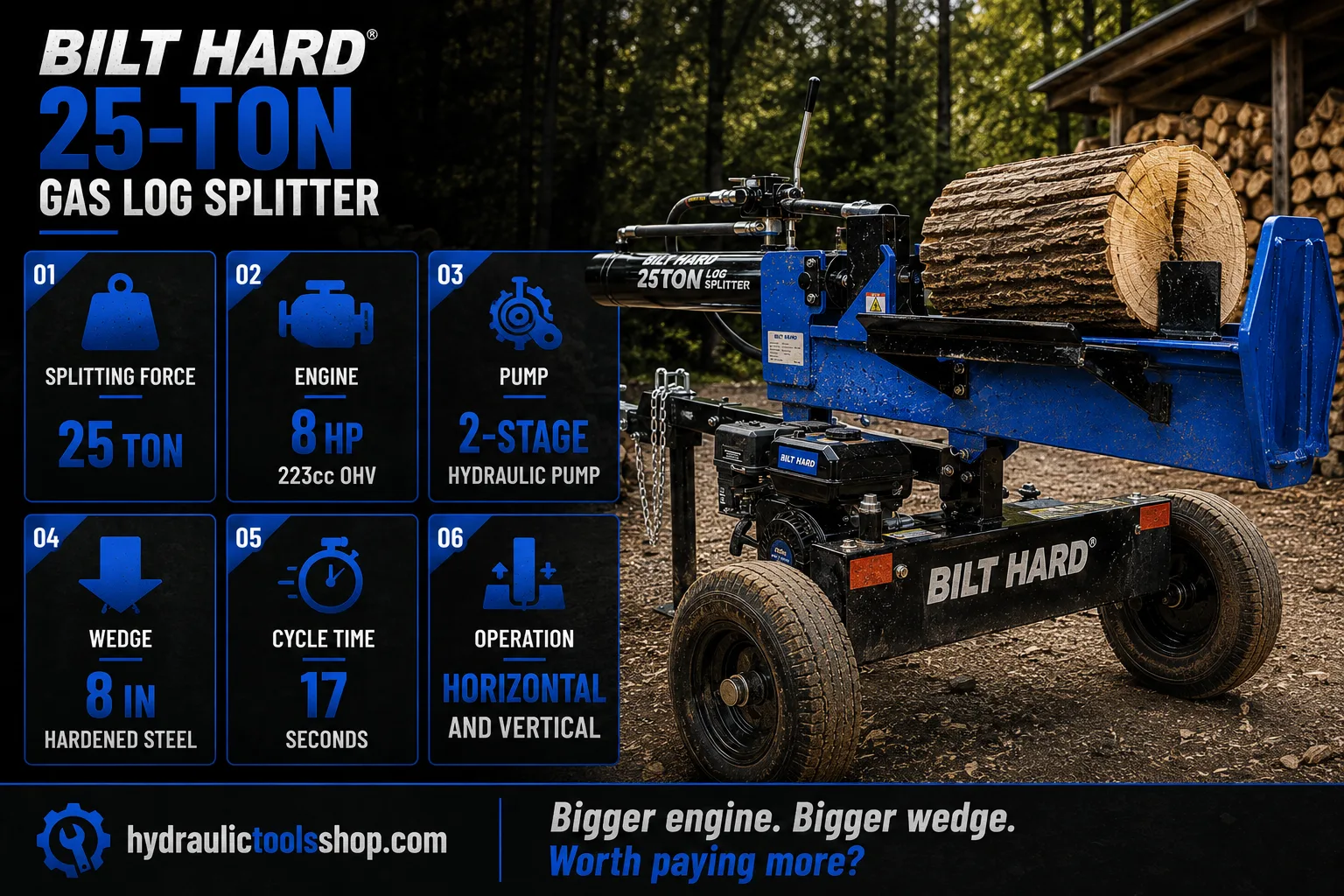
| Splitting Force | Manufacturer-rated 25 ton |
| Engine | OHV 4-stroke gas (verify HP/cc on listing) |
| Torque | 9.6 ft-lb |
| Wedge | 8-inch hardened steel |
| Cycle Time | Approx. 17 seconds |
| Operation | Horizontal and vertical |
| Price | Check current price |
Amazon Associate link
The 8-Inch Wedge, and Why Width Matters
Most gas log splitters in the 20 to 25-ton range use wedges in the 5 to 7-inch range. The BILT HARD uses an 8-inch hardened steel wedge, wider than most alternatives at this price point.
A wider wedge spreads force across more of the log’s cross-section at once. On straight-grained wood this makes little practical difference, since the log splits along the grain regardless of wedge width. On knotty, irregular, or interlocked grain, where a narrower wedge tends to follow the path of least resistance rather than driving cleanly through the whole piece, a wider wedge may help reduce the number of passes needed, though results depend on the specific wood.
The Engine, Torque, and What They Mean
The BILT HARD uses an OHV 4-stroke gas engine. The 9.6 ft-lb torque rating is the more relevant number for splitting work, because torque determines pulling power through sustained resistance, which is what happens when the wedge meets a dense or knotty round.
Under light to moderate splitting loads the difference between comparable engines is unlikely to be obvious in practice. Where additional displacement may show: sustained sessions where the engine runs continuously for extended periods, or particularly resistant wood that keeps the hydraulic system under high pressure for longer than a clean split requires.
Scorecard
Pros and Cons
What Works
- Gas OHV engine with more displacement than several 25-ton competitors
- 9.6 ft-lb torque, relevant for sustained high-resistance splitting
- 8-inch hardened wedge, wider contact for knotty and irregular grain
- Horizontal and vertical operation for large rounds without heavy lifting
- Larger engine and wider wedge than some similarly rated alternatives in this price range
- Same 25-ton rated capacity as cheaper alternatives, with more engine headroom
What to Watch
- 17-second cycle, slower than the SuperHandy at a lower price
- Premium price in the 25-ton category
- Gas engine maintenance required: oil changes, filter checks, seasonal prep
- Loud, not for close suburban settings or noise-sensitive locations
- Needs ventilation, cannot operate in an enclosed garage
- Owner feedback base is more limited than electric alternatives
Gas splitter prices shift with demand. Confirm current stock before deciding.
Check Current Price See all log splittersBILT HARD 25-Ton vs SuperHandy 25-Ton, Side by Side
| Feature | BILT HARD 25-ton | SuperHandy 25-ton |
|---|---|---|
| Price | Higher | Lower |
| Engine | Larger OHV gas | 7HP AlphaWorks |
| Torque | 9.6 ft-lb | Not stated |
| Wedge | 8-inch hardened steel | Standard steel wedge |
| Cycle time | Approx. 17 seconds | Approx. 12 seconds |
| Splitting force | 25 ton rated | 25 ton rated |
| Vertical operation | Yes | Yes |
| Our score | 8.3 | 8.6 |
On pure value the SuperHandy scores higher: faster cycle, lower price, same rated tonnage. The BILT HARD’s case rests on the wider wedge and the larger engine for buyers who specifically need those attributes. For high-volume splitting of knotty dense hardwood where the wider wedge reduces passes per log, the premium may pay back over time. For most home firewood producers splitting mixed wood on an occasional schedule, the SuperHandy covers the need at a more proportionate price.
What Owners Report
Owner feedback for the BILT HARD 25-ton is more limited than the electric alternatives in this category, since a higher price point naturally produces a smaller buyer base. What is documented is broadly positive for the intended use case.
Documented owner feedback from buyers splitting dense hardwood such as oak, hickory, and large knotty rounds is generally favourable on the wider wedge, particularly on difficult pieces. The engine is commonly described as smooth and consistent under sustained load. No recurring reliability pattern stood out in the owner feedback reviewed, though the sample is smaller than for higher-volume products.
Frequently Asked Questions
Sources and transparency: specifications verified against the BILT HARD Amazon product listing. Owner report analysis based on aggregated verified purchase reviews. Performance assessments based on published capacity specifications and mechanic network feedback, not controlled lab testing. Amazon Associate link used; commissions support this site at no extra cost to you. No payment received from BILT HARD.
Reviewed for HydraulicToolsShop.com by Hank Miller. Updated using owner feedback, product spec changes, and market comparisons. Questions or experience to share: reach Hank via the contact page.

20+ Years, Hydraulics and Heavy Equipment
Hank Miller
Born in Ohio’s Rust Belt. Two decades fixing trucks and heavy gear taught me one thing: good tools keep you safe, bad ones cost you time. I dig into owner data and make the call so you know exactly what you are buying. Read Hank’s full story.