
Last updated: May 2026
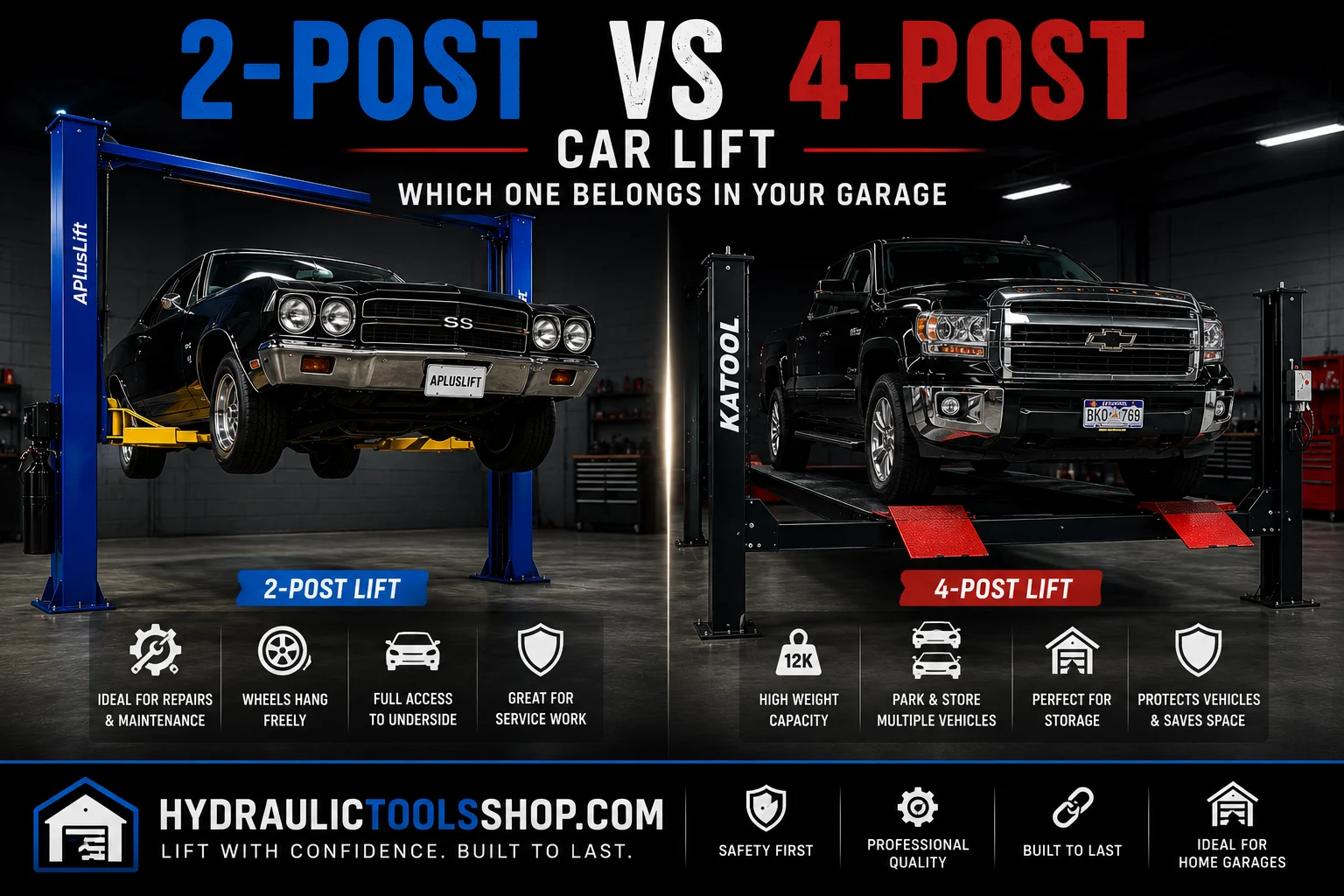
2-Post vs 4-Post Car Lift: Which One Actually Belongs in Your Garage
Car Lift Comparison • 2-Post vs 4-Post • Home Garage • Hank Miller
Here is a mistake Hank has watched home mechanics make more than once. They buy a 2-post lift because that is what the shops use. It arrives. They start installation. Then they discover the ceiling is 11 feet — and the lift needs 12. Or the concrete is 3 inches thick. Or there is no 220V circuit. Three thousand dollars sitting on a pallet, going back. The other version of the mistake: they buy a 4-post because it was simpler, then spend the next two years fighting their way around a platform to reach the transmission they need to drop. Both mistakes come from the same source — not understanding what separates these two lift types before spending the money. This post fixes that.
Choose a 2-Post if:
- You need full wheel-free undercar access
- Suspension, transmission, or drivetrain work is on the list
- Your ceiling is 12 feet or higher
- You have or can run a 220V circuit
- Vehicle storage is not a priority
Choose a 4-Post if:
- You want to park a second vehicle above the first
- Oil changes and basic maintenance cover most of your work
- Your ceiling is under 12 feet for your specific vehicles
- You do not have 220V and want to avoid the install cost
- Drive-on simplicity matters — no lift point knowledge needed
The Core Difference — It Is Not About Price
At first glance these two lift types compete on price. A quality home garage 2-post runs $1,900 to $2,600. A quality 4-post runs $2,800 to $3,800. The price difference is real but it is not the reason to choose one over the other.
The core difference is what happens to the wheels.
On a 2-post lift, the vehicle rises by its frame. The wheels hang free. The entire undercarriage — brakes, suspension, axles, transmission, exhaust — is fully accessible from every angle with nothing blocking the view or the reach. This is how professional shops work because it is the only configuration that makes certain jobs physically possible without extreme difficulty.
On a 4-post lift, the vehicle drives onto a platform and rises on its tyres. The wheels stay on the platform. The tyres, brake rotors, calipers, and lower suspension are partially or fully blocked by the platform structure. Oil changes, exhaust work, and inspections are accessible. Brake jobs and suspension work require repositioning or a rolling bridge jack add-on. Transmission drops are not practical without that add-on.
Ceiling Height — The Number That Eliminates Options
Before any other consideration, ceiling height determines which lift types are physically possible in your garage. This is where most buyers who end up with the wrong lift went wrong first.
The formula for any lift is the same: lift maximum height plus vehicle roof height plus 6 inches of safety buffer equals the minimum ceiling you need.
A 2-post lift like the APlusLift HW-10KOH-A reaches 72 inches of maximum height. Add a standard sedan at 56 inches plus 6 inches of buffer — you need approximately 134 inches, or just over 11 feet. For a taller SUV or truck the ceiling requirement increases. For tall trucks, 13 to 14 feet becomes necessary. Many installers recommend a minimum of 12 feet for a 2-post in a home garage to cover the range of vehicles most mechanics work on.
A 4-post lift like the KATOOL reaches 84.5 inches maximum height. The same calculation with a standard sedan pushes the ceiling requirement to approximately 12 feet as well. The 4-post’s ceiling flexibility shows most clearly with shorter vehicles, lower working height usage, and storage scenarios where the vehicle does not need to be raised to full working height every time.
Undercar Access — What Each Type Actually Gives You
This is where the real difference lives day to day.
On a 2-post lift, the vehicle is supported by four swing arm pads contacting the frame or pinch weld points. Everything below those contact points hangs completely free. You can stand under the vehicle and rotate the brake rotor with one hand. You can remove the rear differential with the vehicle at comfortable working height. The transmission crossmember is accessible from directly below without any platform in the way. This is the configuration that makes professional-speed service work possible.
On a 4-post lift, the vehicle sits on its tyres on two drive-on runways. The runways occupy the space between the front and rear tyres on each side. Oil changes are accessible — the drain plug and filter are reachable through the runway gaps. Basic exhaust work is accessible depending on the vehicle geometry. Brake work is more complicated — the caliper and rotor are partially blocked by the tyre sitting on the platform. A rolling bridge jack that lifts the vehicle off the platform restores full wheel-free access but adds cost and setup time.
Power Requirements — The Cost Nobody Budgets For
Most 2-post lifts at the home garage price point require a dedicated 220V single-phase circuit. If your garage does not have 220V, budget $200 to $600 for a licensed electrician before the lift arrives. This cost is not included in the lift price and catches buyers who focus on the purchase price without reading the installation requirements.
The KATOOL 4-post runs on 110V standard household current in its base configuration — a meaningful practical advantage for garages that do not have 220V. Verify your existing circuit can handle the load before connecting. An optional 220V unit is available separately for faster cycle times.
The APlusLift HW-10KOH-A requires 220V. No 110V option exists for this model. If the electrical work is already done or budgeted, this is not a deciding factor. If it is not, it adds real cost to the 2-post side of the comparison.
Vehicle Storage — The 4-Post’s Unique Advantage
A 4-post lift can double your garage’s vehicle capacity. Park one vehicle on the platform at working height. Park a second vehicle on the garage floor below. No construction, no renovation — just the lift and the vehicles.
For a two-car household with a one-car garage, or for anyone storing a project car, seasonal vehicle, or motorcycle collection, this alone justifies the 4-post regardless of the service work trade-offs. A 2-post lift provides no storage capability — the swing arms and open column design are not configured for long-term vehicle storage.
Full Comparison Table
| Feature | 2-Post Lift | 4-Post Lift | Edge |
|---|---|---|---|
| Undercar access | Full — wheels hanging free | Partial — tyres on platform | 2-Post wins |
| Vehicle storage | No | Yes — stack two cars | 4-Post wins |
| Ceiling requirement | 12 ft min recommended | Depends on vehicle — generally more flexible | 4-Post wins |
| Power requirement | 220V dedicated | 110V standard or 220V optional | 4-Post wins |
| Ease of use | Requires lift point knowledge | Drive on — no lift point knowledge needed | 4-Post wins |
| Transmission work | Fully accessible | Not without rolling bridge jack add-on | 2-Post wins |
| Suspension work | Fully accessible | Limited without add-on | 2-Post wins |
| Brake work | Full wheel-off access | Partially blocked by platform | 2-Post wins |
| Oil changes | Accessible | Accessible through runway gaps | Tie |
| Floor anchoring | Required — concrete spec applies | Required — concrete spec applies | Tie |
| Delivery | Forklift required | Forklift required | Tie |
| Price range | $1,900 to $2,600 | $2,800 to $3,800 | 2-Post wins on price |
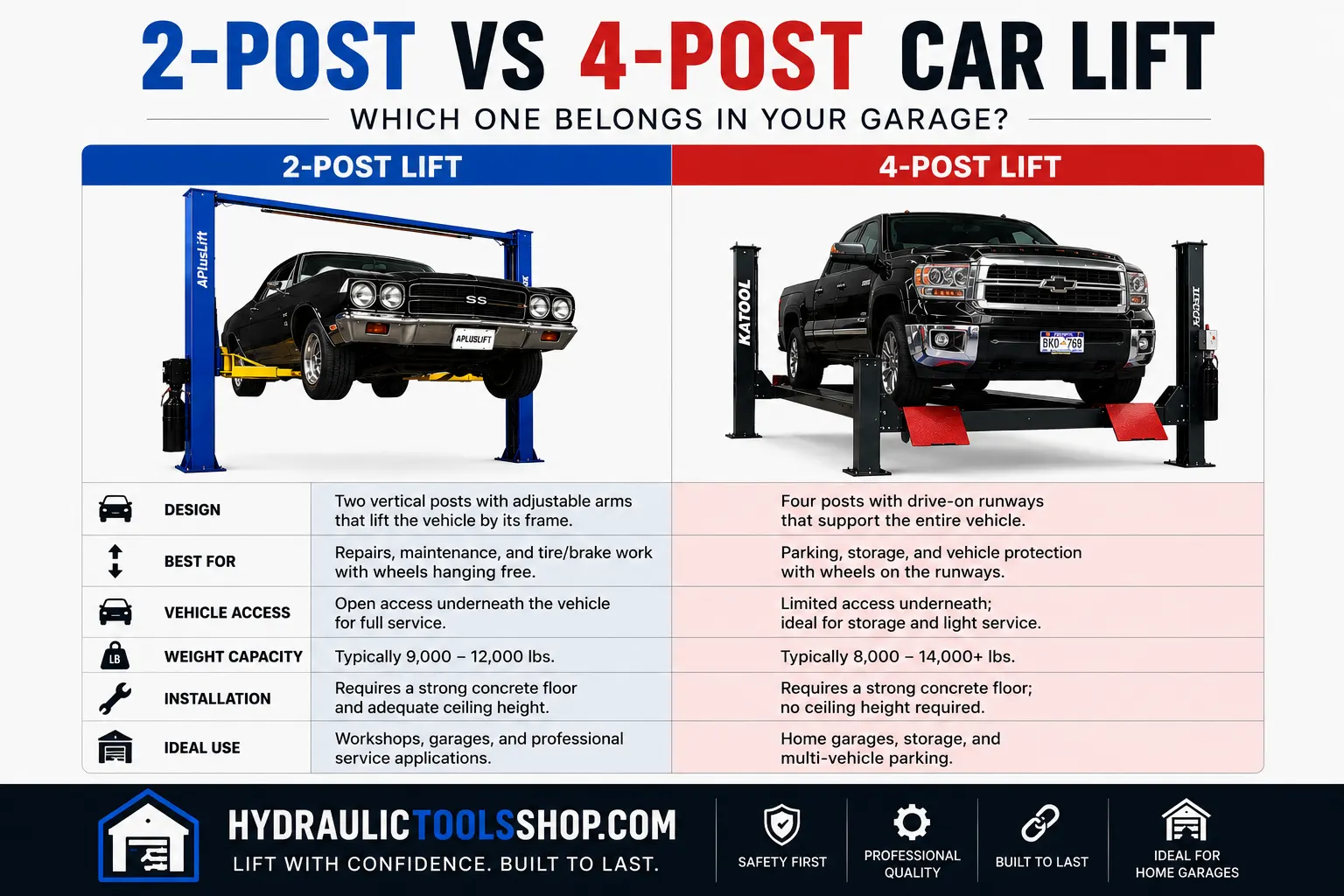
Visual Comparison
Which Lift Wins — By Specific Scenario
Go 2-Post if this is you:
- You do your own brake jobs, suspension work, or transmission service
- Your ceiling is 12 feet or higher and 220V is available or budgeted
- You work on one vehicle primarily and storage is not a concern
- You want the fastest, cleanest access to every part of the undercarriage
- You are comfortable with lift point positioning — or willing to learn
Go 4-Post if this is you:
- Storing a second vehicle or a project car is the primary goal
- Oil changes, inspections, and exhaust cover most of your work
- Your ceiling does not accommodate a 2-post for the vehicles you drive
- You do not have 220V and want to avoid the electrician cost
- You want drive-on simplicity — no learning curve on lift points
Safety Differences Between the Two Types
The safety considerations are different — not more or less safe, just different.
Hank’s Specific Recommendations
For the 2-post category at the home garage price point, the APlusLift HW-10KOH-A is the specific model worth considering. Ten thousand pounds, ALI certified, 3-year warranty, 329 owner reviews. The strongest combination of verified capacity and owner-validated performance in this price range based on available data.
For the 4-post category, the KATOOL 4-post covers 11,000 lbs, runs on 110V standard power, and includes a double-lock safety system — primary and secondary locks at all four posts — that goes beyond what single-lock alternatives at similar prices provide.
If neither permanent option fits your garage — ceiling too low, concrete too thin, or a rental situation — the VEVOR 7,000 LBS portable works in standard 8 to 9 foot ceilings on 120V with no floor anchoring required.
APlusLift HW-10KOH-A
10,000 lbs. ALI certified. 3-year warranty. Full wheel-free access.
Check Price on Amazon Read Full Review →Amazon Associate link
KATOOL 4-Post Lift
11,000 lbs. 110V standard. Double-lock system. Vehicle storage.
Check Price on Amazon Read Full Review →Amazon Associate link
Frequently Asked Questions
Sources and transparency: This comparison is based on manufacturer specifications for the APlusLift HW-10KOH-A and KATOOL 4-post lift, verified against product listings; mechanic network feedback; and aggregated owner reports across both products — not controlled lab testing. Safety guidance cross-referenced against OSHA vehicle lifting standards and ALI vehicle lift safety guidelines. Amazon Associate links used — commissions support this site at no cost to you.

Hank Miller
Born in Ohio’s Rust Belt. Over 20 years fixing trucks and heavy gear taught me one thing: good tools keep you safe, bad ones cost fingers. I gather intel from fellow mechanics, dig into owner data, and make the call so you know exactly what you are buying before it goes in your bay. Read Hank’s full story.