
Last updated: May 2026
This page contains affiliate links. As an Amazon Associate, HydraulicToolsShop.com earns from qualifying purchases at no extra cost to you.
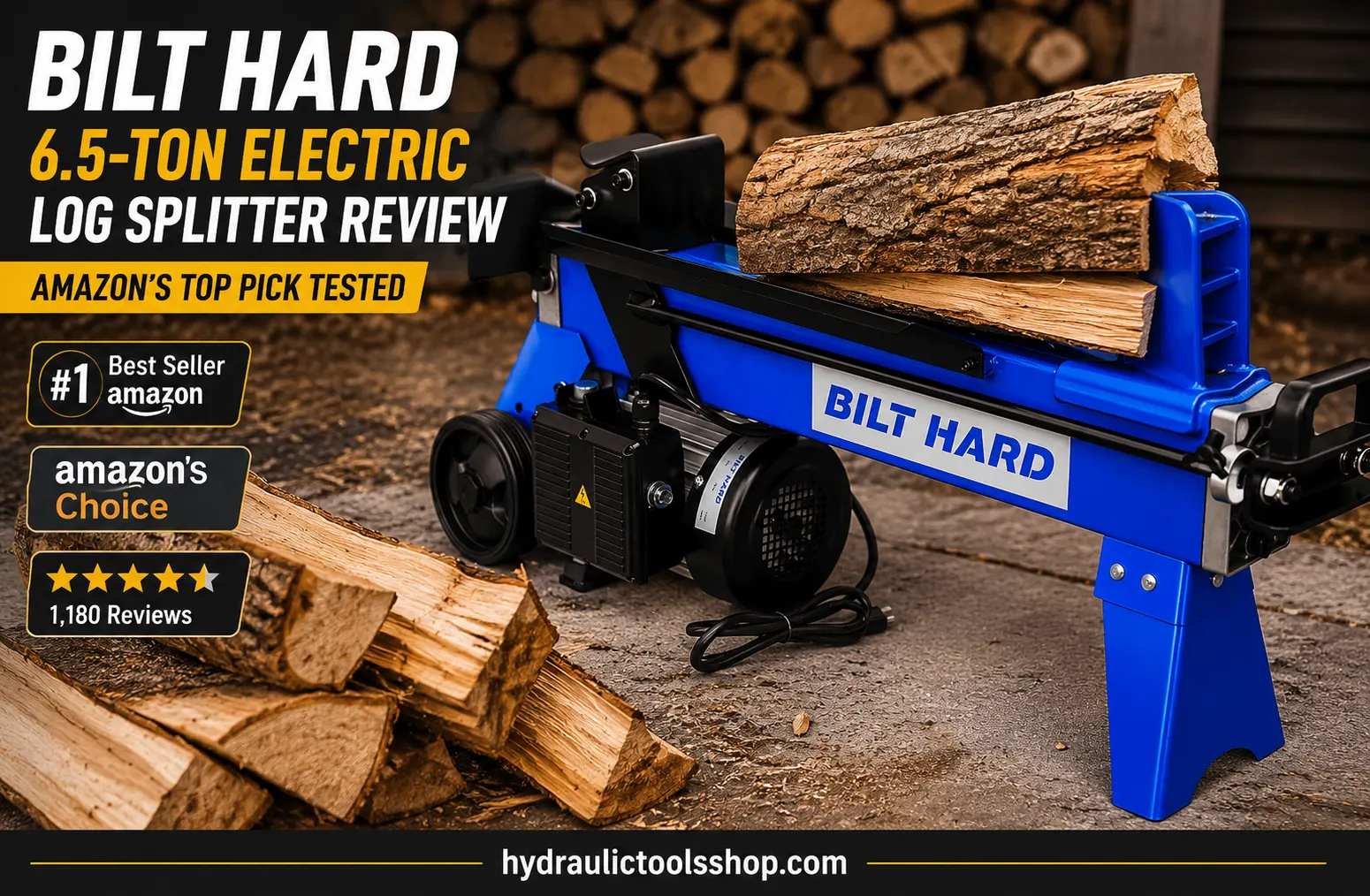
BILT HARD 6.5-Ton Electric Log Splitter Review: Enough Power?
BILT HARD, 6.5 Ton, 120V electric, Amazon #1 Best Seller in Power Log Splitters
The BILT HARD 6.5-Ton Electric Log Splitter is the number one seller in its category, quiet, plug-in, no fuel and no pull cord. The obvious worry is the tonnage. Does 6.5 tons handle real firewood? The honest answer from more than 1,300 owner reviews is that it does far more than the number suggests on seasoned wood, and the limits that actually bite are the log size cap and two-hand operation, not a hard wall at hardwood. Here is what it splits, where it stops, and who should buy it.
Hank’s score is an editorial rating based on five factors: splitting capacity for intended use, ease of operation, value for money, owner feedback patterns, and long-term reliability signals from available data. Not lab testing.
The case for it: Amazon’s number one best seller in Power Log Splitters, and the owner pattern explains why. Quiet, fume-free, no pull cord, no fuel to mix, plug into a household outlet and split. On seasoned wood it punches well above its 6.5-ton rating. Owners regularly report clearing oak, maple, and walnut in the 16 to 20-inch range, with the standard trick of rotating a knotty round 90 degrees and running it again. The 18-second cycle is a fine rhythm for home firewood volumes.
The honest limits: two of them, and neither is a blanket “no” on hardwood. First, the 20.5-inch length cap means long logs get cut down before they fit. Second, the two-hand press-bar-and-lever control means you cannot steady a big awkward round while it splits, which makes the largest pieces fiddly. Green, unseasoned wood is where the tonnage genuinely runs out. Season your wood, keep logs under the length cap, and this machine does more than its number promises.
See It in Action
What to Watch For
Watch how owners handle a knot. The consistent technique across reviews is to stop, rotate the piece 90 degrees, and run it again rather than forcing the wedge straight through. That single habit is why this machine clears wood its tonnage says it should not.
Note the two-hand control. You press a button and the operating arm at the same time, which is a real safety feature but means you cannot hold the log steady during a split. On big or oddly shaped rounds that matters more than the tonnage.
Look at the bleed screw step. Before first use it must be loosened so air can move in and out of the oil tank, then retightened before you move the machine. Skip it and the ram runs sluggish on the first cycles.
Full Specs
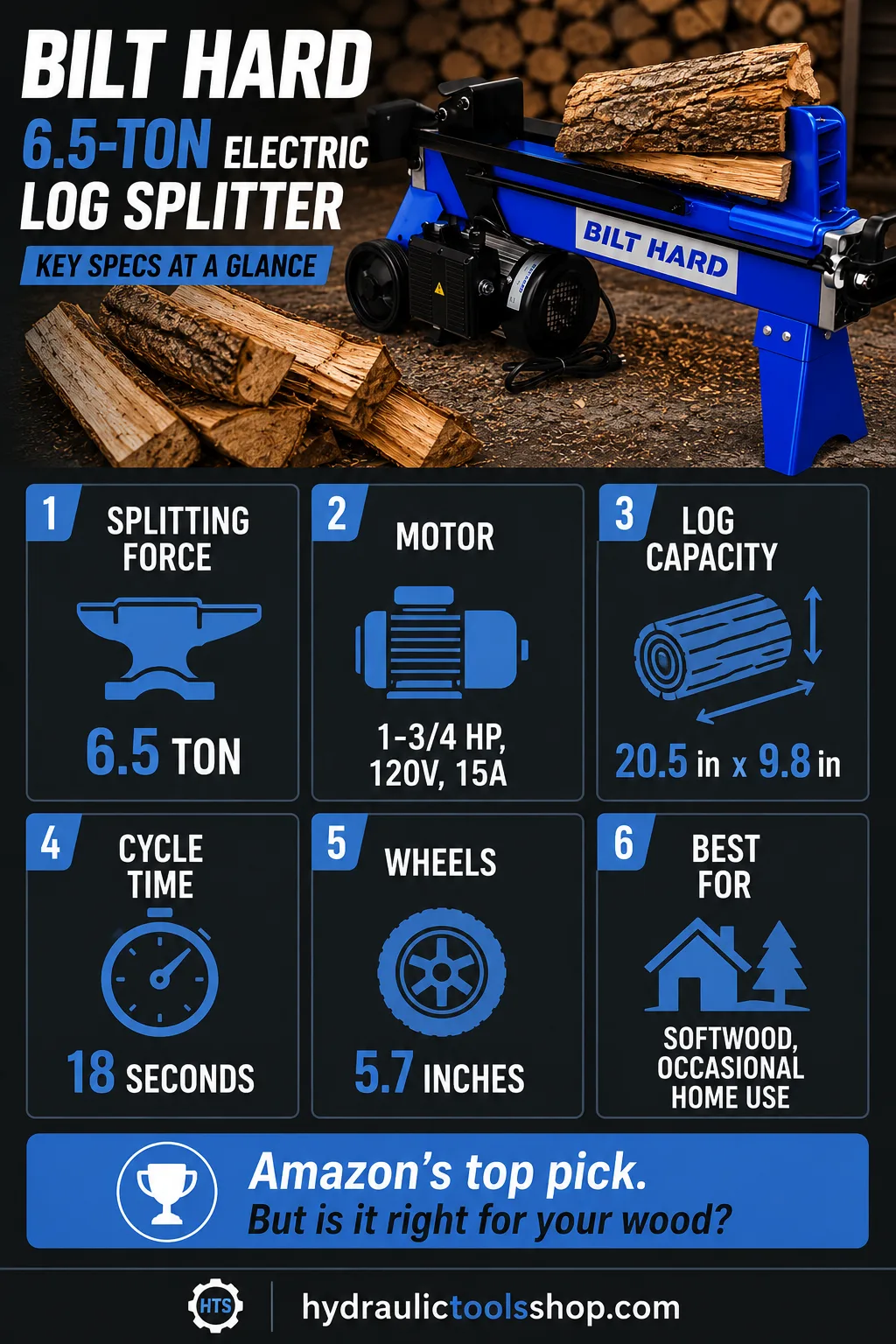
| Splitting Force | 6.5 ton |
| Motor | 1-3/4 HP, 120V, 15A, 60Hz |
| Motor Speed | 3,400 RPM no-load |
| Log Capacity | 20.5 in length x 9.8 in diameter |
| Cycle Time | Approx. 18 seconds |
| Wheels | 5.7 inches |
| Hydraulic Oil | 3.5 litres |
| Dimensions / Weight | 36.4 x 10.4 x 18.3 in, 98 lbs |
| Power Source | 120V household outlet |
| Warranty | 90 days (per listing) |
| Best For | Seasoned softwood and hardwood, occasional home use |
| Price | Check current price |
Prime shipping available
Amazon Associate link
What It Actually Splits
The 6.5-Ton Number vs What Owners Report
Seasoned softwood up to 9.8 inches splits cleanly with a steady rhythm, exactly what you would expect. The surprise is hardwood: owner reviews consistently describe clearing seasoned oak, maple, and walnut well beyond what 6.5 tons “should” manage.
The reason is technique, not raw force. On a knot, owners stop, rotate the piece 90 degrees, and run it again. Reviewers report that habit working on the large majority of pieces, with only the occasional giant knotted round refusing to go.
Where it genuinely runs out: green, unseasoned wood, and rounds longer than the 20.5-inch bed. Season the wood and trim to length and the tonnage is rarely the bottleneck. For dense green hardwood at volume, a gas unit is still the right tool. See the log splitter category for the full breakdown by wood type.
Who This Splitter Is Actually For
The right buyer is a homeowner processing a manageable volume of seasoned firewood who wants quiet, low-maintenance operation. Owners burning wood to heat a house or workshop, splitting a few cords a season, are the ones leaving the strongest reviews. If your wood is cut and stacked to dry, and your rounds fit the bed, this machine handles a mix of softwood and hardwood that its tonnage rating would not lead you to expect.
It also suits anyone re-splitting bought firewood into smaller stove or kindling pieces, a common use owners mention, where the work is light and the quiet electric operation is a real advantage over a gas unit in a garage or suburban yard.
Performance Scorecard
Pros and Cons
What Works
- Amazon #1 best seller in Power Log Splitters, with a deep and consistent review base
- Splits seasoned hardwood well beyond what 6.5 tons suggests, using the rotate-on-knots technique
- 120V plug-in, no fuel, no emissions, much quieter than gas
- Easy startup, no pull cord, no choke, no fuel mixing
- 18-second cycle, a steady rhythm for home firewood volumes
- Portable on 5.7-inch wheels at 98 lbs assembled
What to Watch
- 20.5-inch length cap, longer logs must be cut down first
- Two-hand control means you cannot steady an awkward round while splitting
- Green, unseasoned wood is where 6.5 tons genuinely runs out
- 90-day warranty, short for hydraulic equipment
- Best on a dedicated circuit, a 40-amp breaker is recommended and a heavy drop cord matters
- Heavy box, over 100 lbs shipped, a helper is useful for assembly
Price changes frequently on this model. Check before reading on.
Check Current Price See all log splittersHow It Compares to the Alternatives
| Splitter | Tons | Power | Log Max | Cycle | Best for |
|---|---|---|---|---|---|
| BILT HARD 6.5-ton | 6.5 | 120V | 9.8 in | 18 sec | Seasoned home firewood |
| WEN 56208 6.5-ton | 6.5 | 120V | See review | See review | Softwood, closest rival |
| Sun Joe LJ10M 10-ton | 10 | Manual | See review | Manual | Light manual splitting |
| SuperHandy 25-ton Gas | 25 | Gas | See review | Approx. 12 sec | Green and dense hardwood |
The WEN 56208 is the closest direct rival, another 6.5-ton 120V electric unit, and the two perform similarly on softwood; see the individual reviews for the current spec and price on each. If you need to handle green wood or large volumes, the SuperHandy 25-ton gas is the appropriate step up at a much higher price and with the noise and maintenance that come with gas.
What Owners Report
With more than 1,300 ratings at a 4.6-star average, the owner pattern is deep and consistent. The recurring theme is that the machine outperforms its tonnage on seasoned wood. Multiple verified buyers describe splitting 16 to 20-inch oak, maple, and walnut, with one noting it “easily split 95 percent of what I had to split” and another clearing a knotty seasoned locust “with relative ease” after repositioning the tough rounds.
The most common practical notes are the two-hand operation making large pieces awkward to steady, the assembly being easier with a helper given the heavy box, and the value being strong for the category. The recurring caution is the 90-day warranty. Owners splitting green wood or oversized rounds are the ones who find the limits, which lines up with the spec rather than contradicting it.
Frequently Asked Questions
Sources and transparency: specifications verified against the live BILT HARD Amazon product listing (ASIN B09B75R66Q) and its published User Manual. Owner report analysis based on aggregated verified purchase reviews. Performance assessments based on published capacity specifications, documented owner feedback, and mechanic network experience, not controlled lab testing. Amazon Associate link used, commissions support this site at no extra cost to you. No payment received from BILT HARD.
Reviewed for HydraulicToolsShop.com by Hank Miller. Updated using owner feedback, product spec changes, and market comparisons. If you have used this machine and want to share your experience, Hank reads every message via the contact page.

20+ Years, Hydraulics and Heavy Equipment
Hank Miller
Born in Ohio’s Rust Belt. Two decades fixing trucks and heavy gear taught me one thing: good tools keep you safe, bad ones cost you time. I dig into owner data and make the call so you know exactly what you are buying. Read Hank’s full story.