Best Heavy-Duty Log Splitters: 40 Tons and Up
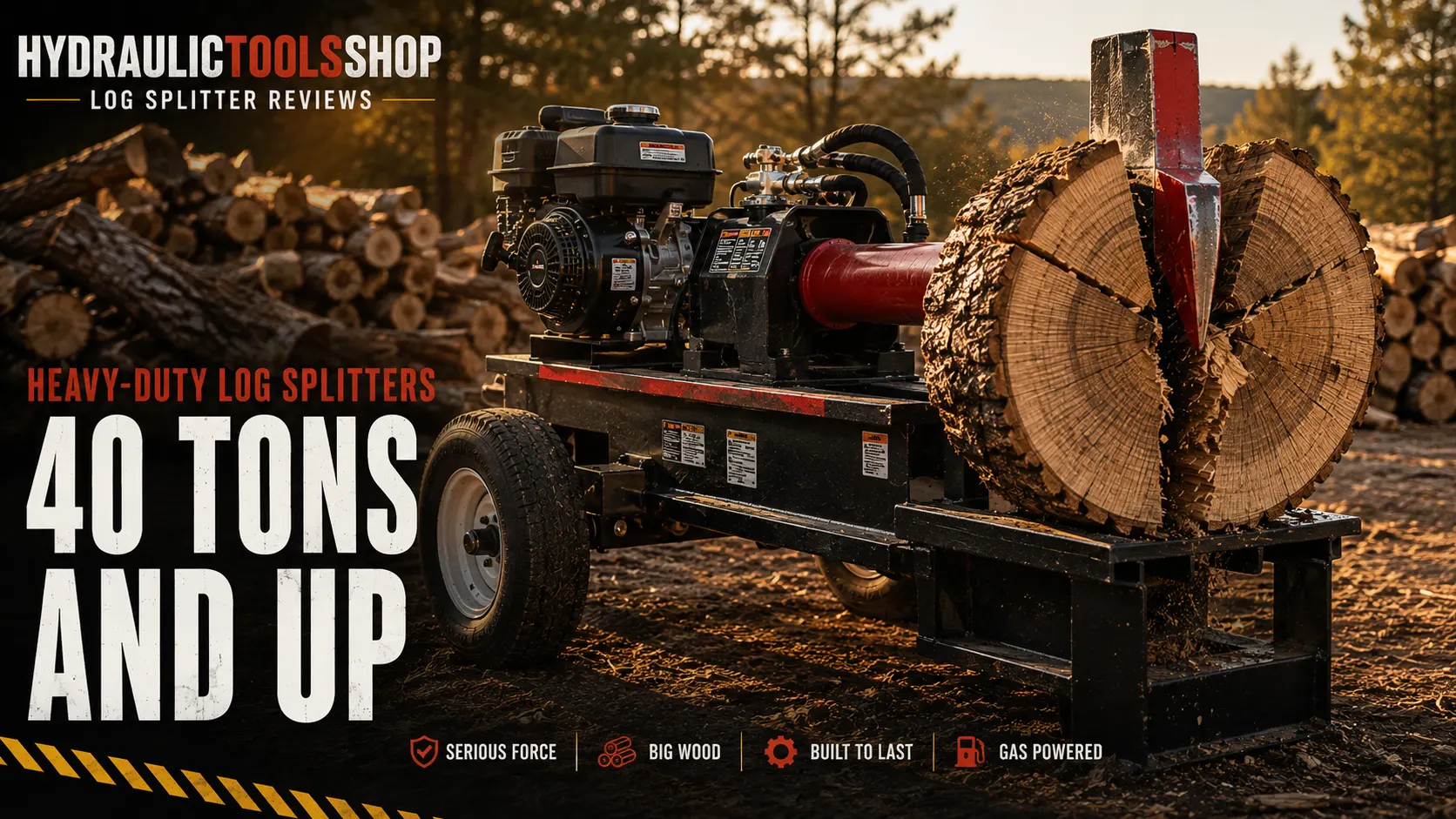
A 40-ton log splitter is not automatically the right choice just because it has more force. For many homeowners, 20 to 30 tons is already enough for seasoned firewood, and buying bigger mostly adds cost and weight you will not use. The 40-ton-and-up class makes sense when large rounds, difficult hardwood, heavy seasonal workloads, or repeated all-day splitting are pushing a smaller machine to its limits. If that describes your wood pile, read on. If it does not, you are better served a tier down, and we point you there below.
So the real question at this level is not whether more power is better. It is whether you have a throughput problem that a 40-ton machine actually solves. Buying one because “bigger is safer” wastes money on capacity you cannot feed. Buying one because you process oversized, gnarly, or high-volume hardwood is exactly the right call. Below are the machines that make the most sense at this level, split across hydraulic and kinetic drive, plus an honest look at when stepping up to a 45-ton commercial processor is worth it and when it is not.
Is 40 Tons Overkill? What This Tier Actually Buys You
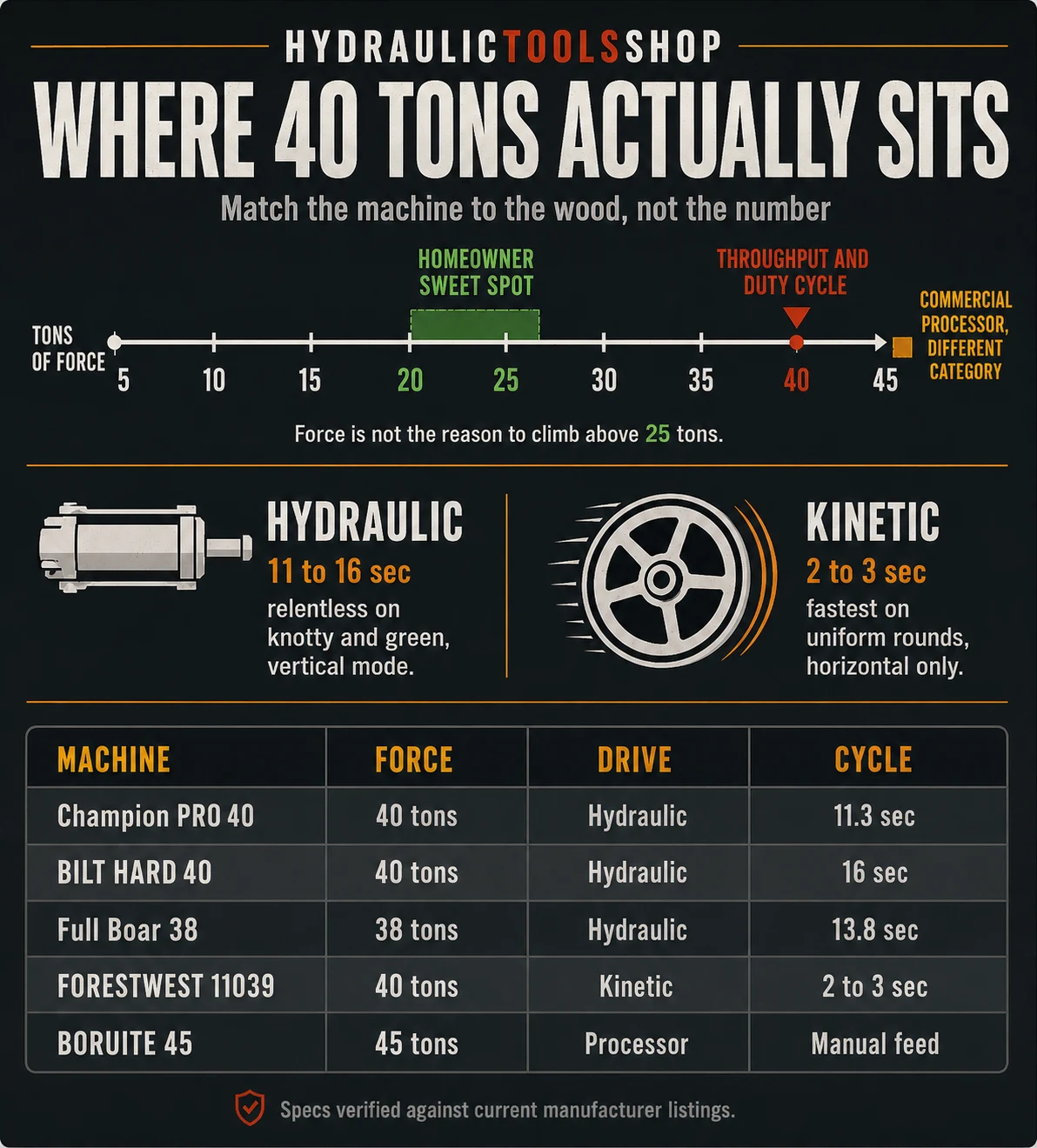
Force is the wrong lens above 25 tons. Most homeowners will never need 40 tons of splitting force for their normal firewood. What changes as you climb from 25 tons into this class is not raw power on a single round, it is the machine underneath the ram: a bigger frame, a larger pump, a heavier beam, and the duty cycle to run for hours without heat-soaking. In plain terms, a heavy-duty machine at this level is built to keep going, not to hit harder.
Three real reasons to be on this page:
- Oversized rounds. Diameters in the 24 to 30-inch range that make a residential splitter stall or ride up the log. A properly sized full-beam machine in this class gives you considerably more margin on oversized rounds.
- Gnarly and green wood. Elm, knotty oak, twisted crotch pieces, and freshly cut green stock that hold together and shrug off lighter machines. High force with a slow, relentless hydraulic push wins here.
- Volume. You are not splitting a face cord for the weekend, you are processing multiple cords a season, or selling firewood. Now cycle time and duty cycle decide your day.
If none of those describe you, the honest answer is to spend less and buy down a tier. We cover that tradeoff in what size log splitter do you need, and the tier most large properties actually land on is covered in our best 30-ton log splitters roundup.
The Lineup at a Glance
Prices move constantly at this tier and depend on freight, so we do not hard-code them here. What is stable is the hardware. Compare the machines on drive type and throughput first, because that is what separates them far more than the tonnage number.
| Machine | Force | Drive | Engine | Cycle | Orientation | Max log | Weight | Best for |
|---|---|---|---|---|---|---|---|---|
| Champion PRO 40 | 40 tons | Hydraulic, 2-stage, 24.7 gpm | 338cc OHV | 11.3 sec | Horizontal / vertical | 24 in, 100 lb | 767 lb | Supported commercial-grade work |
| BILT HARD 40 | 40 tons | Hydraulic, 2-stage, 14 gpm | 389cc, 13 hp OHV | 16 sec | Horizontal / vertical | 24 in | 555 lb | Most engine for the money |
| Full Boar 38 | 38 tons | Hydraulic H-beam | 306cc OHV | 13.8 sec | Vertical / horizontal pivot | 24 in | 514 lb | Budget pick with fast hydraulic cycle |
| FORESTWEST 11039 | 40 tons | Kinetic flywheel | 7 hp petrol | 2 to 3 sec | Horizontal only | 24 in dia, 26 in long | 490 lb | Speed on uniform pre-cut rounds |
| BORUITE 45 | 45 tons | Hydraulic processor, chainsaw + conveyor | 20 hp GX630 | Manual feed | Processor | 19.6 in cut | 3,000 lb | Small commercial operations |
Note on cycle time: the FORESTWEST kinetic is by far the fastest here on paper. Among the hydraulics, the Champion is quickest at 11.3 seconds, the Full Boar next, and the BILT HARD slowest. More on what that actually means for your day in the drive-type section below.
The Machines Worth Considering
Champion PRO 40-Ton
This is the machine to buy if you want a warrantied, commercial-grade unit backed by a real US service network rather than a nameless third-party seller. The 338cc engine, 2-stage gear pump, and 24.7 gpm flow give it the fastest hydraulic cycle in this group at 11.3 seconds, and the full horizontal-to-vertical conversion plus dual log catchers make oversized rounds manageable without lifting them onto the beam. It is EPA certified, tows to highway speed, and carries a 2-year warranty with a lifetime technical support desk.
- Force 40 tons
- Engine 338cc single-cylinder OHV
- Cycle 11.3 seconds
- Wedge 9-inch, single
- Orientation Horizontal and vertical
- Weight 767 lb
Where it wins: the most complete package here. Fast hydraulic cycle, genuine support, and the log-handling to run oversized hardwood without wrecking your back.
Worth knowing: owner reports are consistent that it ships largely disassembled, that only assembled units arrive with fluid, and that you will supply roughly 12 gallons of hydraulic oil yourself. It is also the heaviest machine here, so plan the freight and the unloading. These are logistics facts, not a knock on the hardware.
Check price on AmazonBILT HARD 40-Ton
The BILT HARD carries the largest displacement in the group, a 389cc 13-horsepower engine, and pairs it with full horizontal-vertical operation, DOT-rated tires, and included hydraulic and engine oil. It is usually the lowest-priced true 40-ton hydraulic here. The tradeoff is throughput: with a 14 gpm pump it runs a 16-second cycle, the slowest in this lineup, so it is a splitter you buy for capability and value rather than for volume speed.
- Force 40 tons
- Engine 389cc, 13 hp OHV
- Cycle 16 seconds
- Wedge 8-inch hardened steel
- Orientation Horizontal and vertical
- Weight 555 lb
Where it wins: full H/V and 40 tons of force at the lowest entry price, with oil in the box. For occasional heavy splitting rather than daily volume, the value is hard to beat.
Worth knowing: it ships from a third-party seller, and multiple buyers report a delivery process that requests a commercial address and can add a surcharge (frequently cited around 150 dollars) if there is no loading dock or forklift. The 16-second cycle is fine for a woodpile and limiting for a business. Confirm delivery terms before you order.
Check price on AmazonFull Boar 38-Ton
The Full Boar sits just under the 40-ton mark and is typically the least expensive machine on this page. Its useful trick is the pivoting H-beam design, which lets you roll the machine between horizontal and vertical to handle heavy, large-diameter rounds in place instead of hoisting them. At 13.8 seconds it also has a quicker hydraulic cycle than the BILT HARD, and the hydraulic oil filter sits inside the reservoir, out of the path of falling logs.
- Force 38 tons
- Engine 306cc OHV
- Cycle 13.8 seconds
- Wedge 2-way
- Orientation Pivots vertical to horizontal
- Weight 514 lb
Where it wins: the cheapest way onto this tier, with genuinely useful log-handling and a cycle time that beats the pricier BILT HARD.
Worth knowing: owner feedback on this one is genuinely mixed and we will not smooth it over. Several buyers describe a machine that split hard oak without complaint, while others report engine issues including a seized motor and loss of compression, with one buyer needing a full engine replacement under support. Treat the engine as the variable here. This is anecdotal user evidence, not independent testing, but it is consistent enough to weigh. It is also 38 tons, not 40.
Check price on AmazonFORESTWEST 11039 Kinetic
Everything above is hydraulic. This one is not. The FORESTWEST is a kinetic splitter that stores energy in a flywheel and releases it in a burst, giving a 2 to 3-second cycle that no hydraulic machine here comes close to. If your bottleneck is not force but how many rounds you can run per hour, and your wood is reasonably uniform and pre-cut, kinetic is the throughput answer. It rides on large 16-inch wheels with a tow coupler for moving between piles.
- Force 40 tons (kinetic)
- Engine 7 hp petrol
- Cycle 2 to 3 seconds
- Orientation Horizontal only
- Max log 24 in diameter, 26 in long
- Weight 490 lb
Where it wins: raw speed. For high-volume splitting of consistent rounds, the cycle time turns an all-day job into an afternoon.
Worth knowing: kinetic is horizontal only, so there is no vertical mode for the truly enormous rounds you cannot lift. Kinetic also behaves differently from hydraulic on stringy, knotted, or frozen wood, where a hydraulic ram simply keeps pushing and a flywheel can bounce back. This model has no established owner track record yet, so buy it for the speed profile, not on reviews.
Check price on AmazonBORUITE 45-Ton Firewood Processor
This is on the page to answer one honest question: what does stepping past 40 tons actually get you? The answer is that you leave the log-splitter category entirely. The BORUITE is a firewood processor: a 20-horsepower GX630 engine, a 25-inch chainsaw, a 3-meter feed conveyor, a 4 or 6-way splitting wedge, an emergency stop, and a chainsaw safety net, all on a 3,000-pound machine that ships by freight. It bucks and splits in one pass. It is not cross-shopped against the machines above, it is a different tool for a different job.
- Force 45 tons
- Engine 20 hp GX630
- Saw 25-inch bar and chain
- Feed 3-meter conveyor
- Wedge 4 or 6-way
- Weight 3,000 lb
Where it wins: genuine commercial firewood production. If you are selling wood by the cord and processing tree-length or bucked stock at volume, a processor pays for itself in labor that a splitter never will.
Worth knowing: it costs several times what any splitter on this page does, weighs a ton and a half, needs space and a commercial delivery, and has no owner track record yet. This is a business purchase, not a homeowner upgrade. If you are debating it against the Champion, the answer is almost certainly the Champion.
Check price on Amazon40 Tons or 45? When the Step-Up Is Worth It
The jump from a 40-ton splitter to a 45-ton processor is not five tons of extra force. It is a change in category, price, weight, and purpose. The processor bucks logs to length with an onboard saw and moves split wood on a conveyor, which is a labor story, not a force story.
The line is simple. If you are producing firewood to sell, or clearing tree-length stock at volume, the processor removes the two slowest steps in your day and earns its cost in saved handling. If you are splitting your own wood, even a lot of it, a 40-ton hydraulic machine does everything you need for a fraction of the money and the footprint. Do not buy the processor for capability you will not schedule.
Hydraulic or Kinetic at 40 Tons
This is the real decision at this tier, and it comes down to the shape of your wood pile more than any spec.
Hydraulic machines (Champion, BILT HARD, Full Boar) push with a steady ram that does not quit. On knotty, stringy, twisted, or green wood, the ram simply keeps advancing until the fibers give. They also offer vertical operation, which is the only sane way to handle rounds too heavy to lift onto a beam. The cost is cycle time, from roughly 11 to 16 seconds here.
Kinetic machines (FORESTWEST) trade that relentlessness for speed, cycling in 2 to 3 seconds by dumping flywheel energy in a burst. On uniform, pre-cut, reasonably clean rounds, nothing hydraulic keeps up. On the nasty stuff, a flywheel can rebound where a ram would grind through, and there is no vertical mode. Choose kinetic when volume is your problem and your wood is consistent. Choose hydraulic when the wood itself is the problem.
What Actually Matters When You Buy at This Tier
Freight is not an afterthought. These are heavy machines that arrive crated or palletized, and unloading is your problem, not the driver’s. Buyers across these listings report crating damage, multi-day terminal-to-door delays, requests for a commercial address, and surcharges when there is no dock or forklift. Before you order, check the unloading requirements: know how the crate gets off the truck and where it will live.
Cycle time is a duty-cycle question, not a bragging number. A three-second difference per cycle is nothing on a face cord and hours across a season of production. Match the cycle to your volume honestly.
Assembly and fluids. Several of these arrive partly assembled and without hydraulic oil in the tank. Budget for the oil, the assembly time, and often a second set of hands or a hoist for the heavy components.
Log handling saves your back. Log catchers, vertical conversion, and pivot beams are not luxuries at this weight class. They are the difference between a machine you can run for hours and one that exhausts you before the pile is done.
Where a 40-Ton Splitter Fits
If this page has talked you down a tier, that is a good outcome. Most buyers are better served below 40 tons:
- Large property, heavy but not commercial volume: best 30-ton log splitters.
- The homeowner sweet spot for seasoned hardwood: best 25-ton log splitter and best 20-ton log splitters.
- Not sure which tier is yours: start with what size log splitter do you need.
Frequently Asked Questions
Is a 40-ton log splitter overkill?
For most homeowners splitting seasoned firewood, yes. A 20 to 25-ton machine already has more force than you need. A 40-ton splitter earns its place only when you process oversized diameters, gnarly or green hardwood, or high volume where duty cycle and cycle time matter.
Why would you need 40 tons of force?
To push through massive, stubborn, or twisted logs that smaller residential machines ride up on or stall against, and to keep running for hours without heat-soaking. The tonnage is really about the frame, pump, and beam behind the ram, not the number on a single round.
Is a 45-ton processor worth it over a 40-ton splitter?
Only if you produce firewood commercially. A 45-ton processor adds an onboard saw and a conveyor, which removes the slowest labor steps when you sell wood or clear tree-length stock. For splitting your own wood, a 40-ton hydraulic machine does the job for a fraction of the cost and space.
Hydraulic or kinetic at this size?
Kinetic cycles far faster (2 to 3 seconds) and wins on volume when your rounds are uniform and pre-cut. Hydraulic pushes relentlessly and offers vertical operation, which wins on knotty, stringy, green, or oversized wood. Match the drive to whether speed or the wood itself is your bottleneck.
How long should a 40-ton log splitter last?
The hydraulics and frame on a well-built unit can run for many seasons with basic maintenance. The engine is usually the limiting part, which is why owner feedback on engine longevity is worth weighing before you buy. Keep the hydraulic fluid clean and topped, and follow the service manual.
When is the best time to buy?
Late fall and around the winter holidays, when farm-supply stores and big-box retailers run seasonal promotions. Buying in late summer or early fall also gives you time to split and season wood before winter, so you are not chasing dry wood in a cold snap.
What is the hardest wood to split?
Usually elm, because of its interlocked, spiraled grain that absorbs blows rather than separating cleanly. Sweet gum is similarly stringy. These are exactly the woods where a slow, relentless hydraulic ram outperforms a fast kinetic machine.