Best Kinetic Log Splitters: Fast Splitting, Compared
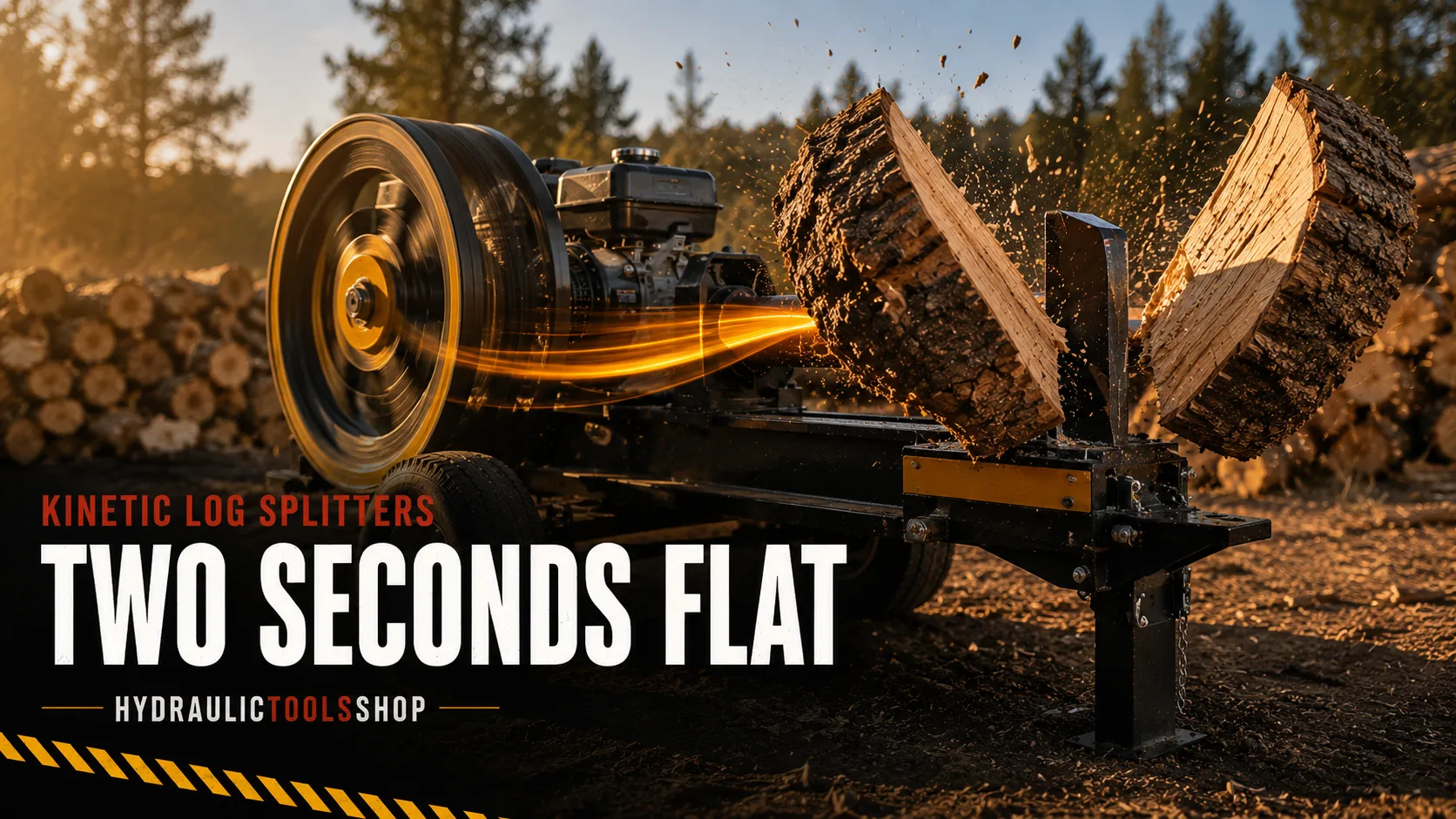
A kinetic log splitter throws out the hydraulic pump entirely. Instead of a ram slowly squeezing a log apart over ten or more seconds, it spins a heavy flywheel up to speed and releases that stored energy in a single burst, driving the wedge through the wood in about two to three seconds. That speed is the whole point. If your problem is volume, splitting cords of reasonably uniform pre-cut rounds, a kinetic machine processes wood several times faster than a hydraulic splitter of the same tonnage. If your problem is the wood itself, oversized, knotty, stringy, or frozen pieces, a hydraulic splitter that keeps pushing is often the better tool. This page explains how kinetic splitting works, where it beats hydraulic and where it does not, and which kinetic machines are worth buying.
How a Kinetic Log Splitter Works
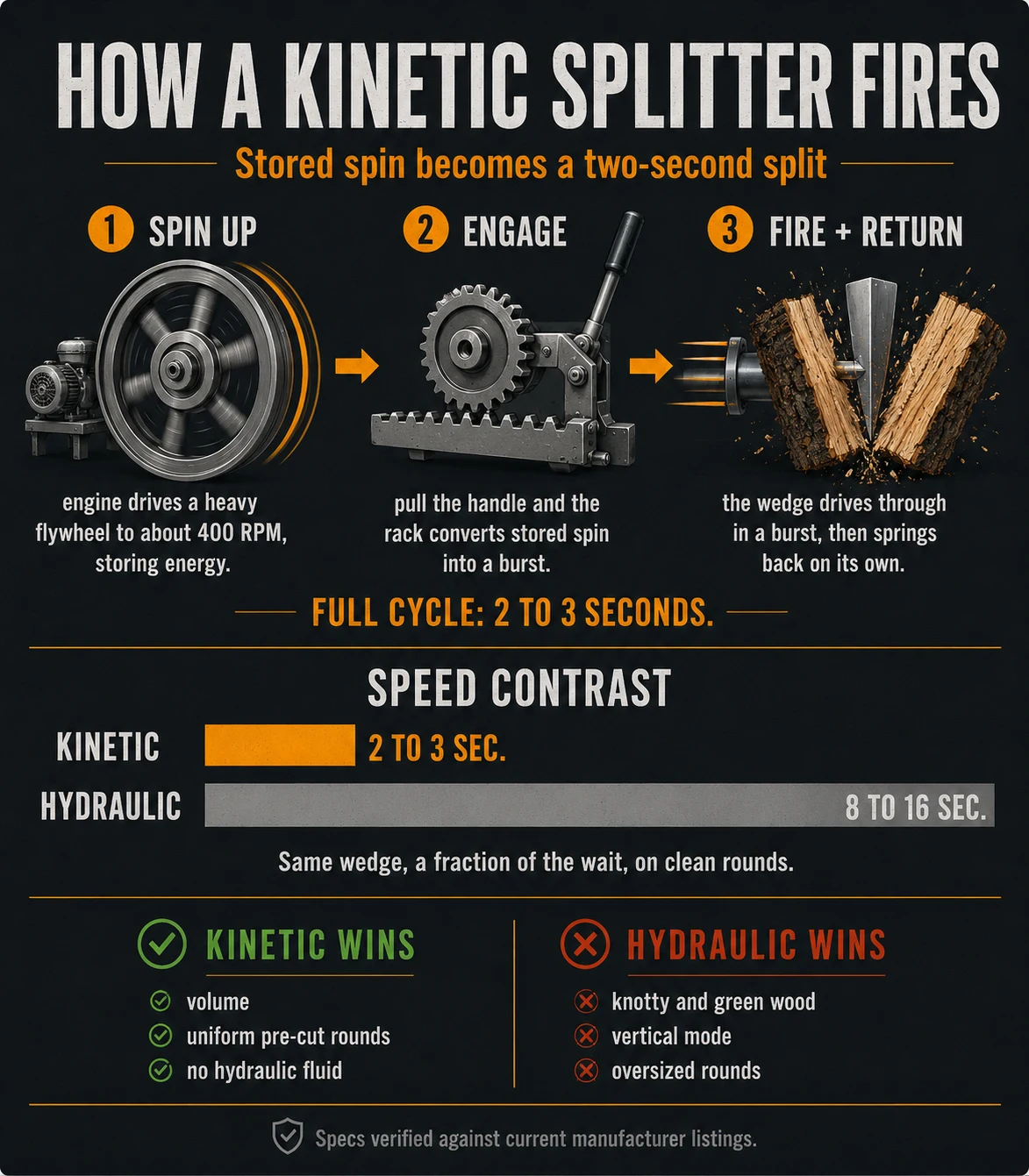
The mechanism is simple once you see it. An engine or electric motor spins a heavy flywheel (some machines use two) up to a working speed, storing rotational energy the same way a potter’s wheel keeps turning after you stop pushing. When you pull the operating handle, a rack-and-pinion engages and converts that stored spin into a sudden linear thrust, ramming the log into the wedge. The split happens almost instantly, the rack disengages, and the pusher springs back on its own, ready for the next round.
To make the numbers concrete, take the FORESTWEST 40-ton kinetic splitter as a worked example: its 60-pound flywheel spins to around 400 RPM, and that stored energy is what produces a three-second cycle where a hydraulic machine of similar force would take four to five times as long. The practical point to understand is that a kinetic machine delivers its force as a fast burst rather than a steady, sustained squeeze the way a hydraulic ram does. That difference in how the force is applied explains most of what kinetic is good at and most of what it is not.
Kinetic vs Hydraulic: Which Is Right for You
This is the real question, and the honest answer is that they solve different problems.
Kinetic wins on speed and volume. A two to three second cycle means you feed rounds almost as fast as you can lift them. If you process a lot of firewood and your wood is reasonably uniform and already bucked to length, a conventional hydraulic splitter generally will not match that cycle speed. Kinetic machines are also mechanically simpler, with no hydraulic fluid to change, no pump to fail, and no fluid to heat-soak on a long day.
Hydraulic wins on difficult wood. Because a hydraulic ram keeps advancing under constant pressure, it grinds through knotty, stringy, twisted, green, or frozen pieces that a kinetic burst can bounce off. A vertical mode, common on hydraulic machines, can also make loading much easier when rounds are too heavy to lift onto the beam. Most kinetic splitters are horizontal only.
So the rule is short. Choose kinetic when your bottleneck is how many clean rounds you can cycle per hour. Choose hydraulic when the wood itself is the fight. If you are still deciding on the broader machine type, our electric vs gas log splitter breakdown covers the power-source side of the same question, and for high-force hydraulic machines see our best heavy-duty log splitters roundup.
The Established Names Worth Knowing
Before the picks below, a straight note. The kinetic category has a few well-known brands that owners and forums consistently name, and most of them do not sell cleanly through Amazon. SuperSplitter is the original kinetic machine and still the reference point many buyers compare against. DR Power’s RapidFire line and the DK2 and Power King kinetic splitters are the other names you will see in reviews and demo videos.
We mention them so this page reflects the real market rather than only what is convenient to link. If you want one of those, you will generally buy direct from the manufacturer or from a retailer like Tractor Supply, Home Depot, or Lowe’s. The machines below are the kinetic options that are actually available to order through Amazon, which is what most readers here are looking for.
The Kinetic Splitters Worth Considering
Prices and stock move constantly on these listings, so we do not hard-code them. The hardware and the drive type are what matter. Compare on power source and cycle first.
| Machine | Force | Power | Cycle | Max log | Orientation | Best for |
|---|---|---|---|---|---|---|
| MechMaxx KT34 | 34 tons | 7 HP Ducar gas | 3 sec | 28 in dia | Horizontal | High-volume gas splitting |
| FORESTWEST 11097P | 18 tons | 3 HP petrol | 2 sec | 16 in dia, 16 in long | Horizontal | Smaller property, still gas |
| FORESTWEST 212cc gas kinetic | Kinetic | 212cc 7 HP gas | Fast | See listing | Horizontal | Value gas option |
| 7-Ton electric double flywheel | 7 tons | 2 HP electric | 2 sec | 14 in dia, 18 in long | Horizontal | No fuel, plug-in entry point |
MechMaxx KT34 34-Ton Kinetic
This is the pick if you want a serious gas kinetic machine. Two things separate it in this group. On specification, the 7 HP Ducar engine drives a flywheel MechMaxx rates at a three-second cycle, and it accepts logs up to 28 inches in diameter, a larger capacity than the other kinetic units here. On owner feedback, it carries the strongest and most numerous ratings of the Amazon-available kinetic splitters in this roundup, where the others are mostly newer listings with little history. That combination, real capacity plus the most owner evidence, is why we rank it first, with the caveat that owner ratings are anecdotal rather than independent testing.
- Force 34 tons
- Engine 7 HP Ducar gas
- Cycle 3 seconds
- Max log 28 in diameter
- Orientation Horizontal
- Drive Kinetic flywheel
Where it wins: the largest log capacity in this group and the most owner ratings behind it, which is why it takes the top spot.
Worth knowing: it ships freight as a non-returnable, hazardous-materials item, so confirm delivery and unloading before you order. Like all kinetic machines it is horizontal only, so there is no vertical mode for rounds you cannot lift.
Check price on AmazonFORESTWEST 11097P 18-Ton Petrol Kinetic
If you want kinetic speed and the freedom of a petrol engine but do not need a 34-ton machine or its footprint, this is the sensible middle. FORESTWEST rates it at a two-second cycle and it splits firewood up to 16 inches long and 16 inches in diameter, which covers the large majority of home firewood. It sits on a stand at working height so you are not bending to load, and large wheels make it easy to drag around a yard or small rural property.
- Force 18 tons
- Engine 3 HP petrol
- Cycle 2 seconds
- Max log 16 in long, 16 in diameter
- Orientation Horizontal, stand height
- Drive Kinetic flywheel
Where it wins: gas portability and fast cycling in a lighter, cheaper package than the big machines, sized for normal home firewood.
Worth knowing: the 16-inch capacity is real, this is not the machine for oversized rounds. It is a newer listing with limited owner feedback so far, so buy it on the spec sheet rather than on a long review history.
Check price on AmazonKinetic Log Splitter, 212cc 7HP Gas Engine, Flywheel Drive
Listed under that plain title with no brand name attached, this 212cc gas flywheel machine is the budget way into gas kinetic. It offers the same core advantage as the others, a fast flywheel-driven split cycle from a 7 HP gas engine, at a lower price than the named units. It is the pick for a buyer who understands the mechanism, wants the speed, and is comfortable choosing on the listing specification rather than brand reputation.
- Engine 212cc, 7 HP gas
- Drive Kinetic flywheel
- Cycle Fast, flywheel driven
- Orientation Horizontal
Where it wins: the lowest-cost route to a gas kinetic splitter, for a buyer who values the drive type over a name.
Worth knowing: it is an unbranded listing with little published detail and limited owner history. Verify the current specification on the listing before you buy, and treat support and parts as an unknown compared with a named brand.
Check price on Amazon7-Ton Kinetic Electric Log Splitter, Double Flywheel
Not every kinetic machine runs on gas. This one uses a 110V, 2 HP, 16-amp electric motor spinning a double flywheel to reach a two-second cycle, splitting logs up to 18 inches long and 14 inches in diameter. It is low-profile and portable, and it suits buyers who want kinetic speed without gasoline, exhaust, or small-engine maintenance.
- Force 7 tons
- Motor 110V, 2 HP, 16 A
- Cycle 2 seconds
- Max log 18 in long, 14 in diameter
- Orientation Horizontal, low profile
- Drive Double flywheel
Where it wins: kinetic speed with no fuel, no fumes, and no engine maintenance, in a light machine that runs off a standard outlet.
Worth knowing: at 7 tons this is for seasoned softwood and moderate hardwood rounds, not gnarly oversized stock. It is a generically branded listing with limited owner feedback, so set expectations to its tonnage and buy it for the convenience, not for brute force.
Check price on AmazonWhat to Check Before You Buy Kinetic
Cycle time is the reason to buy, so weigh it honestly. A two to three second cycle is transformative on volume and irrelevant on a single face cord. Match the machine to how much wood you actually process.
Tonnage is a burst, not a hold. A kinetic rating tells you peak force, delivered instantly. On clean rounds that is plenty. On stringy, knotty, or frozen wood, expect the occasional piece that a kinetic machine will not separate where a hydraulic ram would. This is the core trade of the type.
Log capacity varies a lot. These machines range from 14 inches to 28 inches of diameter capacity. Measure your typical rounds and buy to them, because kinetic units are horizontal only and you cannot fall back on a vertical mode for the big ones.
Freight and unloading. The gas machines ship crated or palletized and are heavy. Some are marked non-returnable. Know how the crate comes off the truck and where it will live before you order.
Maintenance is genuinely lighter. No hydraulic fluid to change and no pump to fail is a real advantage of the type. You still service the engine on gas models like any small engine: oil, filter, fuel, spark plug.
Reviews on several of these are thin. The Amazon kinetic field leans heavily to newer and house-brand listings. Where owner history is limited we have said so above. Buy those on specification and return policy, not on a review count.
Frequently Asked Questions
Are kinetic log splitters any good?
Yes, for the right job. Their two to three second cycle makes them far faster than hydraulic machines on high volumes of uniform, pre-cut rounds, and they need no hydraulic fluid. They are weaker on knotty, stringy, or frozen wood, where a hydraulic ram that keeps pushing is more reliable.
Which is better, kinetic or hydraulic?
Neither is better outright, they suit different problems. Kinetic wins on speed and volume with clean rounds and needs less maintenance. Hydraulic wins on difficult wood and usually offers a vertical mode for heavy rounds. Choose by whether your bottleneck is throughput or the wood itself.
How much does a kinetic log splitter cost?
Kinetic machines tend to cost more than an entry hydraulic of the same tonnage because of the flywheel and gearing, and gas models cost more than electric ones. Prices move often, so check the current listing. The electric units are the least expensive way into the type.
Who makes the best kinetic log splitter?
SuperSplitter is the original and a common reference point, and DR Power, DK2, and Power King are the other established names, mostly sold outside Amazon. Among Amazon-available machines, the MechMaxx KT34 is the most capable and best-received option in this roundup.
Can a kinetic splitter handle hardwood and green wood?
It handles clean, seasoned hardwood rounds well within its tonnage. Green and knotty wood is where kinetic struggles most, because the split is a momentary burst rather than a sustained push. For a steady diet of green or gnarly hardwood, a hydraulic machine is the safer choice.
Do kinetic log splitters need much maintenance?
Less than hydraulic machines, since there is no hydraulic fluid to change and no pump to service. Gas models still need normal small-engine care: oil, air filter, fuel, and spark plug. Electric kinetic units need almost none beyond keeping the flywheel and rack clean and clear.
Still not sure a kinetic machine is the right type for your wood and property? Start with what size log splitter do you need, or compare the power sources in our electric vs gas log splitter breakdown.